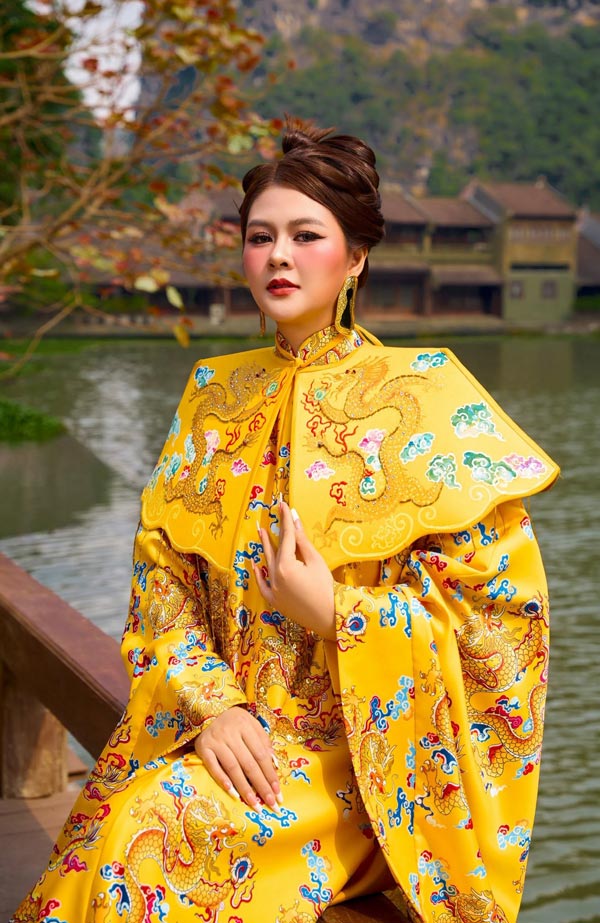
AI is reshaping the creative industry, including ao dai fashion. With just a few lines of command, technology can create thousands of sophisticated patterns in an instant. However, the boundary between AI application and taking advantage to "steal" intellectual property is increasingly fragile.
Facing the flood of AI photos, sharing with Lao Dong Newspaper, designer (NTK) Pham Si Toan looks at the problem from an anthropometric perspective. He affirmed that AI can become a tool to create countless beautiful sketches in 2D space, but high-end fashion, especially ao dai, exists on the real human body with countless differences.
In fact, there are no two bodies that are completely the same. Just handling the curvature of the shoulder, the tilt of the neck, the protrusion of the shoulder blade or the waist-hip ratio already requires the craftsman to observe and adjust directly on each customer.
Designer Pham Si Toan emphasized: "What makes the value of tailoring is not the drawing, but the ability to transform the drawing into a vivid three-dimensional structure. A beautiful ao dai must not only stand still in front of the mirror but also be beautiful when the wearer walks, sits down, turns or moves hands. That is the combination of shape, material and body movement.
If Pham Si Toan approaches it from the perspective of shaping techniques, designer Thach Linh is concerned about creative ethics and the pressure of cultural preservation. According to designer Thach Linh, what is worrying is not how quickly AI draws, but how many people abuse this technology to copy and transform other people's intellectual property without respect for the author.
To create a pattern, a collection with cultural identity, genuine professionals must go on field trips to regions, chat with artisans and spend months researching history. "AI can learn from data, but AI cannot go through that journey" - the female designer affirmed.
The consequence of technology abuse is that Vietnamese designers are under great pressure. An ao dai set invested in embroidery can take weeks, even months to complete. Meanwhile, in just a few hours, AI can become a tool to create dozens of similar sketches for garment factories to immediately mass produce at very low costs, making it difficult for genuine designers to compete in price and speed.
Designer Pham Si Toan believes that when patterns or drawings can be copied quickly, competitive value will shift more strongly to the most difficult to copy capabilities: Shaping techniques, material processing skills and product finishing quality.
The secrets in each cut line, glue pressing method, neckline treatment or wing adjustment are not easily recreated just by images. Instead of just focusing on superficial beauty, serious professionals are investing more in exclusive product structure and practical wearing experience. Designer Thach Linh believes that copied products can be sold quickly, but brand value and sustainability only come from true creativity.
When asked about the ultimate boundaries that technology cannot cross, both designers aim for a concept of "Soul" of national costumes. For them, what AI can never replace is human emotions and experiences.
Designer Thach Linh emotionally shared: "AI can be used as a tool to create millions of beautiful drawings, but AI cannot feel pride, cannot be moved by a national cultural story, nor can it understand the responsibility to preserve and spread Vietnamese identity. That "soul" is something that no technology can copy or replace.
Designer Pham Si Toan concluded that the future of high fashion is not a battle between humans and AI, but a competition between those who know how to use AI as a support tool and those who only rely on AI to replace their skills.