
During the days of the Dien Bien Ban Flower Festival in mid-March, many people and tourists were very excited and surprised to experience the program "Hoang Cam Kitchen and Soldier's Meal".
This is one of the new experiential activities and becomes a highlight of the festival because the program has vividly recreated the daily life of our soldiers in the Dien Bien Phu Campaign. Tourists cannot help but be surprised when they are directly transformed into wartime "brothers and sisters".
Hoang Cam stove is a type of field kitchen used in combat created by soldier Hoang Cam (1914-1996) from the Hoa Binh Campaign in 1951-1952.
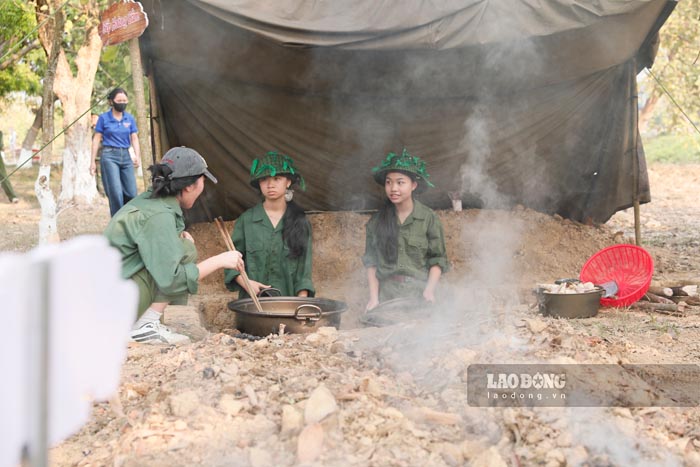
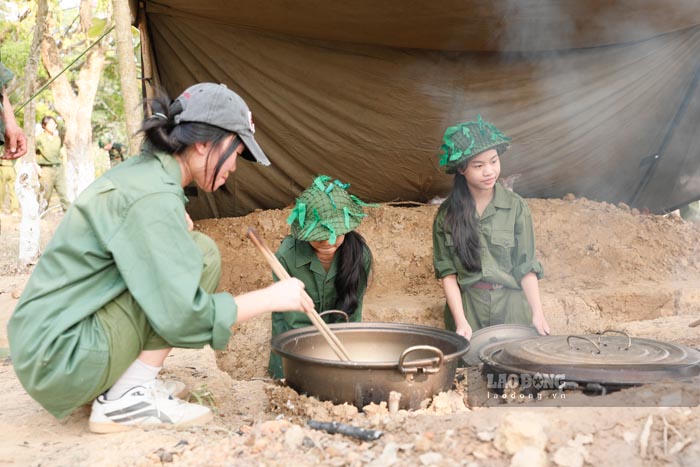
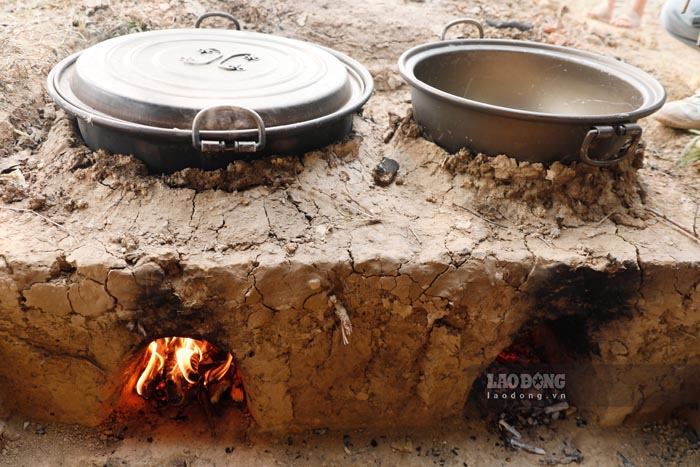
At first, the stove was quite simple. Later, during use, the stove was improved into a basement stove, dug deep into the ground or into the hillside. The stove has a smoke duct system, with a lid to prevent detection and ensure secrecy during cooking.
Thanks to this, cooking can be done both day and night. Through combat practice, Hoang Cam stoves are increasingly being perfected and becoming an effective innovation, widely used to this day.
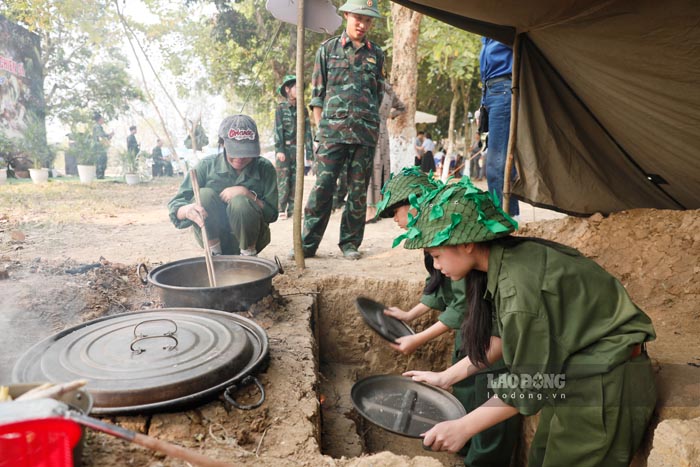
Hoang Cam kitchen system includes 3 main parts: kitchen basement, exhaust system and kitchen roof. The kitchen basement (1.4m wide, 1.7m long), includes the parts: Sitting pot, firewood support, pot holder, kitchen door.
The simmering pit is where soldiers sit to cook, while shielding from the fire and ensuring safety for soldiers. The pit is rectangular (1.4m wide, 0.9m long, 0.8-1m deep), with steps up and down on the side of the pit.
The firewood support runs across the sitting hole, about 10cm wide, about 5cm higher than the bottom of the kitchen door, to prevent firewood from falling into the sitting hole during use.
The pot holder will be a place to burn firewood and support the pot, distributing heat evenly for the cooking process. To put firewood in to cook, it is usually a dome shape to ensure firmness and avoid subsidence.
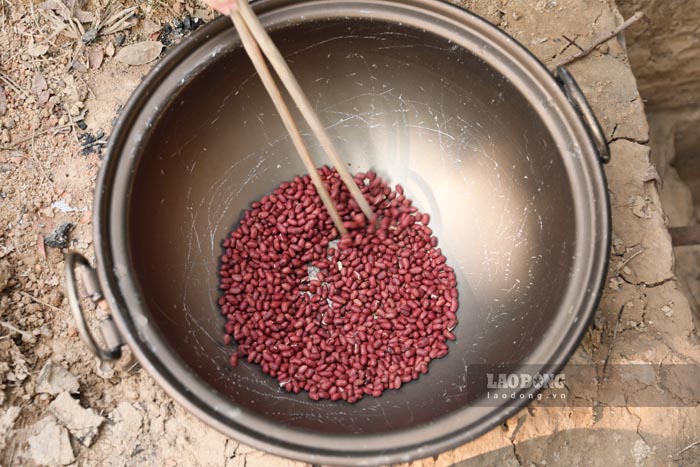
The smoke escape system plays a very important role, helping to create air convection for the stove to burn well and lead smoke out to form thin wisps of smoke flying on the ground.
This system consists of 3 parts: smoke tunnel, smoke paths and smoke vents. The smoke escape system is laid on top with fresh trees and branches, covered with a layer of fresh leaves and on top covered with a loose layer of soil for smoke to spread evenly, into thin mist-like lanes and cool before escaping.
Level 1 Hoang Cam Kitchen has a kitchen tarpaulin (or tent) to shield from rain and sun and is camouflaged with branches and leaves to ensure safety and secrecy in combat conditions.
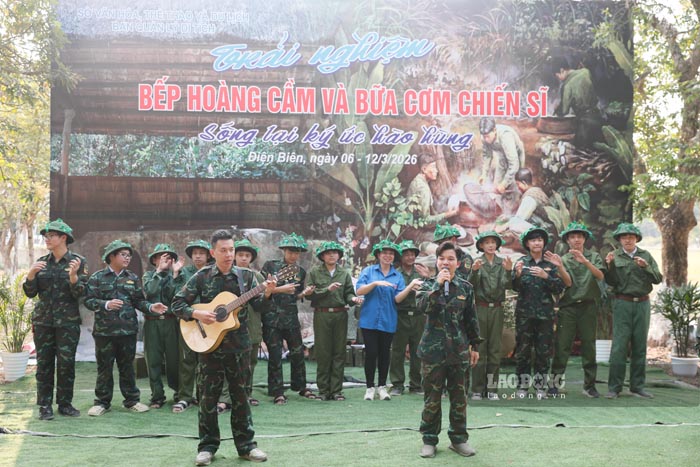
Participating in experiencing Hoang Cam kitchen and soldier meals in the De - Cat tunnel area, Tran Thu Trang (8th grade, Tan Binh Secondary School, Dien Bien Phu ward) said: "This is the first time I have cooked with this special kitchen myself. Through practical experience, I understand part of the hardships that our ancestors had to overcome.
Soldier Giang A Thai (Regiment 82, Division 355, Military Region 2) said: "In the training process, I have practiced cooking with Hoang Cam stoves many times. Thanks to this initiative, previous generations have reduced some of the hardship in raising troops.
The Hoang Cam kitchen cooking experience is not only a cultural and tourist highlight, but also an activity to show gratitude and educate patriotism and national pride for generations.


