Touching historical memories through art
Culture and art are also a front" - President Ho Chi Minh's advice from decades ago to now still retains its value. If in wartime, culture is a spiritual weapon to encourage, motivate, and nurture national will, then in peacetime, culture continues to be a place to preserve historical memories, foster identity and spread the image of the country.
Also in the flow of dedication and preservation of national culture and history, we can mention Miss, designer Ngoc Han. After being crowned Miss Vietnam 2010, Ngoc Han focused on her fashion design career, turning ao dai into a "cultural bridge".
Sharing with Lao Dong, Miss Ngoc Han said that when mentioning the Southern Liberation and National Reunification Day April 30th, she is always moved to see the country increasingly innovate and develop. According to Ngoc Han, art has a special power in conveying history.
For many years, I have been associated with ao dai not only as a profession, but as a way to tell stories about the country. Every major holiday, every special event of the nation, I appear in ao dai, sometimes on domestic stages, sometimes in a foreign country, representing Vietnam in front of international friends. Those moments make me understand that April 30th is the reason I am standing here, doing the job I love, being proud to be Vietnamese" - Ngoc Han said.
In addition, the beauty queen has launched dozens of ao dai collections inspired by traditional values such as Hue royal court music, ceramic motifs or Hang Trong paintings, and at the same time brought her designs to perform at international events to share Vietnamese cultural stories with international friends.
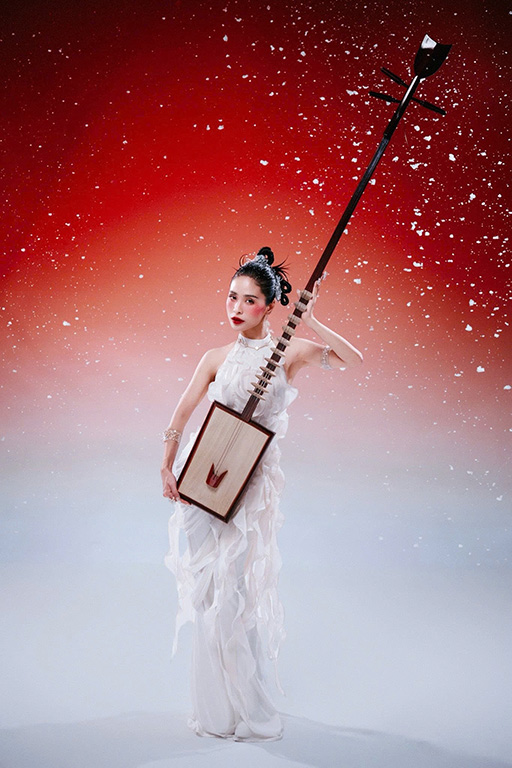
From the perspective of the 7th generation in the ca tru family, ca tru singer Kieu Anh also believes that art is an "emotional bridge" between generations. Kieu Anh has performed ca tru abroad to promote Vietnamese heritage, and at the same time has repeatedly brought the technique of "a dao" singing into modern music genres on large stages and entertainment programs to attract young audiences.
Born into a family with both artistic traditions and many generations of soldiers, I am very aware of the responsibility of a continuing generation" - Ca Nuong Kieu Anh shared.
According to the female ca tru singer, ca tru is also the memory and spirit of a historical period. Therefore, preserving and promoting those values is also a way to show gratitude to the past.
Through family stories and traditional tunes, I feel that peaceful life today is not easy to get. Every time I mention this day, I feel even more grateful and understand my responsibility in preserving and promoting national pride and love for the country" - singer Kieu Anh expressed.
Cultural industry opens the way for artists to spread Vietnamese identity
Resolution 80-NQ/TW on Vietnamese cultural development issued by the Politburo on January 7, 2026 opens up a new approach, defining culture not only as a spiritual foundation but also as an "endogenous resource, great driving force and pillar" for national development.
For the first time, culture is placed on par with economy, politics, and society; cultural industry is identified as a new growth engine, based on the combination of creativity, national identity and modern technology. The Resolution also emphasizes the requirement to strongly develop creative space, digital transformation, form cultural brands of regional and international stature, and at the same time put people at the center of development.
In that context, the role of artists, beauty queens and influential people is no longer limited to building personal images, but also contributing to telling the story of Vietnam to the world with their own strengths.
Miss Ngoc Han believes that the boundary between "building personal image" and "contributing to the country" will naturally blur when each person finds what they truly believe in and pursues with sincerity. For the beauty queen, it is ao dai and national culture.
“I don't choose Ao Dai as an image advantage, but because I am really touched by the beauty of heritage, by historical relics or paintings about war. Therefore, from collections inspired by Kim Hoang paintings to Ao Dai promotion activities at diplomatic events, everything I do stems from real emotions and brings real stories” - Ngoc Han shared.
According to Ngoc Han, the most important thing for influential people today is to find their own story in the larger picture of the country. It could be music, cinema, cuisine or sports, but it must be something that is truly close and comes from within.
Today's audience is sophisticated enough to recognize what is sincerity and what is just a performance," she emphasized.
Speaking about Resolution 80, Miss Ngoc Han acknowledged that this is a great opportunity for people working in the field of culture and art to contribute more methodically, professionally and in depth.
Our job is not to waste that opportunity, to use our strengths to tell the story of Vietnam to the world and do it thoroughly" - Ngoc Han expressed.
Also according to the beauty queen, "responsibility to the country" is not something too great or abstract, but starts from understanding history, understanding where the values you are inheriting today come from. From there, love and preserve traditional culture, do your job well so that when you step out into the world, others know who Vietnamese people are.
Meanwhile, Ca Nuong Kieu Anh recognizes Resolution 80 as an important "push" for artists pursuing traditional art. According to her, when there is orientation and attention from policies, artists will have more opportunities, resources and support to bring national art further.
“For artists, the biggest challenge is how to both maintain identity in music and improve skills to be qualified for integration. If you just chase after tastes and lose the core, it will be very regrettable. Therefore, for me, this is a journey that requires seriousness and perseverance,” she said. According to Ca Nuong Kieu Anh, many young people today are interested in culture and patriotism in a very serious way. The difference is that history and culture are being told in more closer forms such as music, cinema or digital platforms, making it easier for young people to accept. “The important thing is to understand young people and really want to talk to them, instead of just stopping at conveying one-way information,” Kieu Anh emphasized.
In the era of integration, Vietnamese identity cannot be preserved by general appeals. More importantly, it is to make culture a natural part of modern life, so that young people can touch history with emotions, access heritage with love and pride, telling Vietnamese stories in the language of their own generation.