A reasonable decision in the development problem
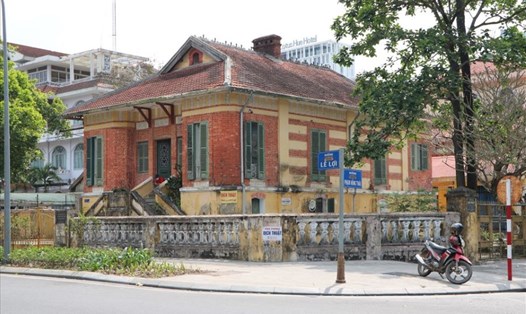
Recently, leaders of Hue City People's Committee confirmed that they will dismantle the ancient French villa at No. 26 Le Loi, Thuan Hoa ward. This is a 100-year-old building, formerly the headquarters of the Thua Thien Hue Union of Literary and Art Associations (old) in the period 1975 - 2021, which is currently degraded and abandoned.
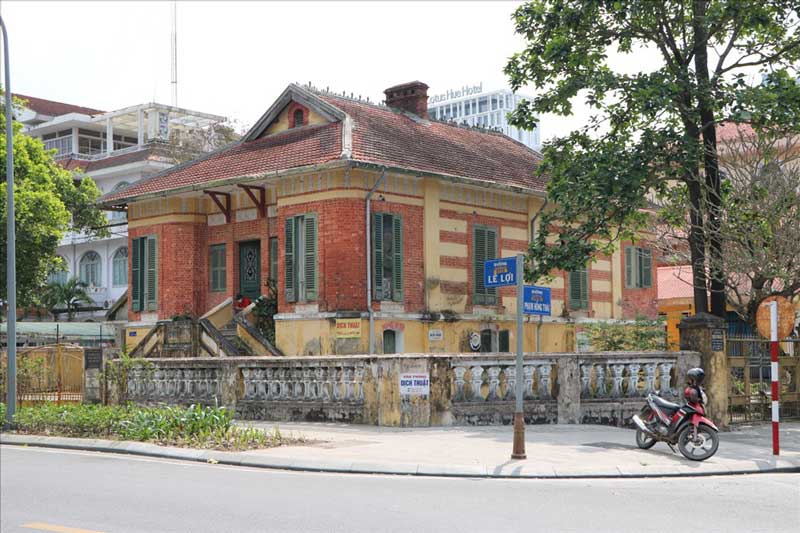
This is a French villa built in the early 20th century. This building was previously renovated in 2000 due to deterioration, but still retains its original appearance with the highlight being a row of cypress flowers decorated on the roof - a unique feature in the architecture of ancient French villas.
Villa No. 26 Le Loi is not just an architectural work. For many generations of Hue artists, it is a "art house" - a place associated with creative memories, meetings, and exchanges. For the people, it is a familiar part of the space of Le Loi street - the street considered the most beautiful on the banks of the Perfume River.
According to Mr. Hoang Viet Cuong - Chief of Office of Hue City People's Committee, the dismantling of this project is part of the overall plan to call for investment in a high-class hotel project at land plots 22 - 24 and 26 - 30A Le Loi street, with a total estimated capital of more than 815 billion VND.
Another important factor is that this villa is not on the list of 27 typical French architectural works of Hue announced from 2018 for preservation. This means that legally, the dismantling is not hindered by heritage barriers.
This is a decision that can be understood. Because a degraded project, not under conservation, located on a land with high economic value; replacing it with a new project suitable for planning is a practical choice.
A closing urban memory
However, the story of villa 26 Le Loi does not only stop at technical or legal criteria. Because 4 years ago, the government of Thua Thien Hue province (old) once chose a different direction, which was not to demolish this villa but to relocate the project for preservation.
At that time, Mr. Nguyen Van Phuong - former Chairman of Thua Thien Hue Provincial People's Committee (old), said that the locality had calculated a plan to move the villa to a location opposite the Perfume River, with the desire to "preserve the soul of Hue city in the development process".
That is a decision that has received much consensus. Because it shows an effort to harmonize, both develop and not lose memories.
However, according to assessments by specialized agencies, after hundreds of years of existence, villa No. 26 Le Loi has seriously deteriorated, reduced its load-bearing capacity, and relocation poses a major safety risk. Therefore, the preservation plan by relocation has been eliminated. And the final choice is dismantling.
Talking to Lao Dong Newspaper, Mr. Ho Dang Thanh Ngoc - Chairman of the Hue City Union of Literary and Art Associations said: "Keeping the villa at 26 Le Loi is the wish of Hue's literary and artistic brothers and sisters and this issue I have spoken out many times and as far as I know, Hue city leaders through various periods have also found many ways.
Now the city leaders have decided to dismantle this villa for force majeure reasons. This is extremely regrettable, but we are forced to accept it because there is no other way".
Hue is facing a new stage of development, with many large projects, many expectations for tourism, services, and urban economy. Changes like at land plot 26 Le Loi are inevitable.
However, after each decision such as the demolition of villa 26 Le Loi, Hue will have more experience to better respond to similar cases in the future.
Hue can review conservation criteria in a more flexible direction, which may be to study solutions to preserve memories such as digitization, partial restoration, or integration of old architectural elements into new works. Or simply, to recognize that heritage is not only in the list, but also in the community's perception.
Villa 26 Le Loi will then be replaced by a new, more modern, and more economically efficient project. Although there is regret, it is an inevitable step in the process of choosing between preservation and development.