
Barge collides with Ghenh bridge, changing train operation plan
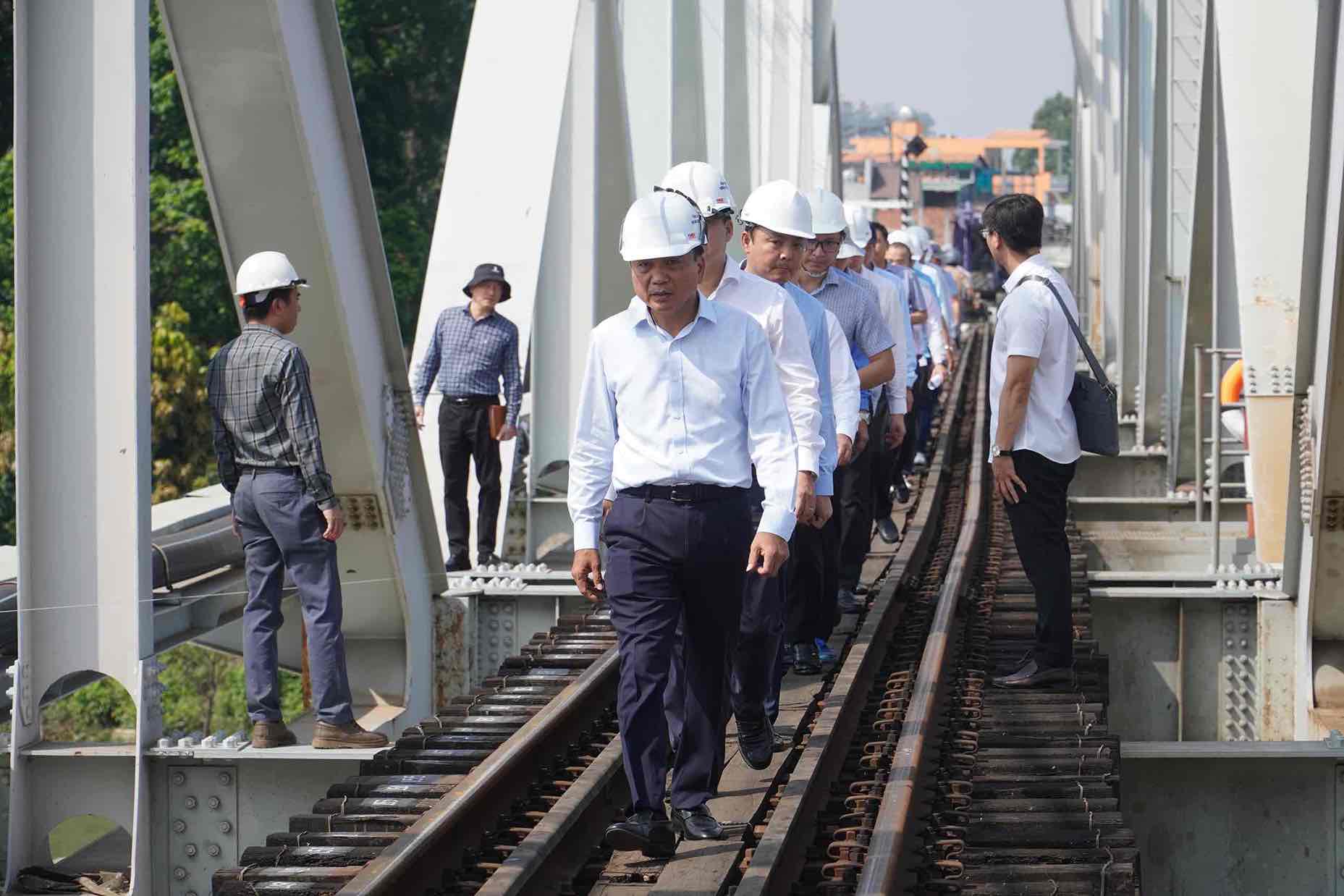
On March 9, the Ministry of Construction, leaders of Dong Nai Provincial People's Committee and relevant departments and agencies inspected the scene and worked on the barge collision at Ghenh bridge (Dong Nai Lon bridge), Dong Nai province.
Reporting at the working session, representatives of Vietnam Railways Corporation said: Ghenh bridge (Dong Nai Lon bridge) Km1699+860 on the Hanoi - Ho Chi Minh City railway line was built in 2016 and includes 3 arch-shaped steel truss spans, each span 75m long, 2 abutments and 2 reinforced concrete pillars, navigation clearance 50x6.5m.
At about 10:17 am on March 6, a barge with license plate NB-8437 (Thanh Dat 86 vehicle), with a tonnage of 3,339 tons, driven by Mr. P.T. B, traveling from upstream to downstream, directly collided with compartment No. 5, span No. 2 of Ghenh bridge.
The barge collided with Ghenh bridge, causing 1 motorcyclist on the pedestrian side of the bridge to be injured, the structure of the project was deformed and deformed, breaking the bridge bearing bolt, causing the bridge bearing to shift about 25mm, deviating the direction of the railway track on the bridge about 320mm; passenger trains and freight trains passing through the Bien Hoa - Di An section stopped running, directly affecting the full-line train schedule, and changing the train organization plan.
By March 20, estimated additional damage was about 140 billion VND.

According to Vietnam Railways Corporation, as of 8 am on March 8, regarding passenger transport, 2 unified passenger trains and 6 sectional passenger trains are abolished daily. The number of tickets returned to trains on the Hanoi - Ho Chi Minh City route is over 10,000 tickets (average cancellation of 2,000 tickets/day); transferred 23 passenger trains between Bien Hoa - Di An, 1 Bien Hoa - Saigon passenger train (9,000 trips). Trains transferred passengers from Saigon to Di An 18 trains (82 trips); transferred 160 tons of luggage.
Regarding freight transport, abolishing 3 pairs of specialized trains/day, 2 regional freight trains. Dissolving along the road 6 specialized freight trains, 2 regional freight trains. Estimated to reduce 6,000 tons of cargo per day, increasing costs due to car transfer distance.
In addition, the incident also slowed down all trains from Nha Trang to Thap Cham - Saigon and slowed down the following days.
From 8 am on March 12 to May 12 (60 days), it is expected to run slowly across the bridge at a speed of 5km/h, each train is delayed by another 12 minutes. Total transportation damage as of 8:00 am on March 9 is over 40 billion VND. It is expected that by March 20, damage is estimated to be about 140 billion VND more.
The Steering Committee at the site has organized a field inspection, together with design consulting units and construction units, to develop 3 preliminary repair plans as follows:
Option 1: Dismantle damaged span N2, move span N3 to span N2. Produce and install 3 temporary bridge spans at span N3. At the same time, produce and install new girders at span N3 to ensure absolute railway traffic safety and restore intersection speed.
Option 2: Coordinate with the Vietnam Maritime and Waterway Administration to divert navigation to span N1. Construction of temporary pillars, reinforcement of span N2 to ensure train safety. At the same time, produce and install new beams at span N2 to ensure absolute railway traffic safety and restore intersection speed.
Option 3: Based on the inspection results, reinforce the girders that are deformed due to barge collisions in compartments 4, 5, 6 of span 2 with 8m long I girders linked to codes with high-strength bolts, welded directly to the head nodes of compartments 4, 5, 6 to enhance the load-bearing capacity of the girder. At the same time, produce and install new girders at span N2 to ensure absolute railway traffic safety and restore intersection speed.
All plans have an expected time of 60 days from the date of approval of the plan by competent authorities.


