According to forecasts from An Giang Hydrometeorological Station, from April 13 to April 19, 2026, the total flow of the Mekong River to the Mekong Delta tends to gradually decrease but is still higher than the same period in 2025 and the multi-year average (MPA) from 20-50%.
The salinity on the Cai Lon and Cai Be rivers tends to decrease slowly in the first 3-4 days, then quickly rise again according to the tide. The highest salinity level is approximately to be higher than the previous week from 0. 5-3. 0‰, higher than the same period in 2025 from 4. 7 - 6. 1‰, higher than the same period in the TBNN from 1. 0 - 2. 0‰. The time of appearance of the highest salinity during the day is from about 10 pm the previous night to 4 am the next morning.
Warning about the impact of saltwater intrusion, a salinity of 4‰ deeply entering the fields of the Cai Lon and Cai Be rivers in the evening and early morning from the 18th to the 19th of April, which may affect crops. It is recommended that people do not use water at the bottom when the tide rises. It is necessary to pay attention to checking salinity before using river and canal water for production and living.
Mr. Le Huu Toan, Director of An Giang Department of Agriculture and Environment, said that the forecast of specialized agencies, in the dry season 2025 - 2026, the water situation in the province is generally relatively favorable, when the water flow from the upper Mekong River to the upstream area of the Mekong River is higher than the multi-year average and there are some unseasonal rains. However, due to the increasing demand for water in the upstream area, the total flow has a tendency to gradually decrease, so there is still a possibility of drought and localized water shortage in some areas, especially during the peak period from February - April. An Giang province has proactively and synchronously implemented many groups of solutions, both engineering and non-engineering.
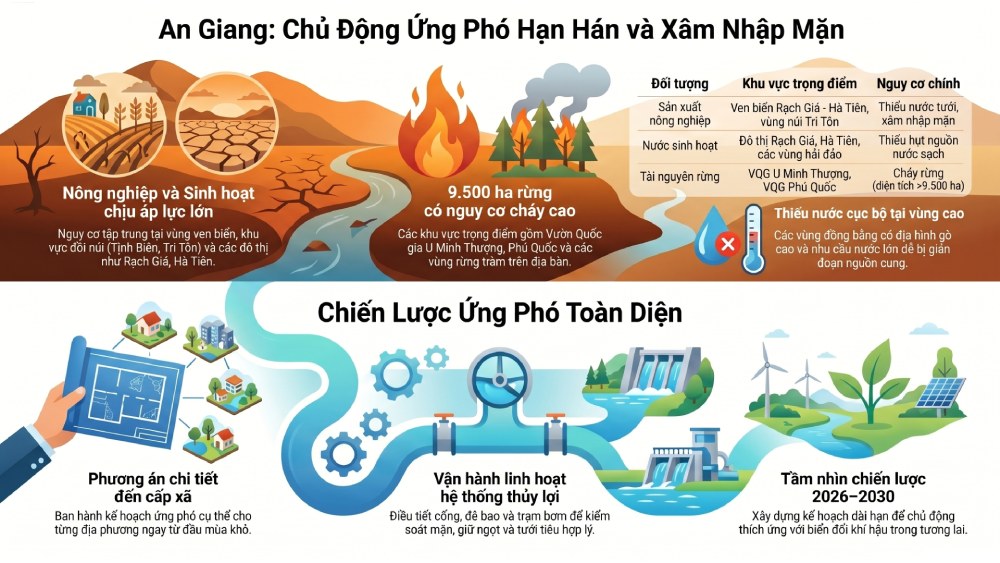
In the long term, Mr. Toan said that the agricultural sector is advising the Provincial People's Committee to develop a Plan to respond to drought and saltwater intrusion in the dry season for the entire period 2026 - 2030. The plan focuses on fully assessing water source scenarios, drought and saltwater intrusion developments in climate change conditions; clearly identifying key high-risk areas to prioritize investment. At the same time, propose a system of synchronous solutions, including: upgrading and completing irrigation and water supply infrastructure; strengthening the capacity to store, regulate and use water resources effectively; promoting adaptive production structure transformation; and raising awareness and proactive capacity of people and businesses.
After the merger of the province, the irrigation system of An Giang province is currently very large in scale, with thousands of works such as culverts, canals, pumping stations, reservoirs... To effectively exploit this system, the agricultural sector has implemented a number of key solutions such as organizing flexible and synchronous operation of the irrigation system throughout the province; closely coordinating with Southern Irrigation Exploitation One Member Limited Liability Company (under the Ministry of Agriculture and Environment) to operate Cai Lon, Cai Be, Xeo Ro culverts to regulate water sources reasonably according to each region, each time, ensuring salt control, retaining freshwater, serving production and people's livelihoods.
Strengthen dredging and drainage work, improve the water storage and water drainage capacity of the canal system, especially in remote, isolated, and water-scarce areas.
Promote the application of science and technology in management and operation, gradually modernize the irrigation system, and move towards automation in regulating and controlling water sources to improve efficiency and proactiveness.
Strengthen coordination between sectors, localities and project management units, ensuring smooth information, timely and effective operation, in accordance with the actual developments of water sources and production needs.