
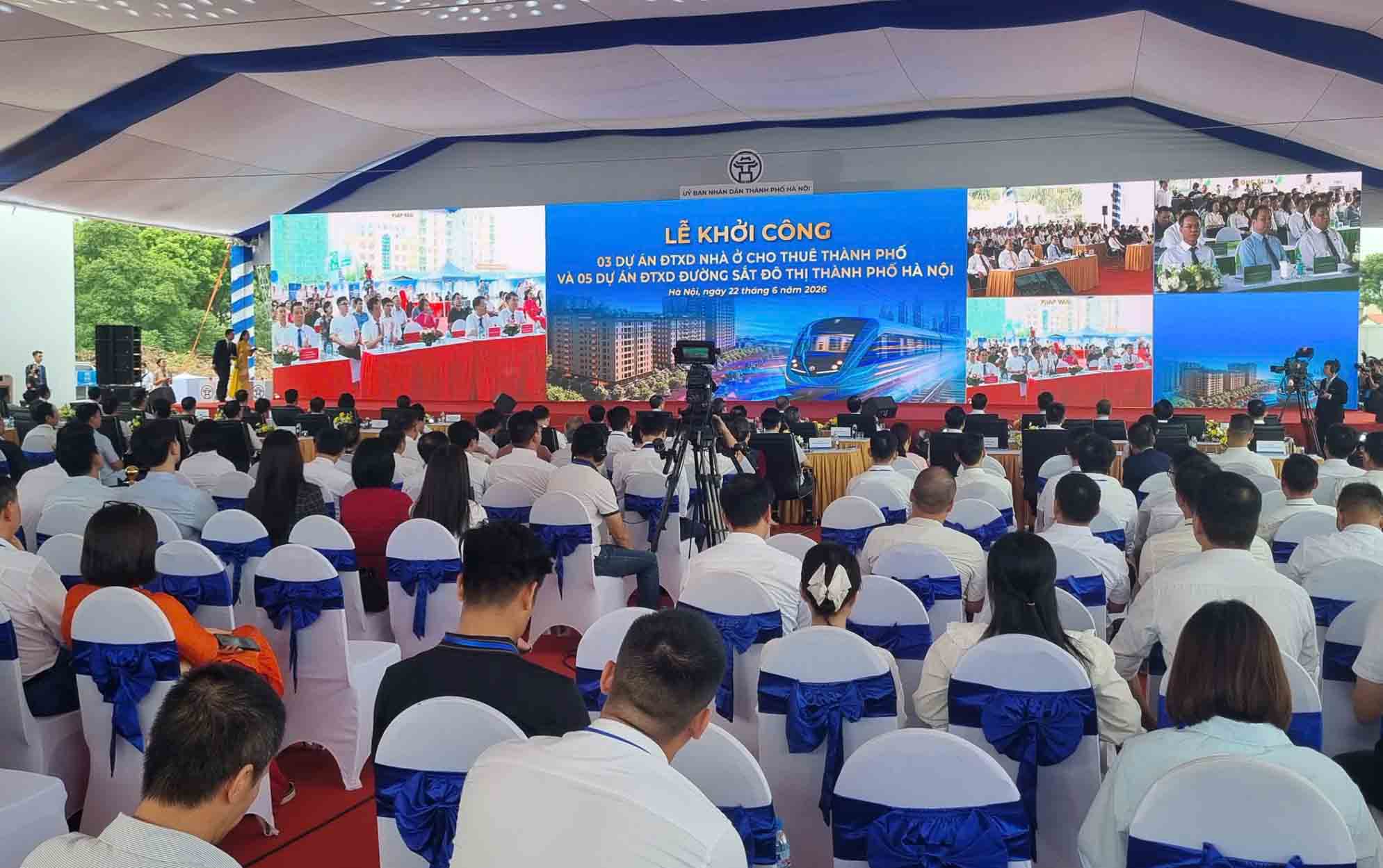
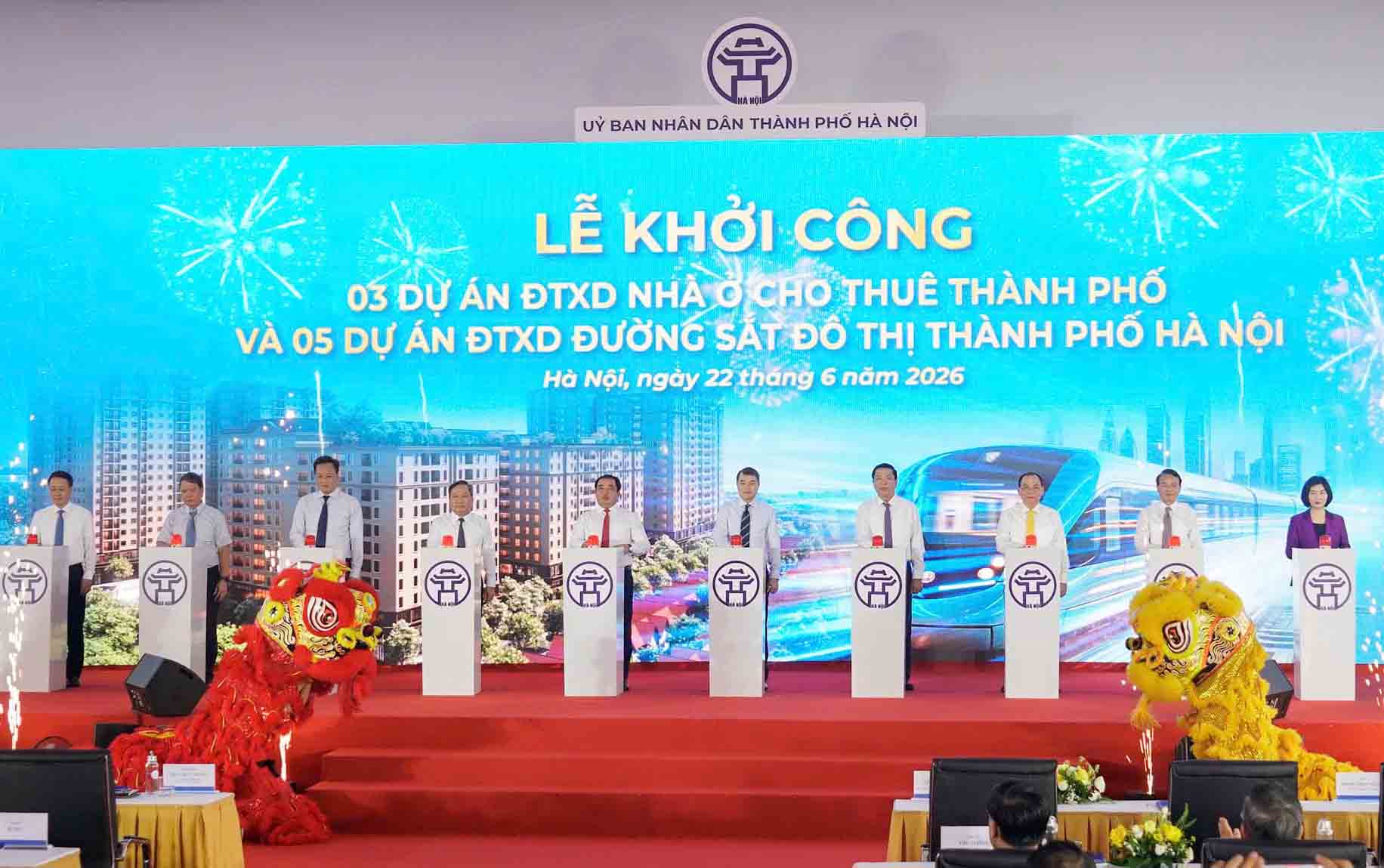
On the morning of June 22, Hanoi City People's Committee held a simultaneous groundbreaking ceremony for 5 urban railway lines and 3 rental housing projects in the area. This is considered the largest scale infrastructure and social security investment program ever in the Capital, marking a shift from the stage of perfecting mechanisms and policies to the implementation stage.
The groundbreaking ceremony was held at the main bridge point, the City Lease Housing Project in Viet Hung ward, along with online bridge points in Long Bien ward and Phap Van - Tu Hiep urban area.
At the main venue, Politburo Member, Prime Minister Le Minh Hung attended the ceremony. Also attending were Politburo Member, Secretary of the Hanoi Party Committee Tran Duc Thang.

According to the Hanoi People's Committee, the National Assembly's approval of the 2026 Capital Law and resolutions on special mechanisms have created an important legal basis for the city to accelerate strategic infrastructure development programs.
On May 13, 2026, Hanoi approved the Master Plan of the Capital with the space model "9 poles - 9 centers - 9 axes - 8 belts", in which the modern public transport system and housing development are identified as important pillars serving the goal of sustainable growth.
Groundbreaking ceremony for 5 metro lines more than 300km long
According to the plan, Hanoi will simultaneously start construction of 5 urban railway lines with a total length of about 303.5km, with a preliminary total investment of about 1.315 million billion VND.
The routes being implemented include:
Route 1: Thuong Tin - Tam Hung - Thuong Phuc - Dan Hoa - Railway industrial park - Ngoc Hoi - Hanoi station - Yen Vien - Thu Lam multi-purpose urban area - Noi Bai airport.
Route 2: Noi Bai Airport - Tran Hung Dao - Thuong Dinh - Thuong Tin - Tam Hung - Thuong Phuc - Dan Hoa.
Route 8: Hoa Lac - Son Dong - Mai Dich - Belt 3 - Linh Nam - Duong Xa.
Route 10: Dong Anh - Vo Chi Cong - Ring 3 - Ring 2.5 - Times City - Dong Anh.
Route 14: Thang Long Bridge - Hong Ha - Gia Lam.
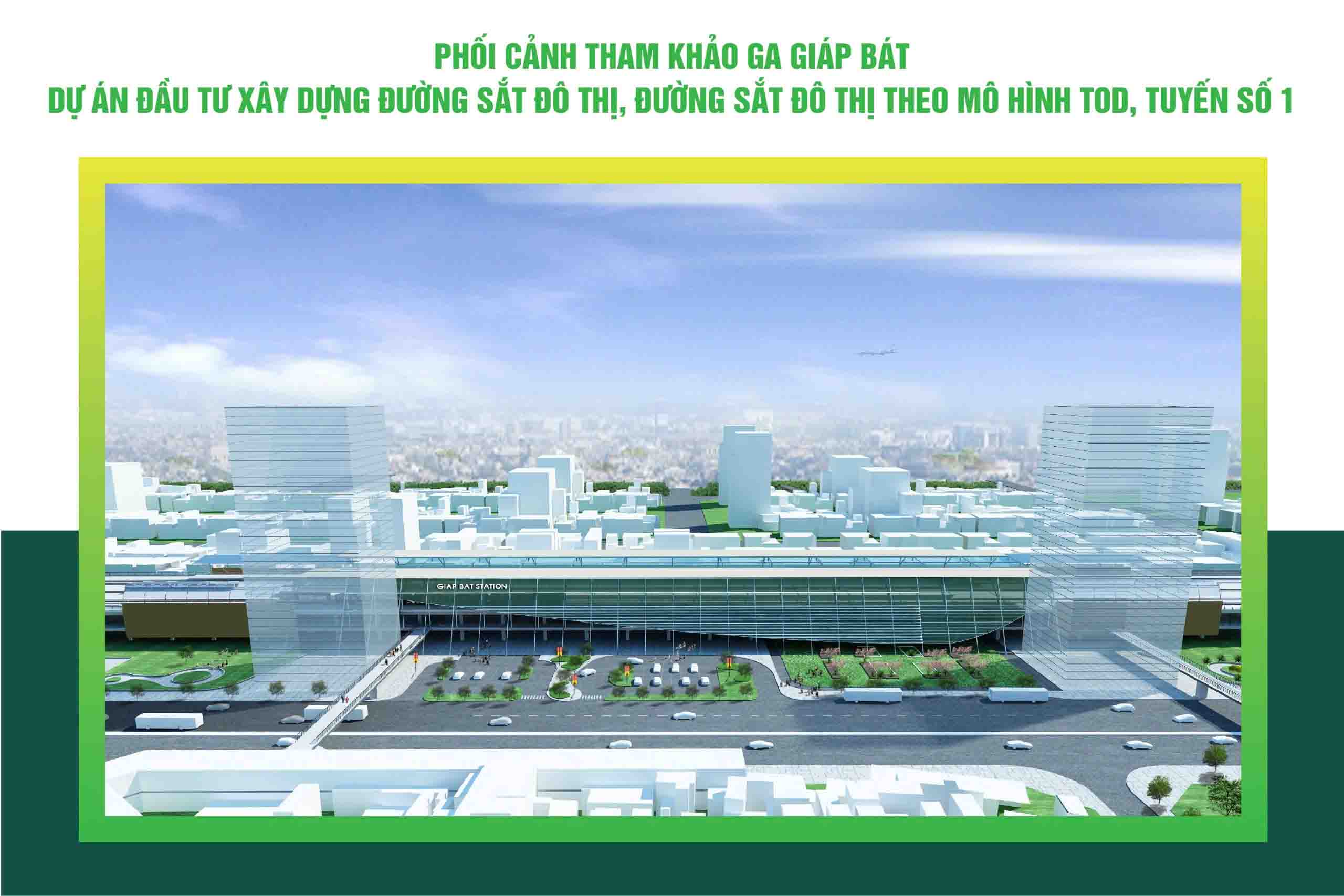
The goal is that all 5 routes are expected to be completed by 2030 and synchronously connected with routes No. 3 and No. 5 being implemented, gradually forming an interconnected public transport network throughout the City.
According to the Hanoi People's Committee, the metro system not only contributes to solving traffic pressure but also plays a strategic infrastructure framework role, promoting urban development in the direction of public transport (TOD), expanding development space along the North-South, East-West corridors, strengthening links with new growth poles such as Hoa Lac, Co Loa, Thu Lam, Gia Lam and localities in the Capital Region.
Deploying 3 rental housing projects with more than 8,300 apartments
Along with investing in transport infrastructure, Hanoi identifies the development of rental housing as a strategic task to ensure social security and meet the diverse needs of people.
The city decided to use public investment capital from social housing development obligation revenue in cash from commercial housing projects to implement two rental housing projects.
The first project is implemented at land plots A2, A3, A4 in the Phap Van - Tu Hiep residential area (Yen So ward) with a scale of 1,176 apartments, with a total investment of about 1,396 billion VND.
The second project is located on a part of the land fund belonging to the Hanoi Old Quarter population expansion housing area in Viet Hung ward, with a scale of 1,166 apartments, total investment of about 3,563 billion VND.
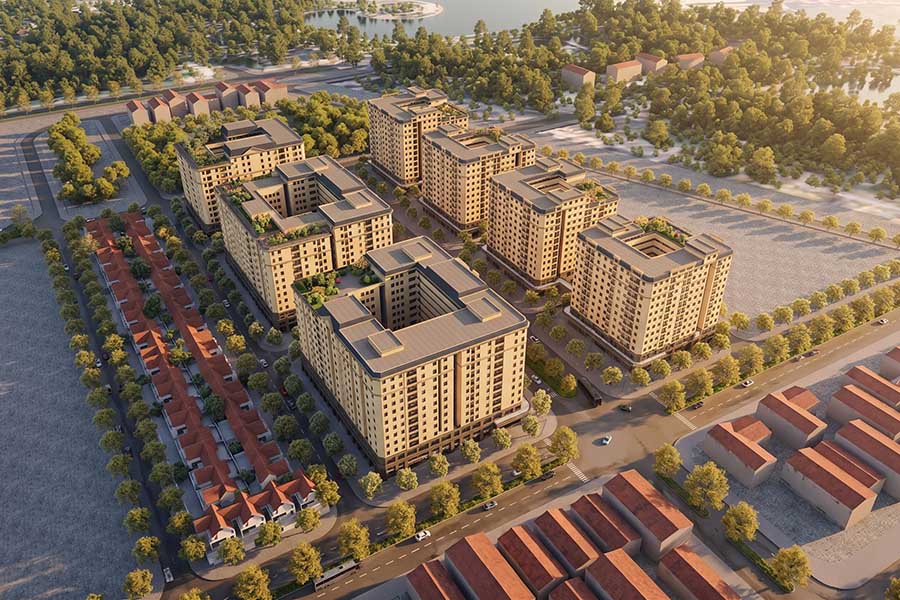
In addition, Him Lam Joint Stock Company proposed to convert the Information Technology Park Project into Him Lam Long Bien Mixed Housing Area. The project allocates more than 11 hectares of land to develop about 6,000 apartments, with a total investment of about 29,000 billion VND, of which about 4,000 apartments are arranged for long-term lease.
These projects are expected to meet the housing needs of workers, laborers, students, officials, civil servants, public employees, armed forces and those who need to rent houses, and at the same time contribute to the development of a healthy and sustainable housing market.
Hanoi People's Committee said that the application of special mechanisms according to the 2026 Capital Law and resolutions of the National Assembly has helped simplify many investment procedures, allowing the separation of site clearance into independent projects, thereby shortening at least 50% of investment preparation time.
Hanoi City aims that this time's transportation and housing infrastructure projects will create a foundation for GRDP growth at double-digit levels in the 2026-2030 period, further affirming its role as a growth pole and the driving force for the country's development.
We believe that when looking back at today's milestone in the coming years, this will not only be the groundbreaking day of important projects, but also remembered as one of the first steps in the process of realizing the aspiration to build a civilized - civilized - modern Hanoi Capital; to become the driving force for the country's development and a city with an increasingly high quality of life for all people...", Mr. Vu Dai Thang - Chairman of Hanoi People's Committee said.


