
The Southern Institute of Water Resources Science has just issued a salinity intrusion warning for March 2026 in the Mekong Delta (Mekong Delta), showing that salinity tends to increase with high tides, peaking in the second half of the month.
According to forecasts, in the central Mekong Delta region, the salinity boundary of 4g/l on the mouths of the Mekong River will enter the deepest at about 40–45km during the high tide from March 2–5 and 42–55km in the period from March 17–20. 3. On the Vam Co river system, the salinity level may encroach on 55–60km by the end of March. Salt intrusion is controlled by irrigation systems; if salinity control works are operated reasonably, it will not affect production.
In the coastal region of the Mekong Delta, saltwater intrudes deeply during high tides. Hydropower operation may change the flow regime; at the same time, the influence of the Northeast monsoon may cause saltwater to enter deeper than forecast. To ensure production in the dry season months, it is necessary to strengthen salt content monitoring and regularly update forecast bulletins.
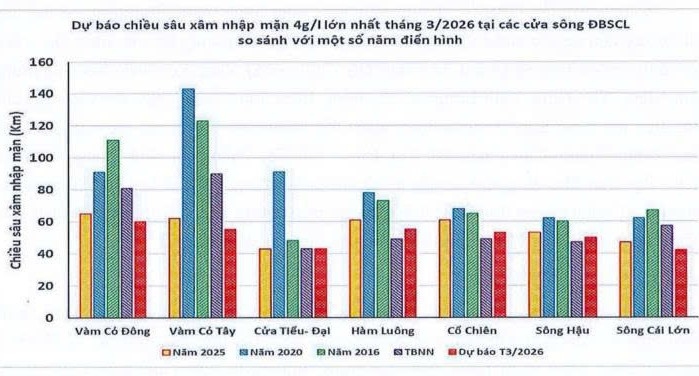
Compared to 2016 and 2020, this year's saltwater intrusion level is assessed to be significantly lower, at an average level or below the multi-year average. However, specialized agencies noted that the operation of upstream hydropower combined with Northeast monsoons may change the flow, causing saltwater intrusion deeper than forecast at each time.
Coastal areas and salty-salt border areas continue to be the most clearly affected areas, especially in coastal irrigation systems and specialized fruit tree growing areas. In March 2026, salinity will enter deeply in high tide periods from March 2–5 and March 17–20; in which, the period at the end of March is likely higher than the first half of the month.
Although the water source for the entire dry season 2025–2026 is assessed to be in the upper-middle group, ensuring sufficient production area according to the annual plans of localities, the highest salinity period is still concentrated from the end of March to April, with a salinity limit of 4g/l commonly 42–55km from the river mouth. Unusual water accumulation can cause salinity to penetrate 50–60km deep. Therefore, localities need to proactively adapt to drought and saltwater intrusion according to the forecast scenario.


