Slow deployment
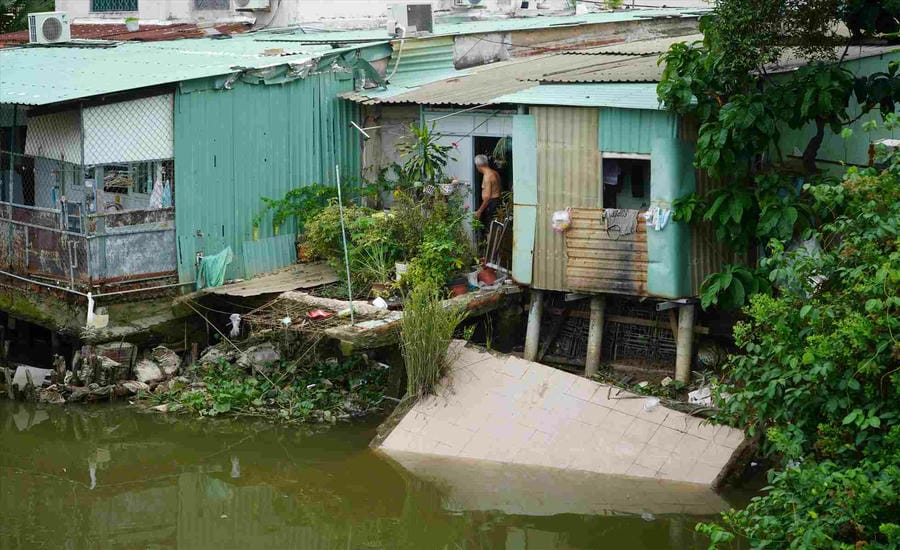
Ho Chi Minh City has 43 landslide locations on riverbanks, canals, and ditches, of which 8 points are particularly dangerous. Although many embankment projects have been approved, the construction progress is slow, causing riverside residents to worry. In Binh Trung ward, two particularly dangerous landslide points appeared on the right and left banks of Giong Ong To canal (near Giong Ong To 1 bridge), with a radius of about 150m each side. This area is located in a densely populated residential area, directly affecting 19 households.
Real-world records show that many houses along the canal are in a state of leaning, with the risk of collapsing into the water. Mr. Do Binh Son, a resident living here, informed that the landslide situation is increasingly serious, while the embankment construction project has been mentioned for a long time but has not been implemented.
A similar situation is happening in the Thanh Da peninsula area (Binh Quoi ward), where more than 10km of riverbank is eroded, affecting many households. The Thanh Da peninsula landslide prevention project was assigned by the Ho Chi Minh City People's Committee to the Department of Transport (now the Department of Construction) to study and propose construction from 2003, which is one of the key projects to prevent landslides on the Saigon River.
By 2006, the Ho Chi Minh City People's Committee approved the investment policy, dividing it into 4 main sections. However, so far, only the landslide prevention project of section 1 of Thanh Da canal has been completed. Sections 2, 3, 4 with many large bidding packages are still under construction, increasing the risk of landslides.
According to Mr. Nguyen Kien Giang - Deputy Head of the Department of Management, Maintenance and Exploitation of Transport Works (Ho Chi Minh City Department of Construction), in the Thanh Da peninsula area, there are currently 3 landslide prevention projects invested by the Project Management Board for Investment and Construction of Transport Works. Among them, the landslide prevention project section 2 (Saigon Domaine Hotel area) has a length of 2.7km, with a total capital of more than 319 billion VND. Up to now, 1.46km has been completed. The underwater part package has reached 95% of the volume, expected to be completed in September 2026; the elevated part has reached 70%, expected to be completed in August 2026.
Project section 3 (Binh Quoi - Cay Bang - Rach Chua) is 4km long, with a total capital of more than 467 billion VND, 3.9km has been completed and is expected to be fully completed on April 30, 2026. Meanwhile, project section 4 (from Ly Hoang villa area to La San Mai Thon church) is 2.7km long, with a total capital of more than 380 billion VND, only 1.24km has been completed. The remaining packages are expected to be completed in the period from June to September 2026.
Need strong enough sanctions
Among the 43 landslide points, 11 locations in Nha Be, Tan Nhat, Thuong Tan, Lai Thieu, Tan Uyen do not have embankment projects. Ho Chi Minh City People's Committee requests urgent surveys and investment proposals. For embankment construction projects with a total length of nearly 18km, total investment of about 3,951 billion VND, Ho Chi Minh City People's Committee requests departments, branches and localities to urgently remove obstacles, accelerate the progress of preparing, appraising and implementing projects in order to soon put them into use.
Dr. Tran Quang Thang - Director of the Institute of Economics and Management of Ho Chi Minh City - assessed that the situation of slow and prolonged landslide prevention projects mainly stems from familiar "bottlenecks" that have not been completely resolved. Among them, the biggest obstacle is site clearance in riverside residential areas, where land laws are complicated, leading to many projects having to be constructed halfway or temporarily suspended.
In addition, the public investment process still has many levels, the allocation of capital is not timely, along with material price fluctuations, making it difficult for contractors to maintain stable progress.
To speed up progress, Mr. Thang said that Ho Chi Minh City needs to prioritize definitively handling the site before deployment, avoiding the situation of "doing while waiting". At the same time, a special mechanism should be applied to urgent projects related to people's safety, streamlining investment procedures and stronger decentralization to localities. In parallel, it is necessary to strengthen supervision, attach specific responsibilities of investors and contractors to project progress. If there are no strong enough sanctions, delays will continue to recur, directly affecting the safety and lives of people.