
Some bridge bearings on the elevated Ring Road 3, Mai Dich - Thang Long bridge section, were found to be displaced, including 3 bridge bearings that had completely slipped away from the support stones.
On June 4, the Traffic Infrastructure Maintenance Board reported to the Hanoi Department of Construction on the situation of disalignment of some bridge bearings on the elevated Ring Road 3, the section from Mai Dich to Thang Long bridge.
According to the Traffic Infrastructure Maintenance Board, the elevated Ring Road 3 section Mai Dich - Thang Long bridge is 5.367km long, of which the elevated bridge is 4.831km long. The project was put into operation in 2022, including 4 standard expressway lanes with a design speed of 100km/h. The entire route uses 2,286 bridge bearings of all kinds.
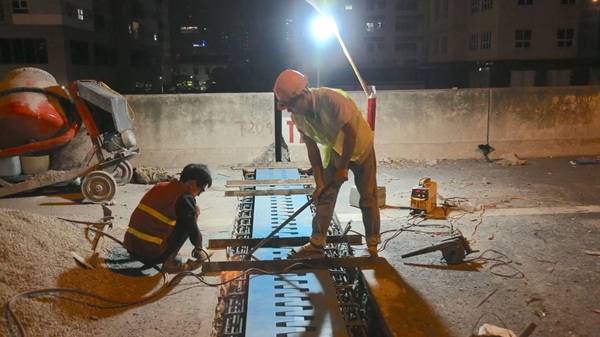
During the management and periodic inspection process, the route management unit, Hanoi Transport Works Joint Stock Company 2, discovered that the bridge bearings at piers P32, P44, P49 and P53 were displaced. Specifically, 3 bridge bearings at pier P32 had completely slipped out of the supporting stone; 5 other bearings at piers P32, P44, P49 and P53 had slipped or rotated from 30-60% of the contact area.
Immediately after discovering the incident, the Traffic Infrastructure Maintenance Board requested the implementation of immediate safety measures, such as temporarily inserting wooden panels at the bridge bearing position to reduce the impact force on the girder head when vehicles circulate.
At the same time, the entire bridge bearing system on the route has been comprehensively inspected. The results show that, in addition to the above locations, no additional abnormalities have been detected and the project still ensures safe operation conditions.
According to the assessment of bridge design and construction consulting units, the main cause of the phenomenon of bridge bearing tilting stems from the working characteristics of prestressed concrete girder structures. Under the impact of traffic loads and temperature changes, bridge girders tend to contract over time. In some locations, the contact surface between the bridge bearing and the steel cushion plate is uneven, causing the bridge bearing to gradually move away from the design position.
Experts believe that moving the bridge bearings while still within the beam bottom range does not cause immediate danger to traffic. However, if prolonged, this phenomenon may reduce the area of bearing contact, causing uneven load distribution, affecting elastic joints, bridge railings and the lifespan of the project. In case the bridge bearings completely slip off the beam bottom, it may lead to structural damage, affecting operation safety.
To overcome the above situation, the Traffic Infrastructure Maintenance Board proposed that the Hanoi Department of Construction allow the development of a plan to repair the bridge bearings that are largely skewed at piers P32, P44, P49 and P53. The expected solution includes lifting the structure, bringing the bridge bearings back to the correct design position and supplementing a sliding prevention frame system. The proposed implementation cost is from the contingency fund of the traffic infrastructure management and maintenance package.
In the long term, the Traffic Infrastructure Maintenance Board proposes to develop a project to comprehensively repair the bridge bearing system on the entire elevated Ring Road 3 section Mai Dich - Thang Long bridge; and at the same time add similar slip protection solutions as on the Phap Van - Mai Dich section that have been implemented before.
This unit also proposed that the Hanoi Department of Construction send a document to the Ministry of Construction and Thang Long Project Management Board to coordinate in assessing the causes and drawing experience in design work for similar projects in the coming time.


