
Proactively "live with" saltwater intrusion
Before the forecast that saltwater intrusion may deeply penetrate and develop complicatedly like the 2022-2023 dry season, people in Quoi Thien commune - a large specialized fruit tree area of Vinh Long province - are urgently implementing many freshwater storage plans to protect high-value orchards.
According to statistics, the total area of gardens in Quoi Thien commune currently reaches 2,502.88 ha, of which the durian area alone accounts for 1,072.6 ha. This is a key crop, bringing high economic value but especially sensitive to salinity.
These days, at inland canals and in durian gardens, a working atmosphere is taking place urgently. People are focusing on dredging garden ditches, reinforcing embankments, installing more tanks and water bags to proactively source irrigation water during the dry season peak.
Having suffered damage many times due to saltwater intrusion, Quoi Thien farmers gradually formed a proactive response mindset instead of passive worries. With durian trees with very low salt tolerance levels, ensuring stable fresh water sources is considered a vital factor.
Mr. Nguyen Van Vinh - a farmer with more than 20 years of attachment to durian trees in Quoi Thien commune, said that his family has learned many lessons from the previous severe saltwater intrusion seasons.
From an initial area of about 4,000 square meters, my family's durian garden has now expanded to more than 18,000 square meters. Through many drought and salinity spells, I understand that I must be proactive from early on, not wait for salinity to rise before running," Mr. Vinh shared.
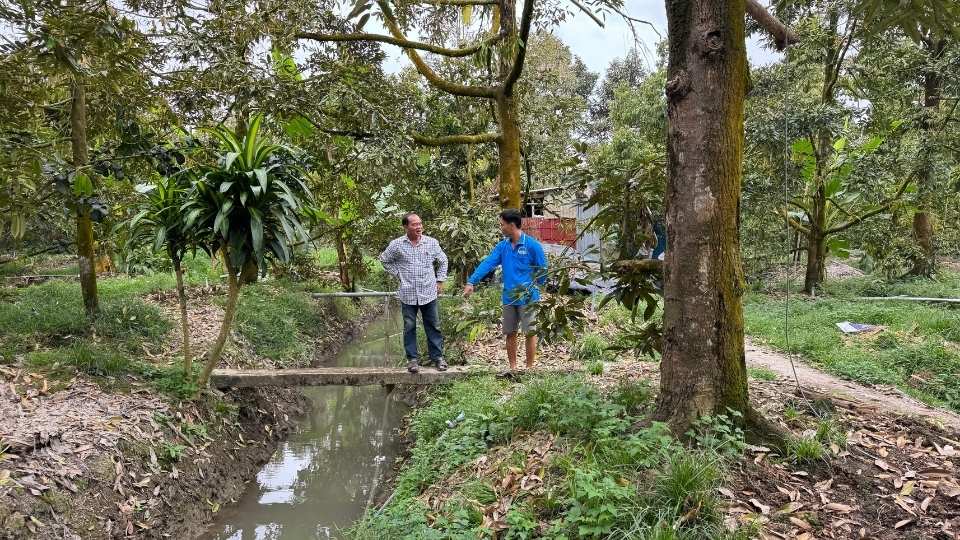
According to Mr. Vinh, the family has dredged the entire canal system in the garden to increase water storage capacity, and at the same time invested in larger tanks to prevent domestic water and irrigation when the outer sewers are closed tightly.
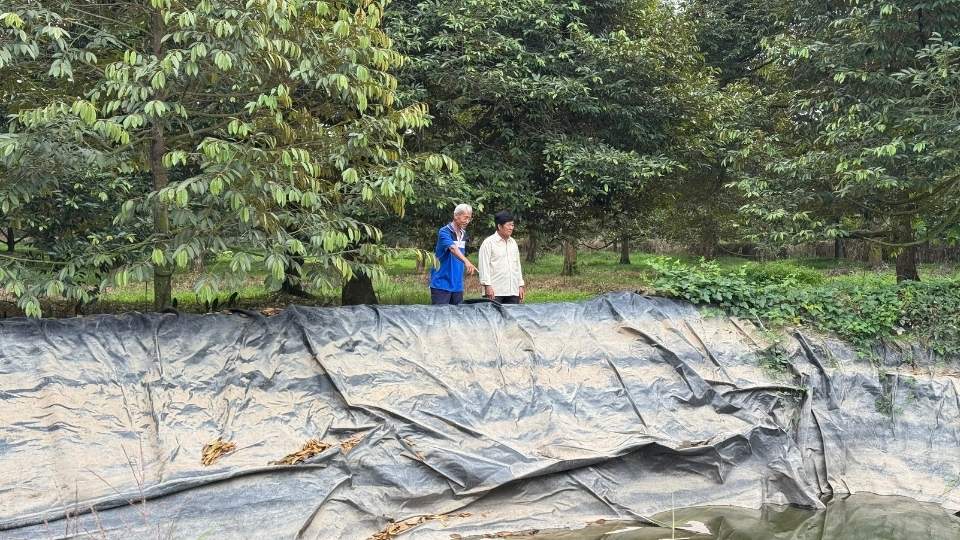
Sharing the same view of "living together" with saltwater intrusion, Mr. Nguyen Chi Tam - owner of 8,000 square meters of durian garden in Quoi Thien commune - has chosen the solution of digging ponds with tarpaulins to store fresh water.
Mr. Tam said that with a large garden area, if saltwater intrusion lasts for a few months, the amount of water in the ditch is not enough to meet irrigation needs. Digging ponds and laying tarpaulins helps prevent saltwater from penetrating from the ground, keeping fresh water from being lost.
Authorities and functional sectors get involved soon
The response to saltwater intrusion in Quoi Thien is not only the private effort of each household but also the synchronous involvement of local authorities and functional sectors.
Mr. Phan Thanh Minh - Head of Phuoc Ly Nhi hamlet, Quoi Thien commune - said that preparation work has been deployed early. The whole hamlet currently has 12 large and small culverts inspected and maintained, ready to operate to prevent saltwater intrusion and store sweet potatoes.
According to Mr. Minh, salinity developments are updated regularly from specialized sectors and promptly informed to people through Zalo groups and loudspeaker systems. Sewers are assigned to be on duty 24/24 to close in time when the salinity exceeds the permissible level.
From the perspective of the agricultural sector, Mr. Le Quang Rang - Deputy Director of the Department of Agriculture and Environment - said that this year's saltwater intrusion situation has many complex factors, with the risk of deep intrusion following high tides.
According to forecasts, salinity of 4‰ may penetrate deeply from 50-60 km at major river mouths, dien bien equivalent to the 2022-2023 dry season. The agricultural sector has issued many recommendations and guidance on effective water storage models to protect the durian area of more than 1,000 hectares of Quoi Thien.
The proactive "step ahead" of the people and the drastic involvement of the government and functional sectors are considered key factors in helping the Quoi Thien durian specialized area firmly overcome this year's drought season.


