Starting from 3 historical photos
The journey to search for martyrs' remains at Le Thi Rieng Park begins with scene photos collected by architect Nguyen Xuan Thang during the process of supporting functional agencies in searching for martyrs.
Since 2018, architect Nguyen Xuan Thang's research group has successively collected 3 photos from various sources on the internet, recording the scene of mass burial of martyrs.
However, according to architect Nguyen Xuan Thang, the biggest challenge is not to find these photos but to accurately determine where and when they were taken. Therefore, throughout the first 4 years, the group only focused on solving the problem of determining space and time by processing photos, analyzing terrain, geophysical features and characteristic milestones appearing in photos.
Details such as water towers, four rows of two-story houses of Bac Hai apartment building and burial ditches were meticulously compared, thereby determining that all three photos recorded the same event at the same location, at about 8 - 10 am on February 12, 1968. The photographer stood with his back to Le Van Duyet street (now Cach Mang Thang 8 street).
To verify the results, the group used a large volume of documents, including DS, D3C, Maxar, Airbus satellite photos; no photos taken by the French army in 1951; many sets of Saigon maps through the periods; military reports, dossiers of clearing Do Thanh cemetery to build Le Thi Rieng park, along with testimonies from witnesses. "After comparing dozens of sources of documents, the group determined that the area in the photo is Do Thanh cemetery (Chi Hoa - Saigon) formerly, now belonging to Le Thi Rieng Park" - Mr. Thang said.
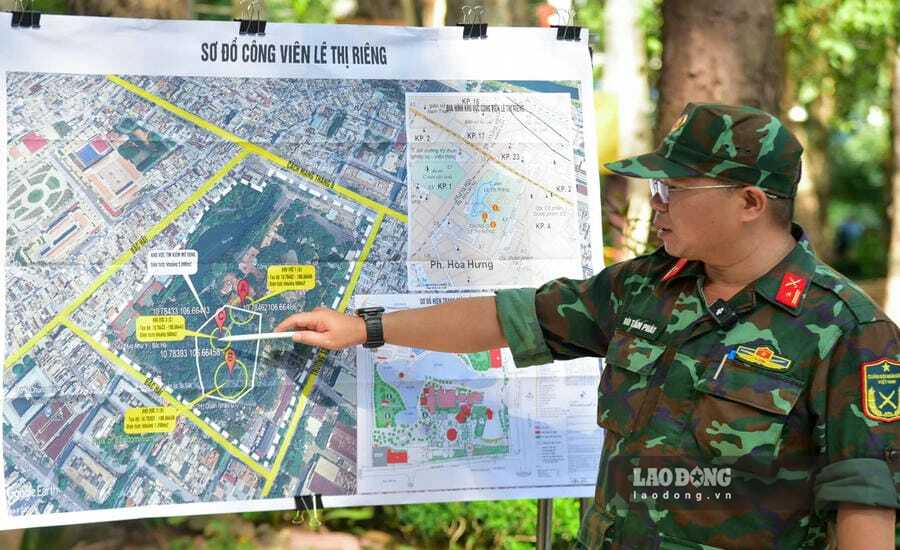
Next, the research group applied the method of converting the reference system, combining stacking non-images and satellite images through many stages to determine the location of the burial trenches. The results cordoned off 3 areas suspected to be mass grave trenches, with an area of about 500 - 1,200m2, located near the fishing pond behind the Traditional House of Le Thi Rieng Park.
The data when compared with the water tower in the area of Thanh Duong Church and Nguyen Gian Thanh street coincide, consolidating the perception that this area was once a mass graveyard, in which many officers and soldiers sacrificed in the General Offensive and Uprising of Spring Mau Than 1968.
The research results were then transferred to the National Steering Committee for Searching, Repatriating and Identifying Martyrs' Remains (National Steering Committee 515). On that basis, the Ministry of National Defense, Military Region 7 and Steering Committee 515 of Ho Chi Minh City directed forces to continue reviewing documents, meeting witnesses and conducting field surveys to clarify the basis for searching.
Searching for the memories of the witnesses
According to Major General Nguyen Thanh Trung - Political Commissar of the Ho Chi Minh City Command, Standing Deputy Head of the Ho Chi Minh City Steering Committee 515, to determine the correct burial location, it is necessary to start from witnesses. The proposal of the Ho Chi Minh City Command, the Ho Chi Minh City Steering Committee 515 has coordinated with press agencies and the online community to search for three young children appearing in historical photos of 1968.
On May 31, 2026, the first survey team arrived at Le Thi Rieng Park. Witnesses directly led the team to compare each topographic marker, traces still preserved in memory. These indications basically matched the research results from military maps, historical photos and satellite photos.
To ensure accuracy, the Ho Chi Minh City Command met with each witness many times. Each account was recorded, mapped, marked on a digital map and only included in the survey area when verified by many sources of documents.
Among the witnesses, Mr. Vo Huy Dinh (75 years old), still making a living by selling lottery tickets, put aside his job to accompany the survey team for three days. Along with Mr. Dinh, another witness, Mr. Nguyen Thanh Phuoc (70 years old), is also always ready to be present whenever the search force needs to supplement on-site information.
Modern science helps decipher the past
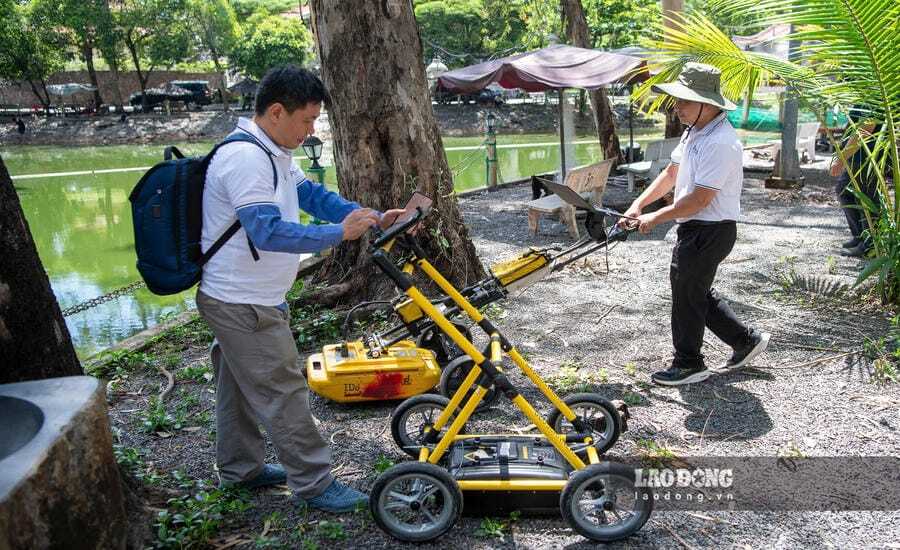
From June 15, 2026, the Ho Chi Minh City Command will coordinate with the Institute of Design (General Department of Logistics and Technology), Hanoi University of Science and Technology, University of Science and Ben Thanh Water Supply Joint Stock Company to use ground-penetrating radar to survey three areas in Le Thi Rieng Park.
After four days of independent surveys, all four units identified two areas with unusual underground signals, creating an important scientific basis for organizing exploration.
On June 23, 2026, the first hoes were applied at point A. After two days of peeling off each layer of soil, the search force discovered the structure of a mass grave, followed by hammock fragments and the first sets of remains.
There were no cheers, only silence and red eyes of officers and soldiers of the Ho Chi Minh City Command when their comrades were found nearly 60 years later.
Initial results identified a grave trench about 25m long and about 3m wide, discovering 5 sets of remains along with many bone samples and artifacts. This is identified as one of the three collective grave trenches appearing in historical photos in 1968, affirming that the research direction is correct and opening up hope to continue finding the remaining grave trenches.
Immediately after that, the Ho Chi Minh City Command advised the Steering Committee 515 of Ho Chi Minh City and Military Region 7 to fully prepare conditions for the repatriation phase, from the temporary command headquarters, DNA sampling area, gift house to mobilizing Teams K70, K71, K72, K73 and professional teams. The goal is to ensure that the repatriation work takes place in accordance with procedures, solemnly, tightly and safely, so that the journey to bring the martyrs back is full of affection.