
Limited reserves
In the last days of March, in Khanh Binh, Bien Bach, U Minh, Hong Dan communes..., it is easy to see that many internal field canals have dried up to the bottom. The water level dropped low because the culverts were closed to prevent saltwater intrusion, causing fresh water for living and production to become increasingly scarce.
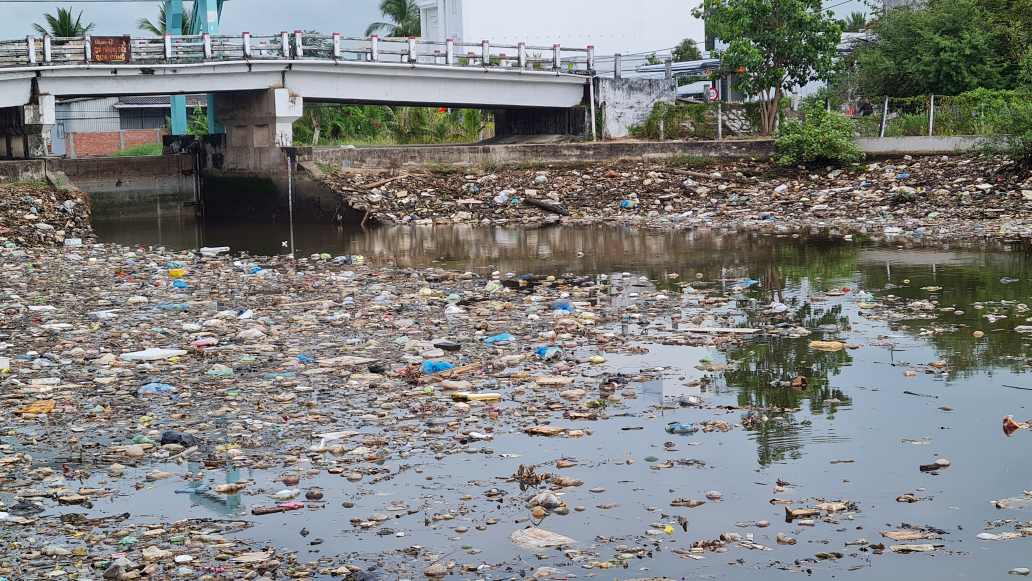
According to local people, before each dry season, households proactively store rainwater in jars, basins, and tanks for use. However, the amount of water stored is only enough for short-term use, not meeting the demand that lasts for many months. The shortage of domestic fresh water has been going on for many years every dry season peak.
Ms. Nguyen Thi Phung, Ong Bich hamlet, Khanh Binh commune, said that her family has to use water very sparingly because the reserves are limited. When the water runs out, buying water becomes the only solution.
Not only is there a shortage of domestic water, people's travel is also facing many difficulties when the canals are dry. Many households who are used to traveling by boats and canoes have to switch to motorbikes or trucks to transport agricultural products.
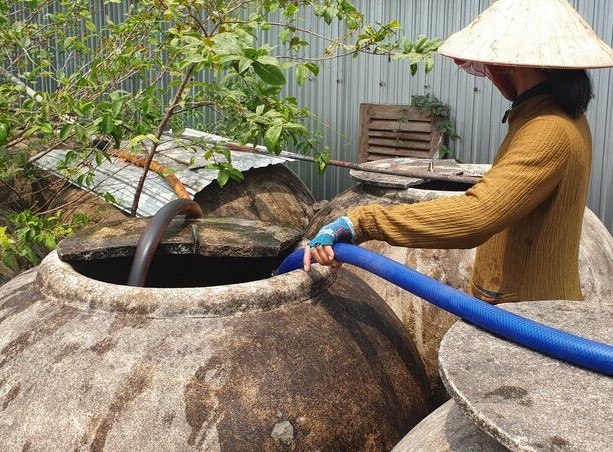
In Bien Bach commune, the water shortage situation is becoming more serious. Ms. Vo Thi Tho (Thanh Tung hamlet) said that for nearly 10 years, her family has never used tap water, completely dependent on rainwater. In the dry season, water purchase costs increase, becoming a burden.
Every week, it costs several hundred thousand VND to buy soft drinks, but we still have to use them very sparingly. Young children in the house have to bathe in pond and ditch water," Ms. Tho shared.
Currently, people rely on boats carrying water from elsewhere, with a price of about 40,000 VND for a jar of water of about 700 liters, causing living costs to increase.
Urgently invest in a clean water system for people
According to Mr. Le Van Day, Vice Chairman of Bien Bach Commune People's Committee, the whole commune has about 40 households that have installed meters but in reality do not have water to use. Some other households can only receive water at night due to weak pressure.
The reason is that the water supply pipeline system is long, with routes of more than 100km. In the dry season, the demand for use increases simultaneously, causing water pressure to decrease sharply, leading to water shortages at the end of the source.
Faced with this situation, in mid-March 2026, Ca Mau Provincial People's Committee approved the investment policy for the Emergency Rural Water Supply Project for the period 2026 - 2030, with a total capital of about 110 billion VND.
The project aims to build complete water supply systems in water-deficient areas, areas affected by drought and saltwater intrusion. It is expected to supply new water to about 6,000 households, contributing to improving people's health and living conditions.
Mr. To Hoai Phuong, Director of the Department of Agriculture and Environment of Ca Mau province, said that the drought in the dry season of 2026 in Ca Mau continues to have a complex trend. Surface water sources in many areas have decreased, saltwater intrusion has deeply encroached into the fields, especially in coastal areas and areas dependent on natural water sources. This makes it difficult for a part of the population to access domestic water, especially in remote and isolated areas, areas without stable centralized water supply systems.
Using water economically and effectively is the most important solution. Water after being used in daily life can be used for watering plants and cleaning, contributing to reducing pressure on water sources. In addition, each person needs to raise awareness of protecting water sources, not littering in canals, ditches, ponds and lakes, contributing to maintaining clean water sources for a long time.


