Village becomes "guard station" for natural disasters
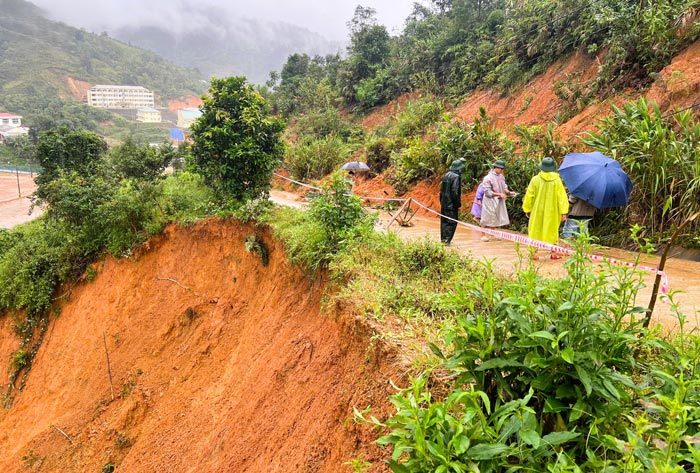
At the end of October 2025, prolonged heavy rain caused landslides and traffic disruption in the western mountainous area of Da Nang. In Tra Van commune, 307 households with 1,215 people were relocated in time. Previously, the commune reviewed 172 households in dangerous areas, built 8 shelters and prepared essential goods sufficient for 15-20 days.
Mr. Nguyen Tan Thanh - Chairman of Tra Van Commune People's Committee - acknowledged that the most important thing is not to let people be surprised: "When it was still sunny, the commune mobilized people to prepare shelters and bring food first. When it rained heavily and the road was landslide, the evacuation and ensuring people's lives were therefore much more proactive.
In Nam Tra My commune, the lesson of "early detection" was learned from a life-and-death situation. In Loong Pok residential area, Tak Lu village, people and authorities discovered a crack up to 50cm wide in the positive taluy, about 250m away from the residential area. Although there was no final professional conclusion, the commune surveyed the site, cordoned off dangerous areas, proposed to announce an emergency situation, and placed the safety of 48 households ahead of all procedures.
The locality needs to promote the spirit of proactiveness, handling right from the initial stage, thereby minimizing damage to people and property" - Mr. Tran Van Man - Chairman of Nam Tra My Commune People's Committee - shared.
The spirit of Conclusion 213-KL/TW is to promote community knowledge, taking people as the subjects in disaster prevention and response. In ethnic minority areas, this knowledge is reflected in the experience of observing terrain, water flows, and signs of landslides.
According to grassroots civil defense forces, local people often detect the risks earliest. When village knowledge is connected to scientific warnings, the effectiveness of prevention will be higher.
Technology extends village experience
Folk experience is only fully utilized when connected to modern forecasting technology. In 2025, Da Nang suffered many natural disasters with 15 storms, 6 tropical depressions, 8 heavy rains and 5 floods, causing damage of about 4,130 billion VND. The flood at the end of October alone caused more than 40 communes and wards to be heavily flooded, and many mountainous areas were cut off and landslides.
In that context, the Central Hydrometeorological Station has transmitted information via telephone, email, website, Zalo, Facebook; when heavy rain and floods occur, hydrometeorological data is updated every hour, and summary messages of rain and flood developments are sent to the City Civil Defense Command and communes and wards with a frequency of 3-6 hours/time.
In Hung Son border commune, during storm No. 12, the commune relocated 243 households with more than 1,200 people to safe areas. In Ha Nha, the low-lying area along the Vu Gia River, the government organized 24/24 hour duty, relocated people from deeply flooded areas, combined with warnings through commune loudspeakers, village loudspeakers and people's flood prevention experience; the result was no loss of life.
However, the early warning gap in remote and isolated areas is still worrying. Many places have power outages, signal outages, internet interruptions; broadcasting equipment is damaged; grassroots officials are part-time, lacking risk communication skills.
The City Military Command also said that the community warning system is still limited, causing people to sometimes receive information not in time, while this is an area at high risk of damage.
Storms and floods are becoming increasingly extreme, but the reality from Tra Van, Nam Tra My, Hung Son, Ha Nha shows that: when information is provided early, trained and given the right to participate, the community is no longer passively waiting for relief but becomes the first preventive force.