
Information from Vietnam Air Traffic Management Corporation (VATM), adverse weather conditions have caused many flights to have to fly for waiting and adjust operating plans.
Accordingly, on August 5, the Northern region experienced a widespread heavy rainstorm. At Noi Bai and Dien Bien airports, heavy rain caused visibility to fall below operating standards.
Especially at Noi Bai airport, air traffic flow regulation (ATFM) measures must be continuously applied, even temporarily suspending the receipt of incoming aircraft to ensure operational safety.
According to the assessment of the Noi Bai Aviation Meteorological Center (AMO Noi Bai), the cause of the thunderstorm is due to the influence of a low pressure range with its axis through the North connecting to storm No. 3 (KUJIRA) in the East Sea, combined with a low pressure cyclone developing from the ground to an altitude of 5,000 m.
The interaction of these weather patterns creates favorable conditions for convective clouds to develop strongly, increasing the intensity and scope of impact of thunderstorms in the Northern region.
Notably, the time when bad weather appeared was also the period when Noi Bai airport had high flight density during the day, making it the airport most affected in the region.
At Noi Bai airport, very strong thunderstorms lasted for many hours from 2:44 pm to 5:18 pm on August 5 (local time). Monitoring bulletins continuously recorded visibility reduced to below 1km, at times only 600 - 800m, lower than the airport's operating standards.
In addition, large convective clouds covering the take-off and landing axis area have significantly affected the take-off and landing operations of aircraft.
At Cat Bi airport, showers and thunderstorms occurred between noon and afternoon, the lowest horizontal visibility decreased to 600m. At Dien Bien airport, heavy showers appeared in the afternoon, causing visibility to decrease below operating standards, at a minimum of about 650m.
Tho Xuan airport recorded moderate thunderstorms with the lowest visibility of 3,500m, while Vinh and Dong Hoi airports had scattered light rain but visibility still maintained above 10km.
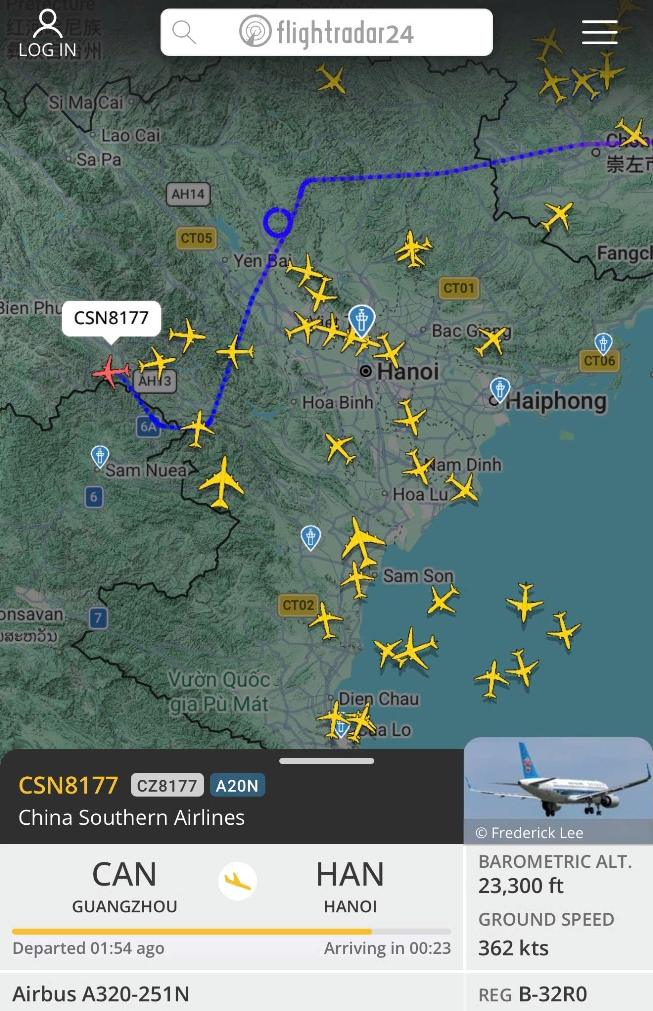
AMO Noi Bai assessed that this is one of the widespread thunderstorms with strong intensity, significantly affecting flight operations in the Northern region in the 2026 rainy season.
Although weather patterns can be predicted early, the assessment of the impact on each airport still needs to be updated continuously due to the development and rapid movement of convective cloud areas. It is forecast that the thunderstorm is likely to last until the end of August 7, 2026.
According to VATM, thunderstorms are one of the dangerous weather phenomena, which can seriously affect flight operations and operational safety.
Therefore, closely monitoring weather developments, accurately assessing the intensity of thunderstorms, visibility and impact time is of particular importance in providing air weather observation, forecasting, warning and consulting information.
This is also the basis for air traffic controllers, airlines and the Air Traffic Flow Management Center to coordinate and operate (CDM), deploy air traffic flow regulation measures (ATFM) and calculate scheduled take-off hours (CTOT), contributing to ensuring safe, regulated and efficient flight operations.


