Low birth rates are creating a major barrier to the Mekong Delta

Phong Linh |

The annual economic report of the Mekong Delta region 2025 (announced at the end of May 2026) shows that low birth rates are creating a major barrier for the region.

Low birth rate, population deficit

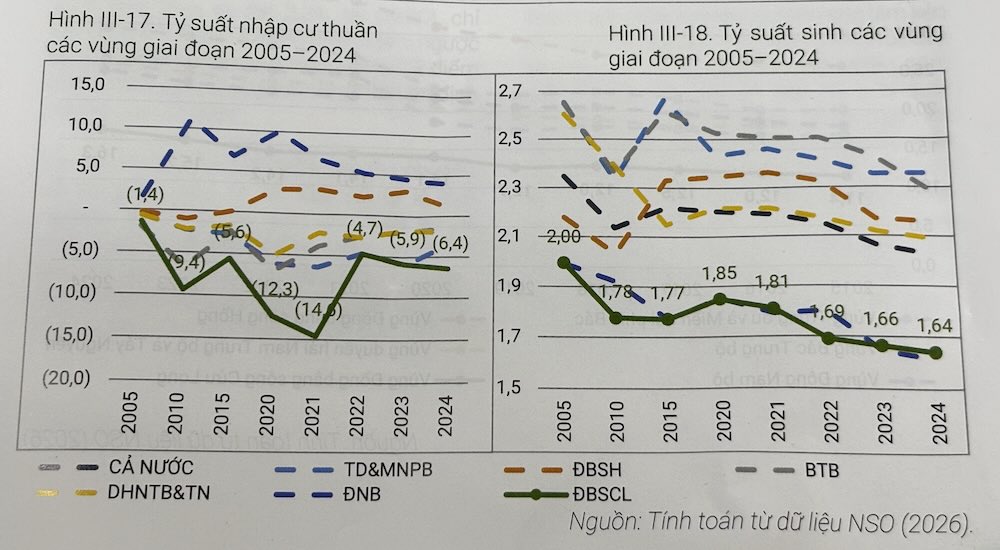
Accordingly, the Mekong Delta (Mekong Delta) along with the Southeast region (Southeast region) are the two regions with the lowest birth rates in the country and have now decreased sharply, only about 1.6; lower than the replacement birth rate of 2.1 children/woman.
a
Immigration rates and birth rates in regions across the country. Photo taken from the annual economic report of the Mekong Delta 2025 - Phong Linh.

In the past two decades, the Mekong Delta region has continuously recorded a negative net immigration rate and is significantly lower than other economic regions. After the administrative boundaries were adjusted without Long An, all 5 new localities of the Mekong Delta faced a population deficit due to migration.

The shortage of young labor along with population aging in the future not only erodes competitive advantages, but also puts heavy pressure on the regional social security system and long-term economic growth momentum.

ĐBSCL là vùng có mức sinh thấp so với cả nước. Hình ở một gia đình ở ĐBSCL. Ảnh: Phong Linh.
Mekong Delta is a region with low birth rates compared to the whole country. Image in a family in the Mekong Delta - Phong Linh

This report also analyzes that the urbanization process of the Mekong Delta is also sluggish. By 2024, the urbanization rate of the whole region will only reach 29%, much lower than the national average of 38%.

Although Can Tho City reached 47% and An Giang 34%, the urbanization rate of all 5 new localities is lower than the national average.

Mức sinh thấp, thâm hụt dân cư đang là rào cản lớn cho phát triển kinh tế ĐBSCL. Ảnh: Phong Linh.
Low birth rates and population deficits are major barriers to economic development in the Mekong Delta. Photo: Phong Linh.

The combination of pure negative migration, slow urbanization and low birth rates is creating major barriers to investment attraction, labor structure shifts and the formation of dynamic economic growth poles for the entire region" - the report stated.

Trained workers

After the merger, the labor force size of the Mekong Delta recorded a decrease of about 1 million people. As of 2024, the regional labor force reached 8.5 million people, maintaining an average position compared to other economic regions across the country.

The rate of trained workers in the Mekong Delta is still the lowest in the country and has a large gap compared to other economic regions. As of 2024, this rate is only 16.3%.
a
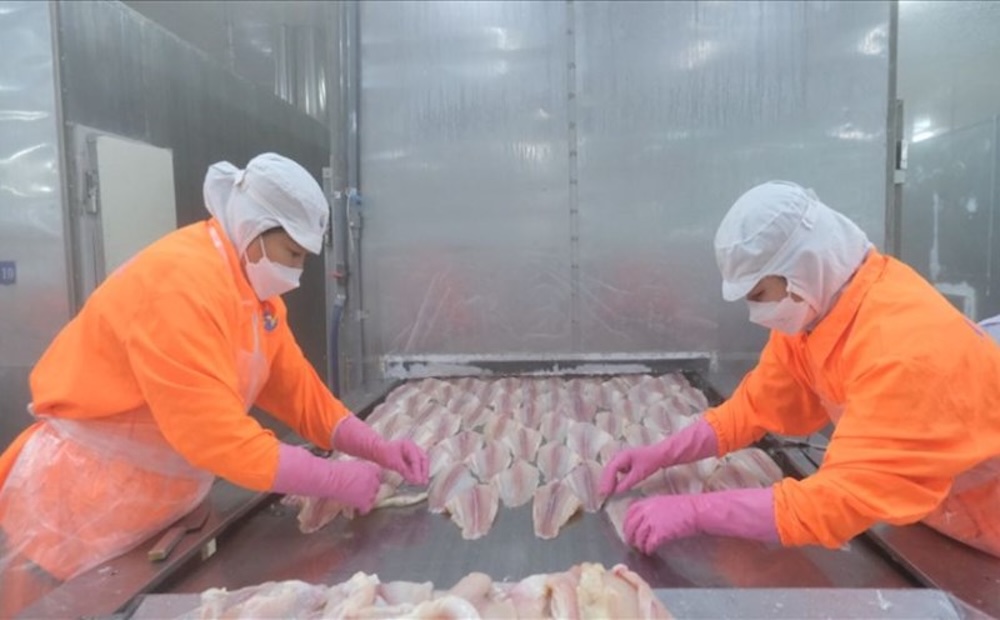
The quality of human resources is also a major barrier to business development in the Mekong Delta. Photo: Phong Linh.

This situation reflects limitations in access to vocational education and in-depth training, causing difficulties for the goal of economic restructuring to high-tech industries, deep processing and value-added services.

Analysis from the Vietnam Chamber of Commerce and Industry (VCCI), prolonged unemployment and unemployment are the key reasons driving the wave of migration in the Mekong Delta for many years. This consequence, combined with the continuous decline in birth rates, is pushing the region to face the risk of gradually losing its advantage in human resources.

Link to synchronize

VCCI has developed a group of key solutions recommended to the Central Government, localities, communities and business associations, to solve the economic development problem in the Mekong Delta.

In which, for human resources, provinces need to link universities, vocational schools, chain-leading enterprises and industry associations to train practical needs.

Training should not only stop at general skills, but should focus on small business administration, logistics operation, food safety, export standards, traceability, e-commerce, management accounting, quality management, automation and green transformation.

Without this new labor force, the Mekong Delta will find it difficult to attract high-value-added industries and difficult to retain young people.

The National Assembly has passed the Population Law, which takes effect from July 1, 2026. The Law prioritizes communication, mobilization, and education on contents such as encouraging marriage and childbirth to maintain the replacement fertility rate.

Phong Linh
RELATED NEWS

Sustainable economic development of the Mekong Delta, it is necessary to build a business ecosystem

|

The sustainable economic development orientation for the Mekong Delta (Mekong Delta) region is to quickly build an integrated business ecosystem.

Long-term leverage, creating a boost to improve birth rates

|

In the context of rapidly aging population, the Ministry of Health proposes financial support to encourage having enough 2 children, creating a boost for the plummeting birth rate.

Encourage marriage and childbirth to maintain replacement birth rates

|

The Population Law encourages marriage and childbirth to maintain the replacement birth rate; reduce early marriage and consanguineous marriage;...

Innovating trade union financial work to ensure sustainability and promote resource efficiency

|

This is the presentation of Mr. Nguyen Anh Tuan - Member of the Presidium of the Vietnam General Confederation of Labor, Chairman of the Hai Phong City Labor Federation at the XIV Vietnam Trade Union Congress, on the afternoon of June 4, 2026.

The most solid "remote defense line" to protect workers

|

The Vietnam Electricity Trade Union determines that close participation in law-making and supervision is the most solid "distant defense line" to protect workers.

Trade unions must become pioneers in promoting science and technology

|

Faced with the wave of artificial intelligence, the Vietnam Trade Union needs to help workers access new knowledge, improve skills and adapt to development requirements.

Deeper understanding of the role of grassroots trade union officials

|

Thanh Hoa - Attending and following the opening session of the 14th Vietnam Trade Union Congress, union members and trade union officials are more deeply aware of the role of the grassroots level.

Solutions to promote labor safety culture in the face of new requirements

|

Hanoi - Participating in the Workshop Center No. 1 of the 14th Vietnam Trade Union Congress, Mr. Nguyen Manh Kha - Chairman of Petrovietnam Trade Union, presented on Solutions to promote occupational safety culture in the face of new requirements.

Sustainable economic development of the Mekong Delta, it is necessary to build a business ecosystem

Phong Linh |

The sustainable economic development orientation for the Mekong Delta (Mekong Delta) region is to quickly build an integrated business ecosystem.

Long-term leverage, creating a boost to improve birth rates

Lệ Hà |

In the context of rapidly aging population, the Ministry of Health proposes financial support to encourage having enough 2 children, creating a boost for the plummeting birth rate.

Encourage marriage and childbirth to maintain replacement birth rates

ANH HUY |

The Population Law encourages marriage and childbirth to maintain the replacement birth rate; reduce early marriage and consanguineous marriage;...