
Small change trading "booms" in closed groups, residential groups
Just joining some groups of residents in apartment buildings in Tay Mo ward, Hanoi, it is not difficult to encounter posts inviting to exchange small change during Tet. The posts are often disguised with familiar words such as "supporting new money", "shipping lucky money", "there is still a little beautiful money for Tet", accompanied by images of stacks of brand new money, transaction invoices or working money counters.
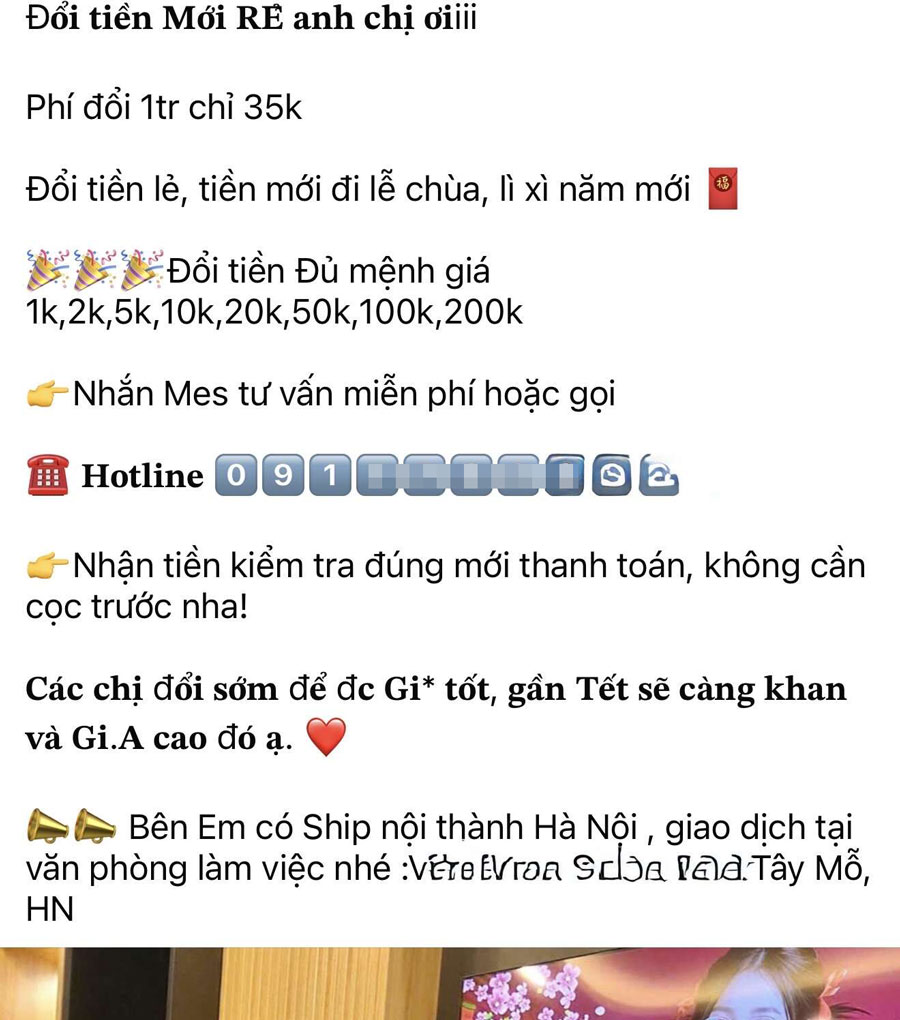
One of the quite active accounts is Bui Thu Thao, living in a high-class apartment building in Tay Mo ward. On her personal page and in residential groups, Thao regularly posts pictures showing off hundreds of orders every day, stacks of small change of all denominations, even creating retail invoices to create a sense of professionalism and prestige for business activities that are strictly prohibited by law.
In the role of a resident of the same apartment building who needs to exchange small change during Tet, reporters contacted Bui Thu Thao directly. Almost immediately, this person quoted detailed prices for each type of money.
My family has two types of money, original series money with a face value of 50,000 VND, the exchange fee is 70,000 VND/1 million VND, and "surfing" money is 50,000 VND/1 million VND. 100,000 VND money, the fee is 35,000 VND/1 million VND. If you agree to the fee, I will deliver it tonight," Thao advised.
When reporters expressed concern about the risk of buying counterfeit money, Thao appeared quite confident: "The small change business is prohibited one, the counterfeit money trade is prohibited ten, I dare not do it. My side checks the money before receiving the goods".
To create more trust, Thao continuously emphasizes her "personal brand": delivering hundreds of orders every day, trading in small change for 6-7 years now, the money source "from the state treasury", customers are mainly residents in the apartment complex, so it is "100% reputable".
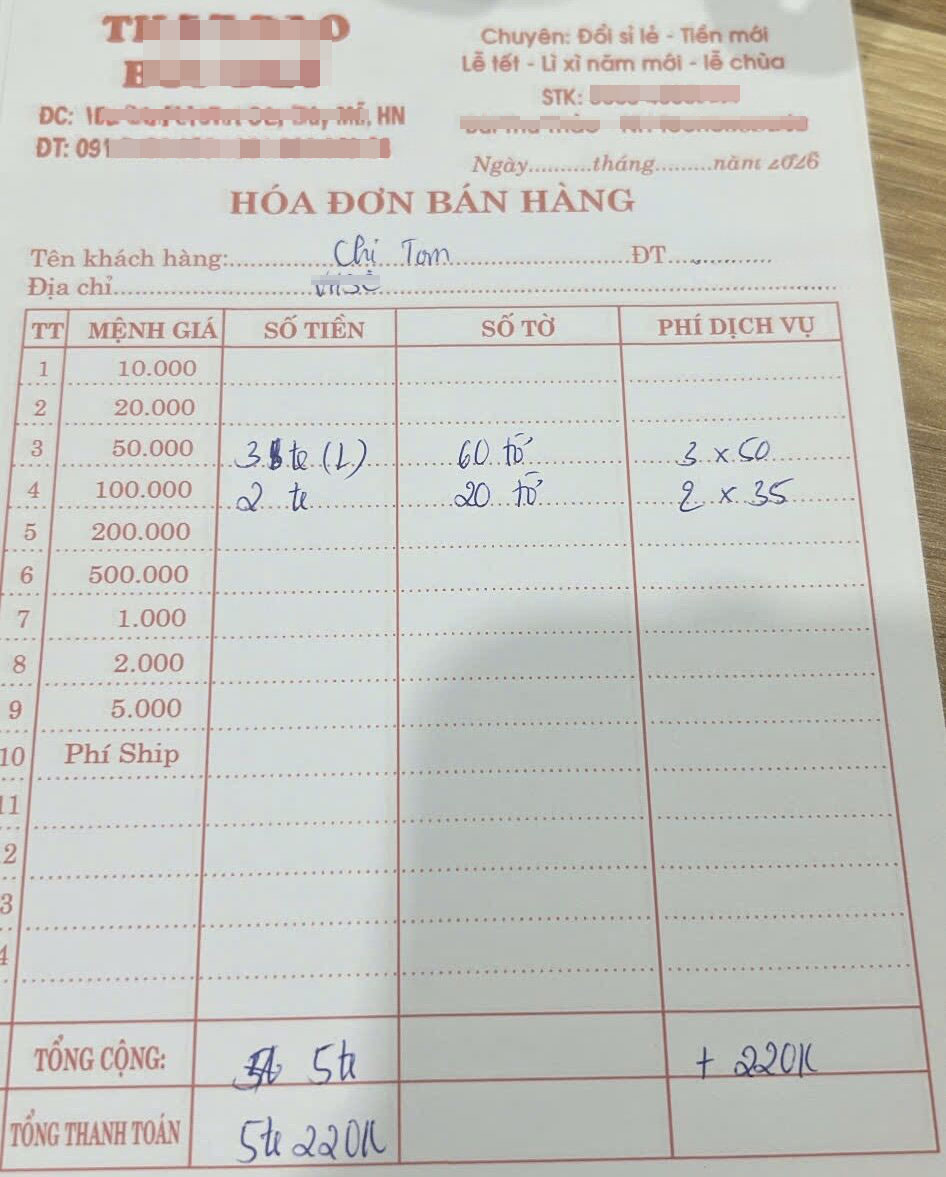
Closed delivery, avoid detection
Not only Bui Thu Thao, another account named Nguyen Thu Tra also regularly appears in groups of residents in Tay Mo and Tu Liem wards with invitations to exchange small change at "preferential prices in the last days of the year".
According to the publicly disclosed phone number 08544446xx, Tra said: "We only have a little left, so the price is very good, 50,000 VND is 60,000 VND/1 million VND, 100,000 VND is 35,000 VND. If you take it, I will ship around Hanoi".
Notably, this person affirmed that they only delivered money through closed delivery, not direct transactions. "Money is very sensitive at this time, so just delivery, my family uses regular delivery, family members to deliver goods for peace of mind, Tet money is easily lost," Tra revealed.
According to the regulations of the State Bank, the act of exchanging small change to enjoy the difference is illegal. In fact, every Tet holiday, functional forces still continuously organize inspections and handle public small change exchange points. However, the fact that small money traders "move houses" to cyberspace, operate in closed groups, and transact through internal delivery is causing many difficulties for management.
The fact that subjects brazenly show off revenue, show off orders, and publicly quote prices right in residential groups raises questions about the supervisory responsibility of local authorities, apartment building management boards, as well as the control role of social networking platforms.
According to the provisions of Decree 88/2019/ND-CP of the Government, the act of illegally exchanging money and collecting fees not in accordance with regulations in the monetary and banking fields may be administratively fined from 20 to 40 million VND. This is a sufficiently strong penalty to deter, but in reality, spontaneous money exchange activities are still common, especially in cyberspace.
According to Circular 25/2013 of the SBV, only the SBV, the State Bank Transaction Office, credit institutions (banks, microfinance institutions, people's credit funds), foreign bank branches and the State Treasury are allowed to carry out money collection and exchange activities and only apply to money that does not meet circulation standards.
Not only potential legal risks, exchanging small change via social networks is also a favorable environment for fraudsters.
Functional agencies warn that this activity poses a risk of fraud. Subjects often offer offers of money exchange services via social networks with low fees or recruit collaborators to post articles for profit. After the victim transfers money, the subject will block contact or send counterfeit money, insufficient money.


