
Hoping to receive support sooner when old age strikes
At the age of 68, Ms. Nguyen Thi Hong (Ninh Kieu ward, Can Tho city) lives with her husband in a small house by the river. Both husband and wife have been doing small business for many years, so they do not participate in social insurance and currently have no pension.
The family's income mainly depends on the grocery store in front of the house, but in recent years, business has been increasingly slow, while medical expenses have increased.
At this age, even if I want to work part-time, I don't have the strength anymore. Each month, the cost of medicine is already millions of VND. If I can receive a pension from 65 years old, it will reduce the burden a lot," Ms. Hong shared.
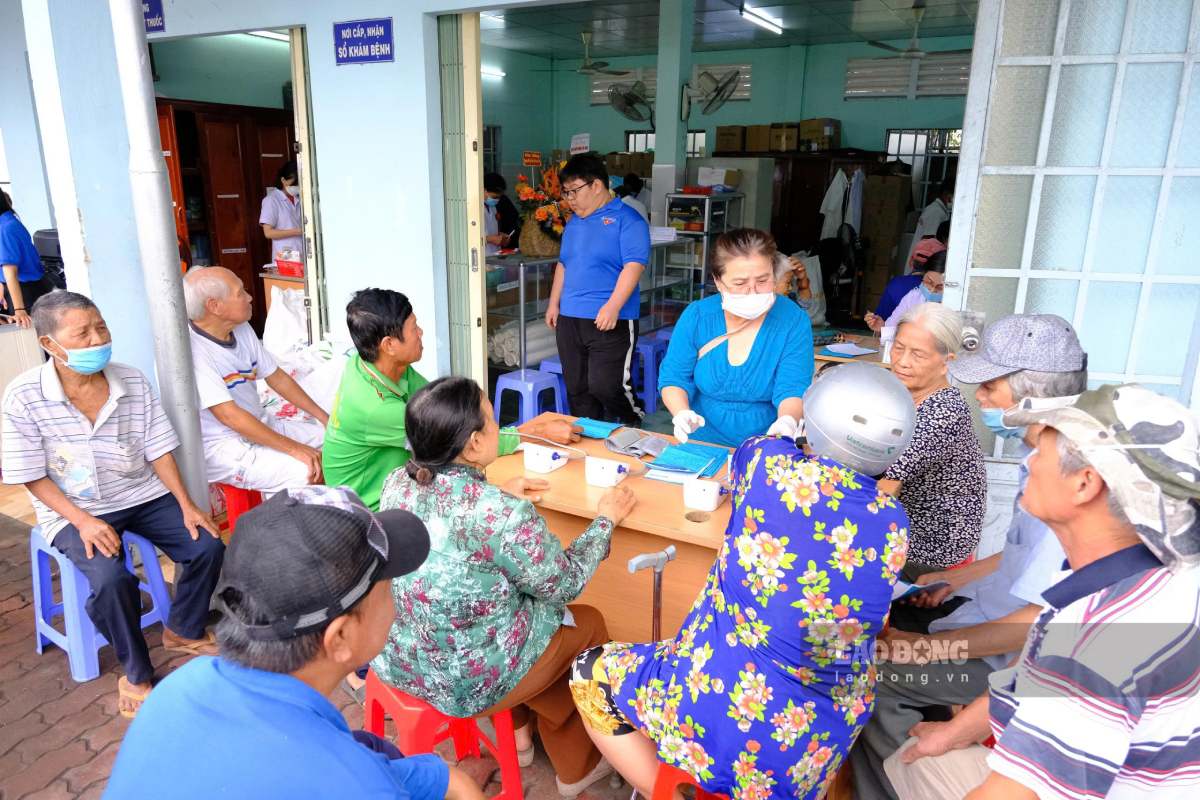
Not only Ms. Hong, Mr. Tran Van Phuc (66 years old, Cai Rang ward) also said that after many years of working as a freelancer, he is not eligible to receive a pension.
Only at the age of 75 can they receive allowances, so the period from when they quit their jobs to when they receive them is too long. That is the most difficult period because their health declines but they still have to manage their lives themselves when they cannot rely on their children," he said.
According to the Law on Social Insurance (BHXH) in 2024, people aged 75 and over who do not have a pension or monthly social insurance allowance will be entitled to social pension allowances; cases belonging to poor and near-poor households are entitled from 70 to under 75 years old.
Contributing opinions to the draft Law amending and supplementing a number of articles of the Law on Social Insurance, many localities also proposed to study reducing the age for enjoying social pension benefits lower than current regulations.
Can gradually decrease to 65 before reaching 60
Prof. Dr. Giang Thanh Long - School of Economics and Public Management (National Economics University), said that in the long term, Vietnam can aim to reduce the age for enjoying social pension benefits to 60 years old - the threshold for determining the elderly according to the Law on the Elderly.
However, according to him, reducing it immediately from 75 to 60 years old will create great pressure on the state budget.
He proposed implementing it according to a roadmap. Initially, the age threshold of 75 years old can be maintained until around 2030, then reduced to 70 or 65 years old, assessing the impact before continuing to reduce it to 60 years old if conditions permit.
This approach both gradually expands coverage and helps the State have time to assess fiscal impacts and adjust policies to suit reality," Prof. Dr. Giang Thanh Long analyzed.
According to the expert, the decision to reduce the age for enjoying allowances should not only be based on age but also consider many factors at the same time such as healthy life expectancy, population aging rate, social insurance coverage rate, proportion of elderly people with pensions, budget balancing capacity and impact on social insurance participation behavior.
He emphasized that healthy life expectancy is a particularly important criterion because the goal of social pension benefits is to support the elderly when their ability to generate income begins to decline, not just based on a certain age milestone.
In addition, Prof. Dr. Giang Thanh Long also noted that the expansion of allowances needs to go hand in hand with maintaining the attractiveness of social insurance. If the gap between social pension and pension is too small, a part of workers may reduce their motivation to participate in social insurance.
According to him, the social security system needs to be designed in many layers: social pension allowances ensure a minimum living standard, social insurance helps maintain a living standard commensurate with the contribution process, and supplementary retirement forms create additional income when old.


