
Infrastructure must be connected for interconnected economy
A key condition to turn the new administrative space into a real economic space is infrastructure connectivity. In the first 6 months of 2026, the whole country put into operation an additional 395km of expressways, increasing the total length of expressways to about 3,345km. The North-South Expressway in the East completed connectivity, creating an important traffic axis to promote regional linkages.
Along with roads, the scale of transportation through seaports continues to increase sharply. In the first 5 months of 2026, the volume of goods through seaports reached about 546.2 million tons, an increase of 15%; container output reached nearly 15 million TEUs, an increase of about 14% compared to the same period.
These figures show that as the scale of production and trade grows, the quality of connection between seaports - highways - railways - industrial parks - logistics centers will increasingly clearly determine the competitiveness of the economy. Vietnam's logistics costs are currently equivalent to about 17% of GDP, while the world average is about 10-11%. That gap is the room for reform.
Escaping the "every locality has its own plan" mindset
In 2026, the public investment capital plan assigned by the Prime Minister is up to more than 1,014 million billion VND. The very large scale of resources poses a new requirement after the merger: Not only to disburse quickly but also to invest in the correct new development structure. What needs to be avoided is the mentality that "ever old locality must have a part". After the merger, it is not necessary that each area has a large project, a logistics center, a new urban area or a symbolic structure to ensure balance.
Capital must be placed in the place that creates the highest efficiency and spillover. If a 20-km road can connect three industrial parks with seaports, economic efficiency may be much greater than three small roads divided equally among three regions. If a regional-scale logistics center is capable of serving the entire new economic space, there is no need to build three small centers just because they were previously three different localities. That is the difference between administrative boundaries management and development management.
After the 3rd Central Conference, public investment must play the role of "bait capital", leading private resources into growth corridors, growth poles and high-yield production chains.
Land is a particularly important resource in the new development space. The Central Government sets a goal to complete the construction of a digital database for all land plots that have been collected by the end of 2026; by the end of 2027, basically complete surveying, mapping, cadastral records and land databases for the remaining area. After merging, it is not possible to simply add old planning documents into a larger plan. What needs to be done is to review synchronously the land, transportation, urban, industrial, logistics and housing planning; resolutely handle land areas that have been allocated but are used inefficiently, prolonged projects and overlapping planning. Land resources must go to the place that creates the highest productivity, and cannot continue to be locked in the old geographical thinking.
The ultimate measure must be people's jobs and income.
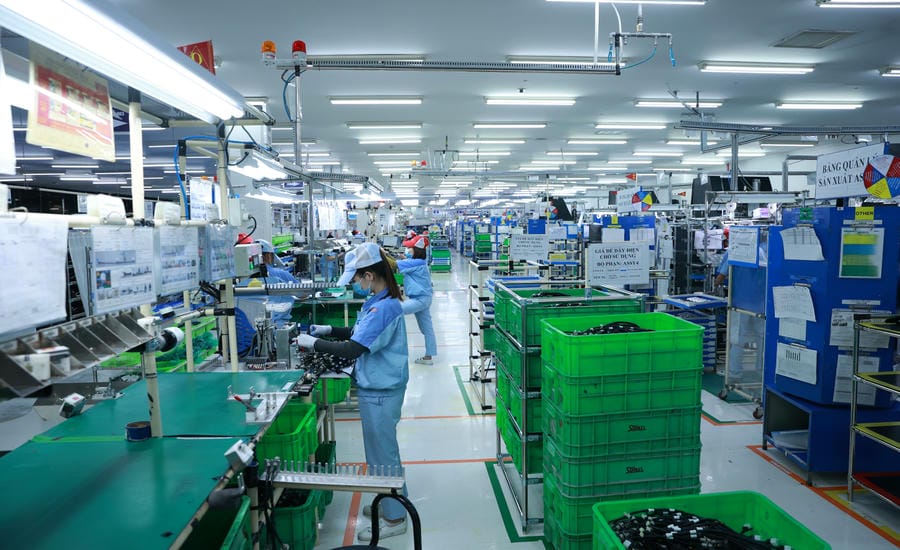
There is a special aspect that needs to be emphasized when discussing development space: Workers must be the beneficiaries of this change. A new industrial park cannot only be assessed by occupancy or FDI capital attracted. It is necessary to look at the number of jobs created, wages, housing conditions, transportation, schools, healthcare and workers' access to services. In the new space, job planning, housing, transportation and human resource training must go hand in hand with production planning.


