
On January 15, the University of Transport organized a seminar with the theme "Realities and challenges in building common railway and road bridges".
Here, Associate Professor, Dr. Pham Minh Ha, Deputy Minister of Construction, provided many new information related to infrastructure development orientation, including contents related to the North-South high-speed railway.
According to Deputy Minister Pham Minh Ha, the Ministry of Construction is currently directing the My Thuan Project Management Board to study a plan to build Can Tho 2 bridge with a scale equivalent to the existing Can Tho bridge. According to the Deputy Minister of Construction, if only road bridges are built, the project will be more favorable because the system of regulations and standards is complete. However, the Ministry is considering a bolder option, which is to build a bridge combining road and railway together.
The My Thuan Project Management Board has prepared a pre-feasibility report to seek opinions from relevant ministries and sectors. According to initial assessments, the joint plan faces many difficulties due to differences in standards and regulations for roads and railways. However, if successfully implemented, this plan can save about 4,500 billion VND compared to building two separate bridges.
Through review, the Ministry of Construction focuses on researching the bridge construction plan in the period 2026-2030, considering this as one of the key projects of the next phase. It is expected that construction can begin at the end of 2026 or the beginning of 2027.
Technically, the Ministry is studying a plan to build a two-story bridge instead of arranging roads and railways on the same plane. Accordingly, road bridges will be built first, railway bridges will be built later. Calculations show that even if railway bridges are only deployed by 2035, the two-story plan is still more effective than building two independent bridges.
Deputy Minister Pham Minh Ha said that Vietnam needs to carefully study international experience, especially from China and Japan. From surveying, designing to construction, everything must be concretized. The question is whether Vietnam will design itself or hire foreigners to design, self-build or hire foreign contractors.
According to leaders of the Ministry of Construction, choosing a separate option will be safer and easier to implement. However, if the combination option is accepted, despite being risky and facing many challenges, Vietnam has the opportunity to master technology, not only for Can Tho 2 bridge but also for application to high-speed railway projects in the future. To do this, the Ministry of Construction will urgently research and supplement the necessary technical standards and criteria.
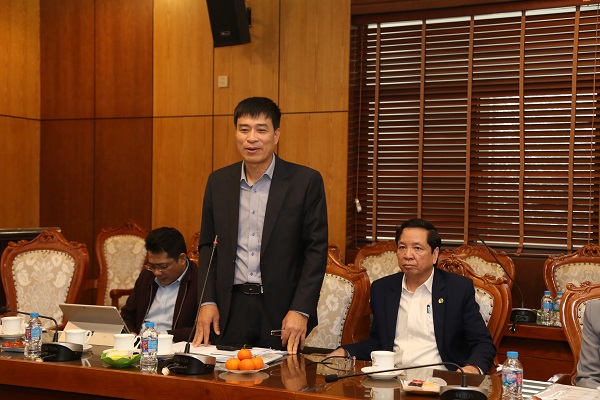
Exchanging at the seminar, Associate Professor, Dr. Nguyen Van Hung, Rector of the University of Transport, said that the school has received a task from the Ministry of Construction to study contents related to the high-speed railway project, including technical solutions for road and railway bridges. The seminar also wished to share useful information from scientists in this solution.
Discussing in depth about technical solutions, Associate Professor, Dr. Tran Viet Hung, Department of City Traffic Works and Water Works, said that currently, land funds for traffic corridors are increasingly scarce, making the need to build road and railway bridges and railway works become inevitable in many areas.
According to studies, there are currently two main trends. The first option is that roads and railways go together on a flat surface, railways in the middle, and roads on both sides. This option has the advantage of low architectural height but the disadvantage is that the bridge width is very large, increasing structural costs.
The second option is a two-story bridge, usually using girders, with roads on the upper floor and railways on the lower floor. This option saves width and increases the rigidity of the bridge, but is more resistant to large horizontal wind loads and higher maintenance costs.
Associate Professor, Dr. Nguyen Huu Hung and his department believe that combined bridges bring clear economic benefits, especially in the context of limited capital and high urbanization. Sharing foundations and pillars helps reduce initial investment costs, while saving land funds and reducing site clearance pressure.
However, experts also point out many challenges, from structural design that meets the strict load requirements of railways to complex operation and maintenance in the long term. Maintaining an item can simultaneously affect both roads and railways, causing major disruptions to traffic.
In fact, in Vietnam, Thang Long bridge is a typical example of a two-story bridge combining roads and railways. International experience shows that Japan and China have built many large-scale combined bridge projects, mastering complex technology and techniques.
These experiences are being carefully considered by the Ministry of Construction and research units, as a basis for further decisions in the process of implementing large bridge and North-South high-speed railway projects.


