
The People's Committee of Ho Chi Minh City has just directed the implementation of Resolution 05/NQ-HĐND of the People's Council of Ho Chi Minh City on agreeing to assign the People's Committee of Dong Nai province as the competent authority to implement the project to invest in building and extending Metro Line No. 1.
According to the direction, the Ho Chi Minh City Department of Finance will closely coordinate with departments and branches of Dong Nai to implement the project in accordance with the order and procedures according to the provisions of the 2025 Railway Law, the 2024 Public Investment Law, and Resolution No. 188/2025/QH15 of the National Assembly. At the same time, this agency is responsible for advising on capital allocation, assessing the feasibility of the financial plan and the coordination mechanism between the two localities, ensuring harmony of interests and investment efficiency.
One of the key tasks is to separate compensation, support, and resettlement work in Ho Chi Minh City into an independent project, thereby shortening the preparation time and accelerating the overall progress. Issues beyond authority will be summarized and reported to competent authorities for consideration and decision.
The Ho Chi Minh City Department of Construction is assigned to coordinate with Dong Nai to agree on the route direction, technology, technical standards and design plans at connection points, ensuring synchronization of the entire route.
At the same time, the Ho Chi Minh City Department of Construction continues to review and develop a plan to deploy the Binh Duong - Suoi Tien New City urban railway line, aiming for exploitation by 2030, synchronously with the extended line of Metro No. 1.
The Department of Planning and Architecture urgently completes relevant planning projects, ensuring a full legal basis for project implementation.
The Department of Agriculture and Environment is responsible for carrying out environmental procedures, compensation, resettlement and relocation of technical infrastructure, avoiding affecting progress.
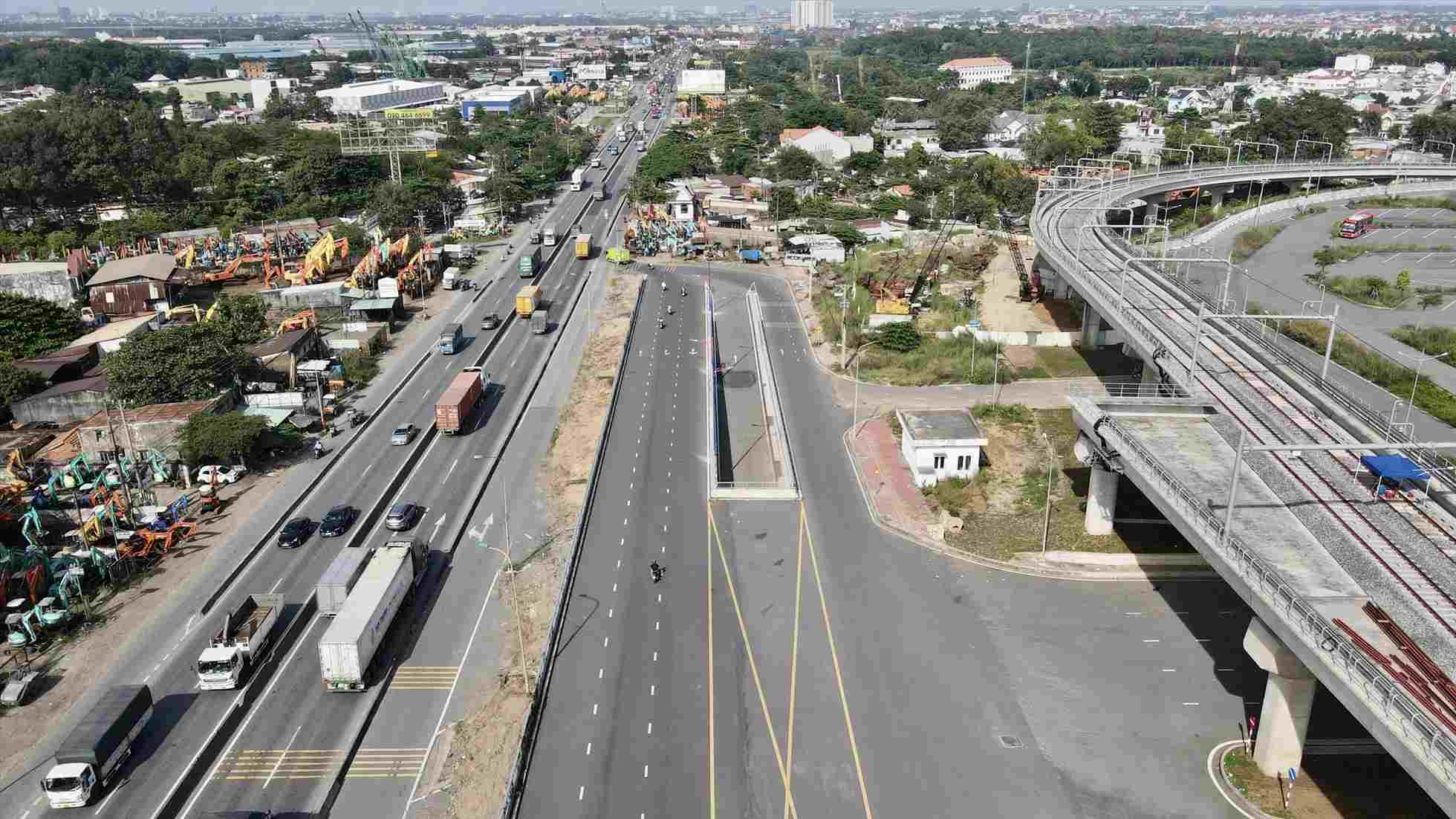
Previously, Prime Minister Pham Minh Chinh approved the policy of extending Metro Line No. 1 under an emergency order to shorten investment procedures.
According to the proposed plan, the Metro extension project No. 1 starts from station S0 (Tan Van), crosses the Dong Nai River, runs along National Highway 1 and connects to the new administrative center station of Dong Nai province. From here, the line continues along the Bien Hoa - Long Thanh railway corridor, along provincial road 771, crosses the Ho Chi Minh City - Long Thanh - Dau Giay expressway before entering the Long Thanh airport area.
The total length of the entire route is about 41.4 km, divided into 3 main sections: the section from station S0 to the administrative center is about 6.1 km long; the section from the administrative center to the connecting area of the Thu Thiem - Long Thanh route is about 28.2 km long; the section to Long Thanh airport is about 7.1 km long.
The project has a preliminary total investment of more than 60,000 billion VND, of which most are expected to be implemented in the form of PPP (BT contract).
Compensation, support and resettlement costs are estimated at about 4,300 billion VND, including about 3,408 billion VND implemented in Dong Nai province and about 915 billion VND in Ho Chi Minh City.
The extended Metro Line No. 1 is designed with a maximum speed of 120 km/h, and the underground section reaches 90 km/h, expected to be completed in 2029.
Metro Line 1 was approved in 2007, started construction in 2012, nearly 20 km long, connecting the center of Ho Chi Minh City with the eastern gateway.
The metro line has 11 elevated stations and 3 underground stations, with a total investment of more than 43,700 billion VND, mainly using ODA capital from Japan.
Metro Line No. 1 officially opened from December 22, 2024, and has served more than 26 million passengers with more than 100,000 train trips to date.


