
According to Mr. Viet Anh - specializing in the automotive field at TIPCAR, many people believe that blaming oil will help the car engine lubricate better. However, this is a wrong concept and can cause the engine to be damaged over time.
At the standard oil level, only the oil pump and oil filter net are in the lubricating oil to absorb and distribute the oil to the lubricating parts. The crankshaft almost does not come into direct contact with the oil in the case.
Meanwhile, Mr. Nguyen Van Ha - Head of the Hz car service center in Hanoi, said that when the oil is poured beyond the permissible level, especially about 1 cm higher than the standard line, part of the crankshaft will rotate in the oil.
At speeds of thousands of rounds per minute, the crankshaft will stir the oil to create foam. Foamy oil reduces lubrication and heat dissipation efficiency, while increasing pressure in the cuttings.
Increased pressure can cause oil leaks from the front and rear of the engine. Even if the engine does not break down immediately as if there is a lack of oil, this situation will cause the internal parts to gradually degrade over time.
According to experience, if the oil level only exceeds about 5 mm or less, it is usually not worrying. However, when exceeding about 1 cm or more, the risk of affecting the engine will increase significantly.
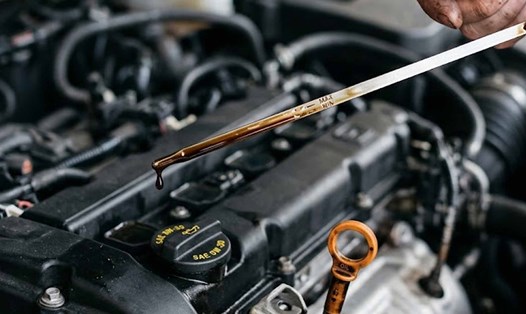
There are many reasons why the car spills excess oil after maintenance. One of the common errors is that the technician checks the oil level too early, when the oil has not yet settled but has pulled out the oil meter, leading to thinking the car is still missing and continuing to add more.
In addition, some technicians are worried about oil shortages, so they proactively pour excess oil to "be sure". There are also cases of pouring the correct capacity recorded in the repair documents. However, this document applies to completely newly assembled engines. For vehicles currently in use, a quantity of oil still sticks to the engine after discharge, so if you pour the correct recommended capacity, it is very easy to be left over.
To check accurately, users should measure the oil level before starting the car, preferably after the car is left overnight. When checking, it is necessary to pull out the oil test strip, wipe it clean, plug it in again and pull it out again to read the oil level. Because the test strip has a curve, the two sides can give different oil streaks, users should take a lower level to evaluate.
If you detect oil exceeding the maximum line, the car owner should take the car to the service workshop to discharge excess oil. This is a simple operation but helps limit the risk of engine damage in the long term.


