
Second stroke when arbitrarily not taking anticoagulants
Mr. N.H. A (64 years old, Tan Ngai commune, Vinh Long province) was hospitalized at Can Tho S.I. S International General Hospital in a state of stroke due to cerebral blood vessel blockage. After being examined and evaluated, doctors treated with drugs combined with cerebral blood vessel recirculation intervention.
After intervention, the patient's condition improved significantly, almost completely recovered, and he could walk, live, and work again as before the illness. Feeling his body was healthy, he did not re-examine as scheduled. Notably, he still maintained his habit of smoking a lot.
About 6 months later, he suddenly showed signs of crooked mouth, difficulty speaking and weakness in one side of his body. Realizing that this could be a sign of stroke, the family quickly took the patient to S.I.S Can Tho International General Hospital for emergency treatment.
According to the hospital, through examination and implementation of modern diagnostic imaging methods, doctors determined that the patient continued to suffer from stroke due to stent blockage.
BS.CKI Tran Tien Thanh - Deputy Head of Stroke Neurology Department - said that the blood vessel position where the stent was placed before was blocked. This is a much more complicated situation than the first intervention, because bringing the instrument and reopening a position that already has a stent requires high technique and experience. More worryingly, the brain blood vessel also has a large aneurysm.
Therefore, the team must simultaneously solve two problems: one side needs to be reopened to save the brain area that is deficient in blood, while the other side has a large aneurysm that is likely to cause a ruptured event causing bleeding if not treated appropriately.
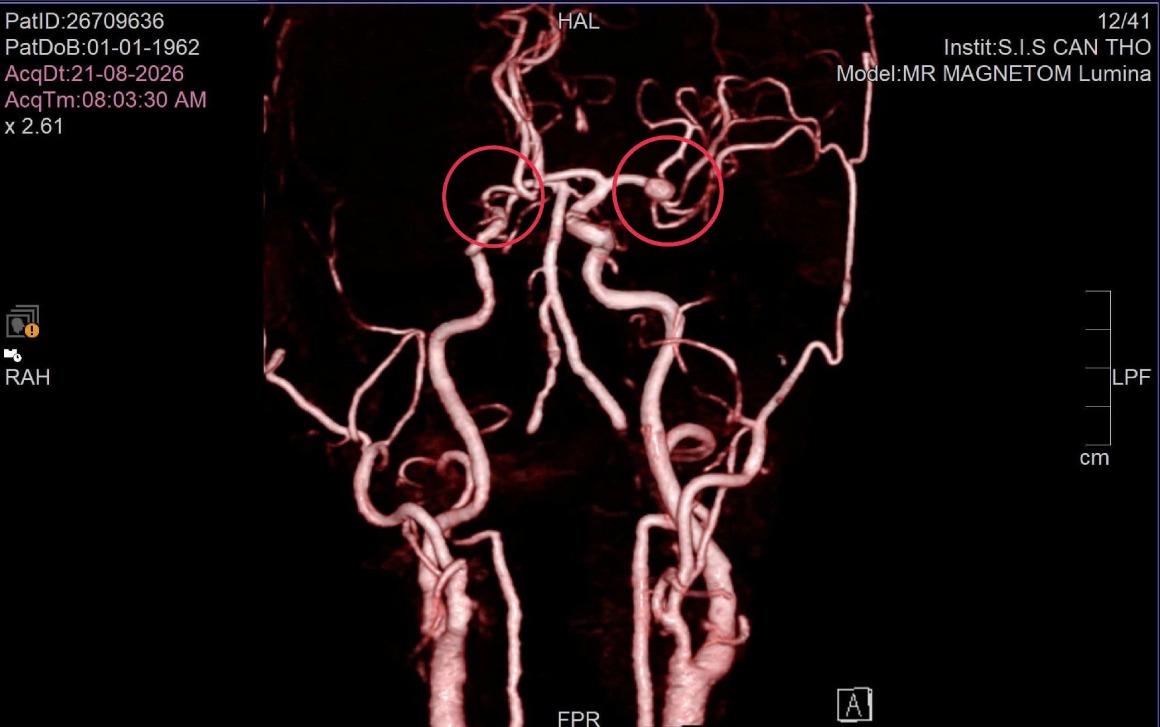
As the person who directly intervened and handled the two problems, MSc. Dr. Nguyen Dao Nhat Huy - DSA Unit - said that the team had performed revascularization of the rewound blood vessel in the stent; at the same time, intervened to handle the large aneurysm on the opposite side.
This is one of the difficult points of the case, because blood vessel recirculation at the location where the stent was previously placed is significantly more complicated than the first intervention. In addition, the large aneurysm on the opposite side also requires careful calculation of the treatment process to limit the risk of incidents," MSc. Dr. Nguyen Dao Nhat Huy informed.
After intervention, the patient continued to be resuscitated and received intensive internal medicine treatment. After about a week, his health improved significantly, walking and communicating were almost normal, and daily life was better. The patient is now stable and discharged from the hospital.
Recovery from a stroke does not mean the risk is over
From the above case, BS.CKI Tran Tien Thanh warned that one of the common mistakes in patients after stroke is seeing their body recover well and then thinking that the disease has completely recovered. In fact, people who have had a stroke are still at risk of recurrence, especially when risk factors are not controlled or patients do not adhere to treatment.
For cases that have had cerebral vascular intervention and stent placement, re-examination is even more important.
Depending on the case, patients may be indicated for examination using appropriate diagnostic imaging methods such as MRI or CT scan of cerebral blood vessels.
Adherence to medication is also a mandatory factor. Patients need to take medication at the correct dose, on time and absolutely do not arbitrarily stop taking medication or change medication without a doctor's prescription," Dr. Tien Thanh emphasized.
In particular, smoking is one of the habits that needs to be eliminated in people with vascular diseases. In addition, patients need to limit alcohol, maintain appropriate exercise, control underlying diseases and have a healthy lifestyle.


