Notably, the initial symptoms of children are very difficult to recognize, easily confused with common diseases.
According to the family's sharing, before being admitted to the hospital, the child showed symptoms of painful urination. When taking the child to a local medical facility for examination, ultrasound and tests at the local hospital showed that the child had cystitis and was prescribed home treatment.
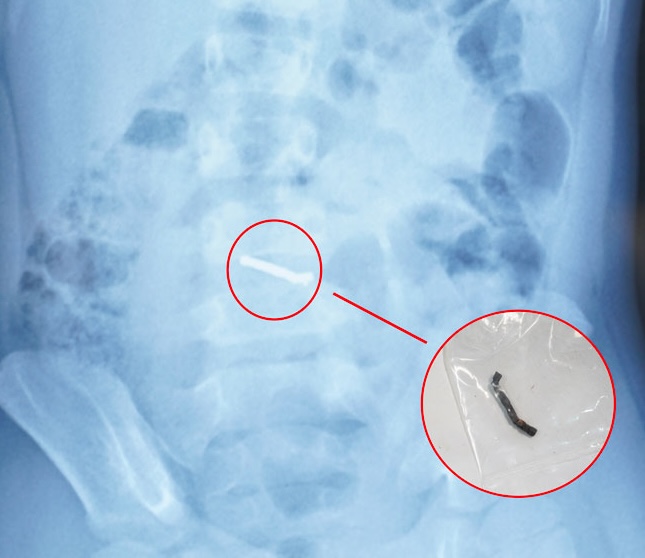
During the time of using the medicine at home, the symptoms did not improve, the child was re-examined and X-rays revealed a foreign object in the abdominal cavity. After that, the child was transferred to the National Children's Hospital for continued monitoring and treatment.
According to the patient's mother, the family had no idea when the child swallowed the foreign object. "I thought the shaped magnets of the toy were quite large, so the child probably couldn't swallow them. I didn't expect the child to be able to separate them and put them in his mouth. At home, the child did not show any unusual signs other than painful urination, so the family did not notice it," the patient's mother said.
At the National Children's Hospital, after performing tests and paraclinical imaging diagnosis and monitoring the developments, doctors found that the foreign object in the digestive tract did not move over time. Usually, the foreign object in the digestive tract will be gradually pushed out by intestinal motility.
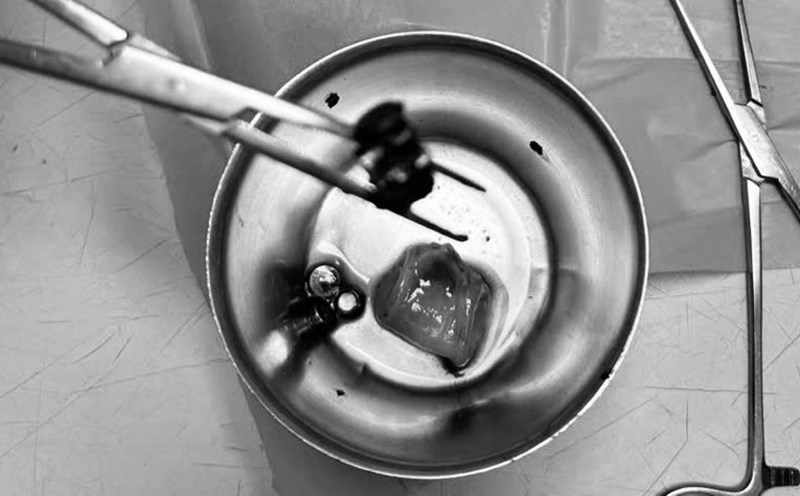
However, in this case, the foreign object did not move. From information provided by the family about the type of toy with small magnets that can be drawn together, doctors diagnosed that the child swallowed many magnets at many times. After determining that the foreign object was magnetic and could not be self-exposed, doctors performed surgery on the child.
During the surgery, doctors discovered many small magnets sticking together in a chain, causing intestinal perforation. Surgeons proceeded to remove the foreign object, stitch the puncture and place drainage. After 4 days, the patient returned to normal life, began to practice eating again and is expected to be discharged from the hospital in the next few days.
MSc.BS Vu Thanh Tu - General Surgery Center, National Children's Hospital said: Swallowing foreign objects is a common accident in young children. Every year, the National Children's Hospital receives many cases of children hospitalized due to swallowing foreign objects such as buttons, coins, toothpicks or small details of toys. Especially magnetic details, which can cause the risk of digestive tract damage.
Magnets are strong magnetic materials. When children swallow two or more tablets at different times, they may lie in different segments of the intestine but still stick together through the intestinal wall. This suction force creates prolonged pressure on the intestinal wall, causing local ischemia, leading to necrosis and intestinal perforation. If not detected in time, it can lead to peritonitis, intestinal obstruction, septic shock and life-threatening.
Doctors recommend that young children are often hyperactive, especially children under 3 years old who have a habit of exploring the world around them with their hands and mouths. Therefore, parents need to be especially careful when choosing toys for young children, avoiding small, sharp objects that easily cause injury or small magnetic toys that children easily swallow.
At the same time, it is necessary to observe the child's living environment to limit the risk of swallowing foreign objects. In case of suspected child swallowing foreign objects or appearing abnormal signs such as abdominal pain, vomiting, digestive disorders,... or changing living habits, families need to take the child to a medical facility for examination and timely treatment.