
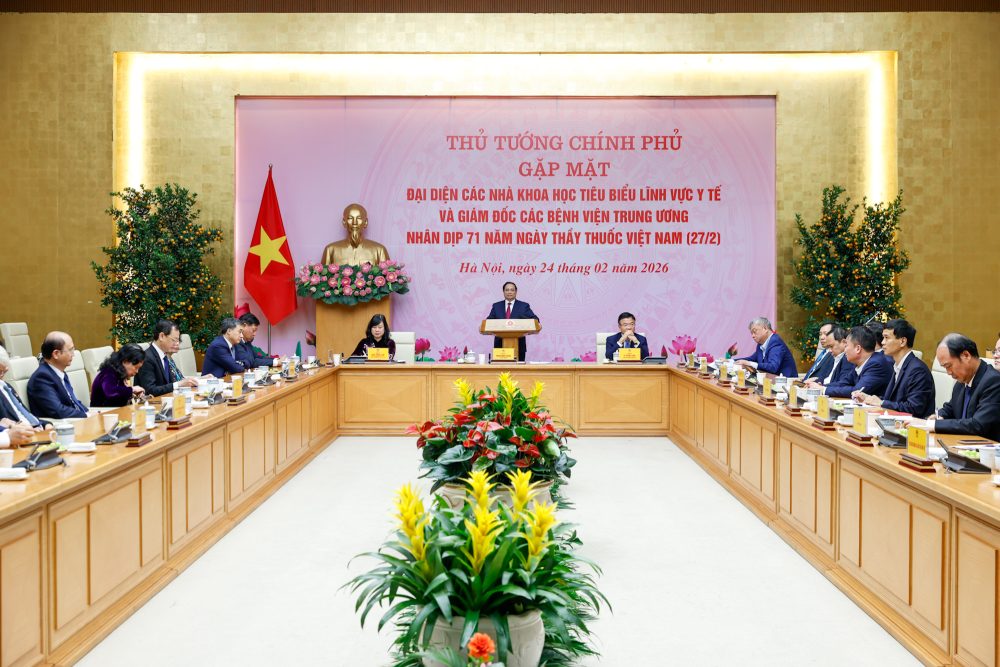
On February 24, at the Government Headquarters, Prime Minister Pham Minh Chinh met with representatives of typical scientists in the field of health and Directors of central hospitals to celebrate the 71st anniversary of Vietnamese Doctors' Day, February 27.
At the meeting, delegates proposed that the Government and the Prime Minister continue to pay attention to and improve institutions and mechanisms related to the development of the health sector such as: Improving institutions related to the field of organ transplantation; research and production of pharmaceuticals and vaccines; having policies to train and treat human resources in the health sector; investing in purchasing advanced and modern medical equipment to equip hospitals; investing in grassroots healthcare and disease prevention.
Speaking at the meeting, the Prime Minister emphasized that the medical profession is a noble profession, a symbol of sacrifice, compassion, wisdom, perseverance and, above all, faith in the most noble values of life - human health and happiness.
Doctors and medical staff are both doctors who heal diseases with "medical theory", "medical art"; and also "white-shirted angels" who light up and spread hope and belief in life with "medical ethics".
The Prime Minister requested the entire health sector to thoroughly grasp 6 key contents.
First, identifying the team of scientists and experts, medical staff as a decisive force to bring the Resolution of the 14th Party Congress and strategic decisions of the Politburo (Resolution No. 57-NQ/TW and 72-NQ/TW) into life.
Second, continue to improve institutions, policies and effectively implement legal regulations on health; focus on improving the capacity of the health system, especially preventive medicine, grassroots health, promoting the strengths of traditional medicine, developing the pharmaceutical industry and healthcare industry.
Arrange the health system to be streamlined and effective, ensuring linkages between professional levels. Complete the functions, tasks, and organizational structure of commune-level health stations.
Third, focus on mobilizing all social resources to participate in people's health care according to the "3 yes" spirit: There is contribution from the State, there is contribution from the people, there is contribution from businesses; "5 no" motto: No saying no, no saying difficult, no saying yes but not doing; not causing trouble for patients; not giving up the opportunity to save people, save patients, even the smallest.
Create all conditions for the private healthcare system to become an important driving force in the work of protecting and caring for people's health.
Fourth, focus on investing in healthcare infrastructure and focusing on modernizing facilities and equipment to serve medical examination and treatment for people. SOON complete the deployment of electronic medical records nationwide; develop a platform for big data analysis and artificial intelligence in disease diagnosis and forecasting.
Fifth, build a team of medical intellectuals of regional and international stature; continue to improve institutions, policies, and specific mechanisms in training medical human resources, especially high-quality medical human resources. Promote the completion of mechanisms and policies so that scientists can feel secure in researching and creating; create an open and transparent academic environment; encourage international cooperation and technology transfer.
Sixth, ministries and sectors, especially the Ministry of Health and the health sector, need to continue to listen, always accompany and create the best conditions for intellectuals to develop their abilities.


