
Hanoi apartment prices surpass Ho Chi Minh City
Research data from the Vietnam Real Estate Market Evaluation Research Institute (VARS IRE) shows that the Vietnamese real estate market is undergoing a "healthy purification" process, with a clear shift in both investor behavior and the logic of the entire market.
If previously, the common psychology was to be afraid of missing opportunities and to spend money according to short-term price increase expectations, now buyers have been more cautious, choosing more carefully, besides legal issues and investor capacity, the ability to exploit reality, liquidity as well as the space for sustainable growth of real estate is increasingly focused on.
From the end of Q3/2025, the increased interest rate level makes investor sentiment more cautious, but the primary price level continues to be maintained at a high level, due to the increasing input costs of the project. The new land price list taking effect from the beginning of 2026 in a direction closer to market prices contributes to improving fairness and transparency, but at the same time also significantly increases project development costs, when land prices account for up to 30% of house prices. Along with that is pressure from construction material prices, financial costs, labor costs and related implementation costs.
In Hanoi, the average selling price of newly opened apartment projects reached about 128 million VND/m2, an increase of 28% compared to 2025; if Hung Yen is included, the average price reached about 87 million VND/m2.
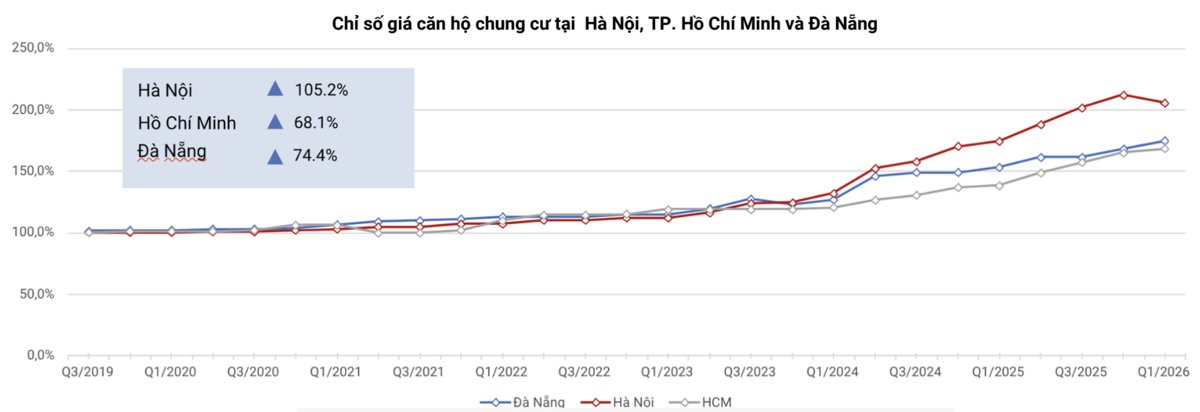
In Ho Chi Minh City, the average selling price reached about 110 million VND/m2, slightly higher than the average of 2025. Meanwhile, in Da Nang, the average selling price reached about 91 million VND/m2, an increase of about 10%, mainly due to the appearance of luxury supply and price adjustments in subsequent sales phases.
Regarding liquidity, the market has not recorded signs of "reverse" in the first quarter of 2026, the absorption rate on new supply across the whole market has decreased, but is still at a good level - about 58%, with transaction volume 2.6 times higher than the same period in 2025.
Forecast of Hanoi apartment prices in 2026
Talking to Lao Dong Newspaper, Ms. Do Thu Hang - Senior Director of Research and Consulting Department of Savills Hanoi - said that prices on the secondary apartment market tend to increase faster than the primary market. In the first quarter of 2026, secondary prices still increased compared to the same period last year, but if considered in the 5-year period, the primary market still had better growth.
The reason for this trend is that secondary prices are still lower than primary prices, and at the same time reflect the need to find completed products that can be moved in immediately. This is a trend suitable for the actual needs of buyers.
Regarding the trend in the coming time, Ms. Hang said that apartment prices are unlikely to decrease deeply due to the impact of many input factors such as land costs, compensation costs and construction material prices all tend to increase. In addition, the supply structure is still mainly Grade A and B apartments, while Grade C apartments continue to be scarce.
Therefore, it is predicted that Grade A and B apartment prices will continue to remain high. In which, Grade A apartments tend to remain stable and may increase, while Grade B apartments are likely to adjust to a more reasonable level. The reason is that supply is shifting, as small projects outside the metropolitan area increase, while supply from the metropolitan areas decreases compared to before.
Regarding investment prospects, Ms. Hang believes that the Hanoi apartment market will still attract large demand in 2026, despite facing some challenges. This stems from rapid urbanization, strong infrastructure development and increasing housing demand, not only from Hanoi residents but also from other localities that tend to move to the Capital. Thanks to that, the apartment market is forecast to still maintain its growth momentum, although there may be sideways phases or short-term adjustments.


