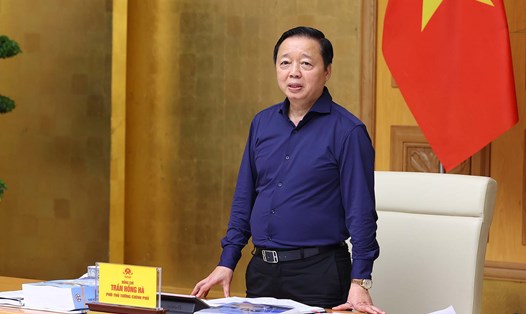
100-year vision master plan
The plan identifies new and outstanding orientations, with 11 groups of breakthrough solutions. The plan also specifically identifies 9 development poles, 9 major centers, combined with 9 driving axes, with belts, corridors, promoting regional and national linkages, connecting borders, seaports and international; cultural, historical, landscape heritage spaces along the Da River, Red River, Duong River; green belts of natural, cultural, historical, spiritual, and tourism heritage in the West connecting a chain of scenic spots and historical relics.
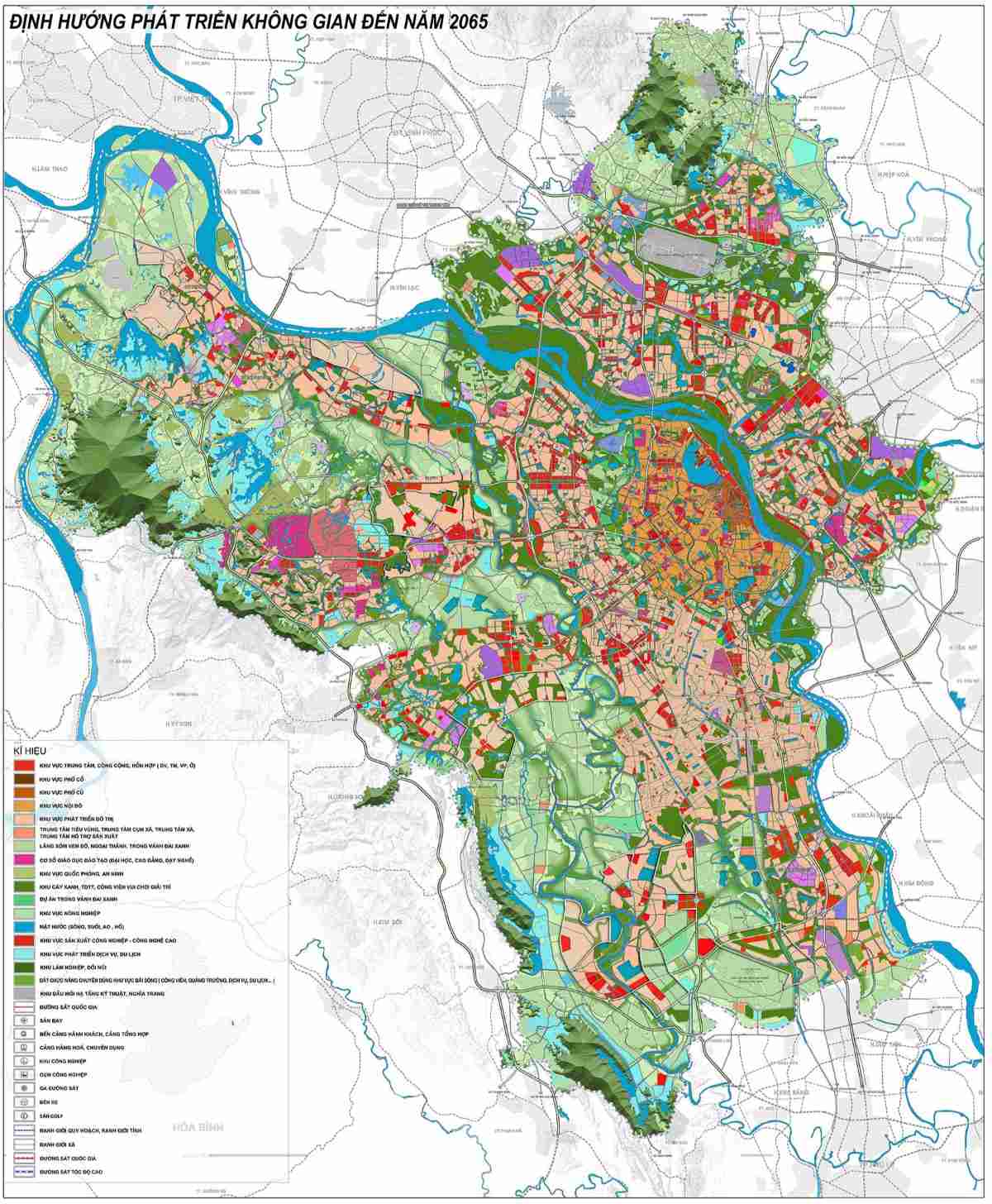
According to the content of the project, Hanoi is positioned to develop according to the "radial urban cluster" model. The Capital plays the role of a core urban area, a political, economic, scientific and technological center and international connection; surrounded by a network of satellite cities sharing development functions and reducing pressure on the inner city area.
Regarding transport infrastructure, Hanoi plays the role of the most important connecting hub of the region with the country and internationally. Hanoi develops urban railways and inter-regional railways according to the TOD model (urban development based on public transport orientation), connecting with satellite cities, reducing urban population pressure. High-speed railways and the review and expansion of the scale of Noi Bai airport, along with the research of the second airport of the Capital Region, will strengthen the role of transshipment of goods and passengers.
The city wants to restructure focusing on the historical inner city area with priority on preserving unique value spaces such as the political and administrative center of Ba Dinh; Hoan Kiem Lake and its vicinity; Old Quarter; Old Quarter; West Lake and its vicinity; Red River axis....
In addition to the Red River landscape axis, Hanoi plans to develop 3 other landscape axes, including West Lake - Co Loa; Nhat Tan - Noi Bai and West Lake - Ba Vi. The West Lake - Co Loa landscape axis will be associated with the National Exhibition Center; tourism, culture, and history center associated with Co Loa Relic; medical center, MICE, health care near Yen Vien station and mixed commercial - service center.
The northern landscape axis (Nhat Tan - Noi Bai) will focus on the 108-story financial tower; smart city; Kim Quy park, science and technology park, commercial - service center; cultural - service - international tourism center.
The western landscape axis (Tay Lake - Ba Vi) is oriented to arrange cultural, artistic, entertainment works, national and international research and cultural exchange centers. This axis will connect the core historical area (Tay Lake) with the new development area to the West, specifically Hoai Duc (C2 sub-zone) and extend to the Ba Vi ecological landscape area, Son Tay.
Need to use digital technology
According to architect Tran Huy Anh - Member of the Standing Committee of the Hanoi Association of Architects, many previous Hanoi plans lacked feasibility due to not being synchronously integrated between infrastructure, economy, environment and investment resources. This makes many ideas only stop on paper.
Therefore, new planning needs to change the approach, it is necessary to use digital technology and big data to coordinate multi-sectoral relationships, solving many goals at the same time.
An important example is the "city-wide current status map". According to him, the map needs to supplement layers of data reflecting the actual development of the city such as population migration flows, current status and traffic needs, environmental status, infrastructure capacity, instead of just simply showing the terrain in a simplified way or zoning and coloring and then subjectively naming functional areas as announced.
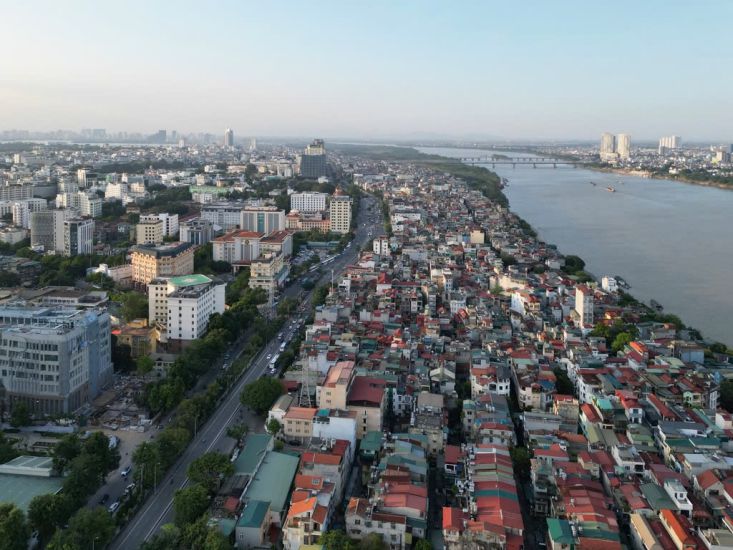
Architect Tran Huy Anh also emphasized that the Hanoi urban reconstruction process is not limited to the Old Quarter, old apartment buildings or historical heritage sites, but must also take place right in newly developed areas, along major roads, urban railway lines and even urban areas that have been abandoned for many years. This is a long process, which can last for decades, even centuries.
Urban reconstruction cannot just stop at a few 2D, 3D drawings, but is a whole process of evolution of financial models, legal frameworks, management apparatus and the participation of the whole society," architect Tran Huy Anh emphasized.
The Standing Committee Member of the Hanoi Association of Architects believes that Hanoi cannot enter a new era with old tools and methods. Planning needs to be built on a basis of data and digital technology, instead of just relying on simple drawings as it is now.
100-year vision planning is not just a set of drawings, but must be a continuous urban development management system, capable of adapting to economic, social and environmental changes.
If the current bottlenecks are correctly identified and a new approach is applied, Hanoi can turn today's challenges into the driving force for a sustainable urban development in the next century. If the causes of the current bottlenecks are misidentified or not fully identified, the solutions proposed in the published documents will not only not solve the bottleneck but also make it more serious" - Architect Tran Huy Anh contributed his opinion.
According to Dr. Architect Pham Anh Tuan, Chairman of the Vietnam Association of Landscape Architects, Head of the Landscape Architecture Professional Group, Faculty of Architecture and Planning (Hanoi University of Civil Engineering), the current status analysis in the project has raised many existing problems, especially the assessment of "bottlenecks". However, the explanatory notes do not have sufficient analysis of the causes to serve as a basis for proposals to orient solutions to overcome in the process of preparing and implementing new planning for a 100-year vision.
Mr. Tuan also said that the planning project being presented in a filling style is not really appropriate. The project needs to propose space organization solutions based on a sustainable ecological approach, a natural-based planning method.
At the working session of the Standing Committee of the Government with Hanoi City leaders recently, Prime Minister Pham Minh Chinh assessed that the overall plan of the Capital is very important for the development of the Capital, the region and the whole country; showing Vietnamese intelligence, Vietnamese culture, Vietnamese identity, Vietnamese people, Vietnamese society, and Vietnam's development in the new era.
The Prime Minister believes that the philosophy of the Planning is to take people as the center and subject; rich and strong, civilized, prosperous, unique, modern urban areas with a 100-year vision, developing multi-polar, multi-layer, multi-layer, multi-center, multi-directional, multi-dimensional, digital, bright, green, clean, beautiful, and civilized; harmonizing people, culture, society, nature, "village in the city, city in the village", with preservation, inheritance and development. Breakthroughs are urban reconstruction, rural modernization, service and industrial smartening must be advanced.