
When Mikel Arteta and Arsenal's board of directors identified Viktor Gyokeres as a key contract for the summer of 2025, the Swedish striker was expected to "close" the number 9 position. However, when the season has passed halfway, the question is whether he is really worthy of starting or not?
The former Sporting CP striker faced many difficulties in making his mark. Most of his goals in the tournament came against opponents predicted to struggle in the relegation battle such as Leeds United, Burnley and Nottingham Forest.
More worryingly, Gyokeres' overall performance is at a low level. In the match against Wolves, the Swedish striker only touched the ball 15 times when the team considered the weakest in the league still caused Arsenal no less hardship. A similar scenario repeated in the 4-1 victory over Aston Villa, when he only touched the ball 16 times.

When Gyokeres was injured in November, Arteta was forced to give the opportunity to backup Mikel Merino. The Spanish player brought a different structure. It is a mixture of midfielder and striker qualities, helping Arsenal have more than a pure number 9.
Even when Gyokeres has returned, the current numbers are still enough to strengthen the view that Merino is a bright candidate for the center forward role. Merino's progress in this position, especially in matches with high difficulty, helps Arsenal's attack become more flexible, more unpredictable and richer in deployment options. In that context, Merino can completely be the optimal choice for Arteta at the present time.
What needs to be emphasized is that, according to statistics, Arsenal's attack does not show a clear improvement when the Spanish international plays center forward. This detail suggests that although Merino performs his role very effectively, his presence does not necessarily increase Arsenal's attacking quality significantly.
In fact, The Gunners have a higher number of ball touches in the opponent's penalty area when Gyokeres is present on the field. Besides, stats like xG or the number of goals scored are also not much different between the two scenarios using Gyokeres and Merino.
However, that does not mean Merino is not surprising when shining in the number 9 position. Conversely, the problem lies in Merino being good enough to take on the role of key striker without having to "raise the ceiling" of attacking power.
Considering the overall contribution, Merino's striker role brings Arsenal a flexible and versatile option. He makes many forward attacking passes, participates in effective defensive intervention, and can also lower the squad to promote his qualities in midfield when retreating to his own half. In other words, Merino has the appearance of a comprehensive player.
Merino's defensive interventions are crucial. He often fills the gaps in midfield, proactively contests to regain the ball, thereby helping Arsenal maintain pressure on the opponent's half with quick ball recalls.
The situation leading to the 1-1 equalizer against Sunderland is a typical example. Merino was the initiator of the pressing phase, creating direct pressure on Sunderland, before Declan Rice took advantage of the opportunity to take the ball.
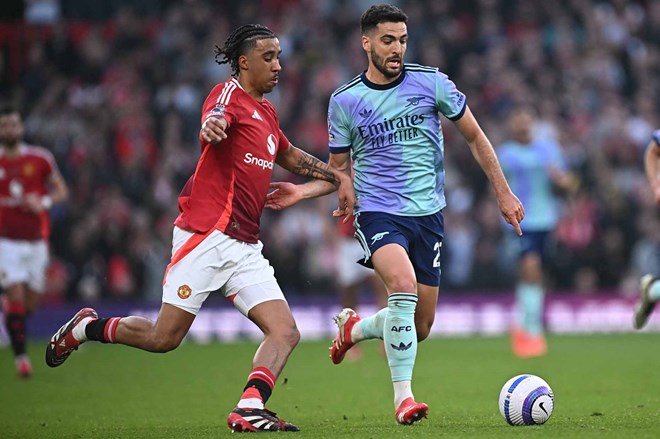
When Arsenal reaches an optimal operating state, the links coordinate smoothly, creating a unified structure for the machine to operate smoothly. This is also the reason Arteta is given squad depth to rotate many different players, bringing suitable skill sets at each point of the match.
In that context, Gyokeres is still a rookie who has to adapt to a harsh, competitive and constantly volatile tournament. Although initial signals show he is facing difficulties, the final answer still depends on time.
But while waiting, the reasonable question is why Arteta must adjust tactics thoroughly to suit Gyokeres, when a feasible option like Merino is present?


