
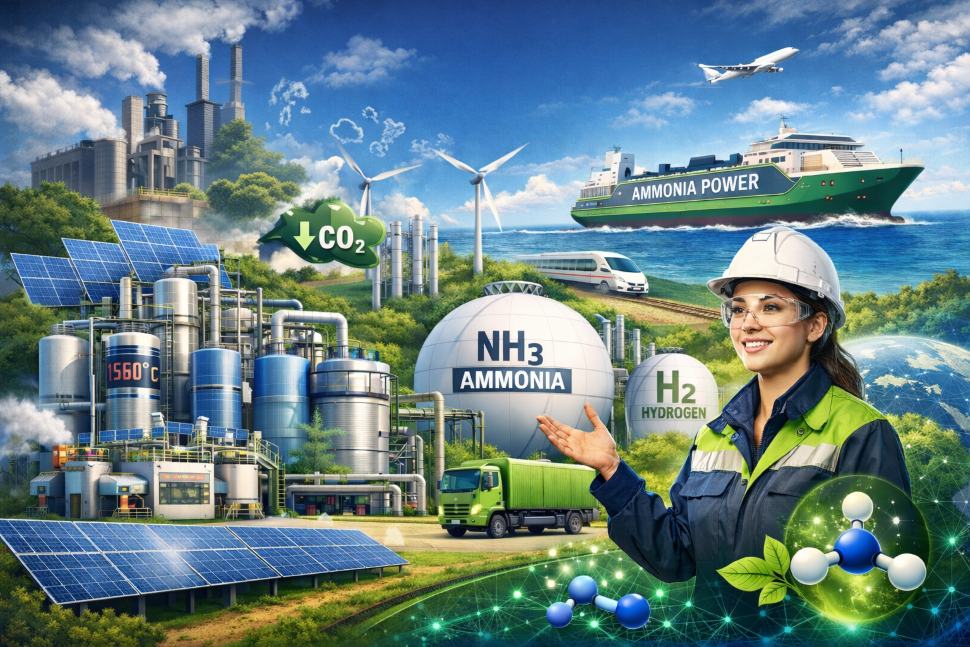
Ammonia is one of the most important chemicals for global food production, but it has received little attention. For more than a century, humans have produced ammonia mainly through the Haber-Bosch process, the foundation for the modern fertilizer industry. However, this process consumes a lot of energy and is a major source of emissions, accounting for nearly 2% of global greenhouse gases.
Recently, startup Ammobia said they have improved the Haber-Bosch process in the direction of operating in lighter conditions, thereby helping to reduce production costs by up to 40%.
To prove the feasibility of technology, Ammobia has just successfully raised 7.5 million USD in the seed capital raising round, with the participation of many large investors such as: ALIAD of Air Liquide, Chevron Technology Ventures, Chiyoda Corporation, MOL Switch and Shell Ventures.
According to Ms. Karen Baert - co-founder and CEO of Ammobia, ammonia has a great advantage over hydrogen in carbon reduction efforts. This substance is easier to transport, store and has lower costs, while the infrastructure for hydrogen is still limited. Japan and South Korea have built ammonia-based industrial and transportation routes as a potential energy and raw material source.
The biggest problem in the ammonia industry today is pollution. The traditional Haber-Bosch process requires a temperature of about 500 degrees Celsius and a pressure of nearly 200 bars, usually maintained by burning fossil fuels. Hydrogen input is mainly produced from natural gas, continuing to increase emissions.
Ammobia said their technology operates at temperatures about 150 degrees Celsius lower and pressures up to 10 times lower than current standards. As a result, factories can significantly reduce emissions, while using cheaper equipment because they do not have to endure harsh operating conditions.
Although not completely eliminating fossil fuels, the new process is assessed as more flexible because it can be combined with many different heat and hydrogen sources. Notably, operating at low pressure helps the system easily increase or decrease capacity, creating conditions to utilize electricity from renewable energy to produce hydrogen and ammonia at a lower cost.
This technology also allows the construction of smaller-scale plants. While most ammonia plants currently produce from 1,000 to 3,000 tons per day, Ammobia's commercial model aims for a capacity of about 250 tons per day.
Ammobia has not announced technical details as it is awaiting a patent, but said they use a system of integrated absorbent reactions to separate ammonia as soon as it forms. This method helps release space on the catalyst, creating conditions for the reaction to continue to be more efficient. Some other research directions also involve new iron-free catalysts, aiming to reduce the energy needed for the reaction.
Currently, the company has operated a small-scale unit for about a year. New capital will be used to build a pilot plant with a capacity of about 10 tons per day, fully recreating the characteristics of the commercial model.
According to Ammobia's leader, the modular approach helps shorten project implementation time and is suitable for the needs of many customers looking for flexible, low-cost solutions for ammonia production in the energy transition phase.


