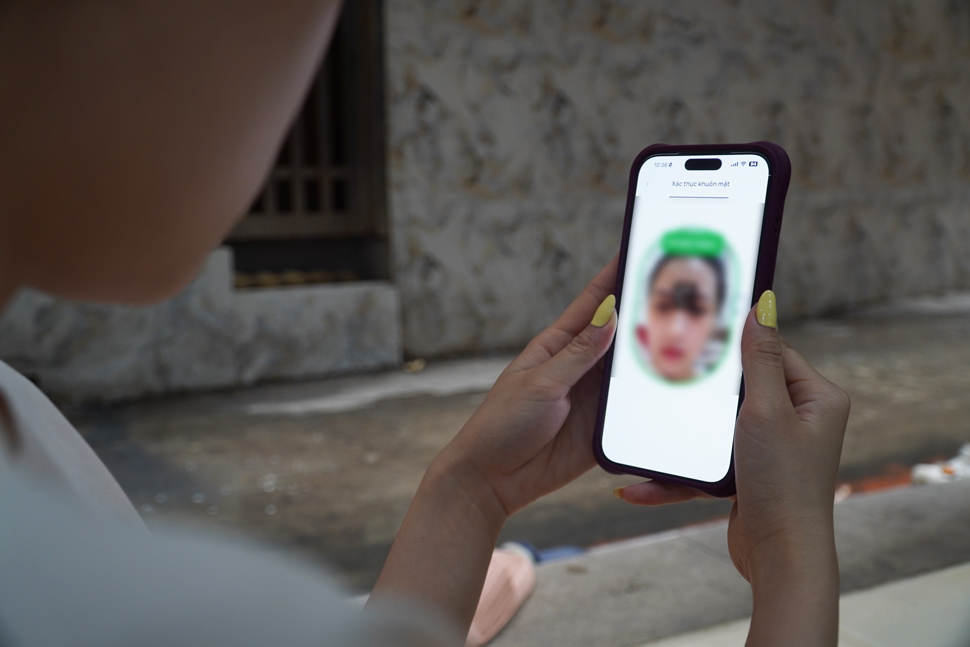
After the subscriber authentication regulation took effect from April 15, many users in specific situations began to wonder if the use of the service would be affected.
Mr. Ta Quang Sam, from Bac Ninh, working in Taiwan (China) said that he still maintains a number of Vietnamese phones to serve important transactions such as banking and online services. Because he does not use them regularly abroad, he keeps SIM cards in Vietnam for relatives to keep.
When I heard information about subscriber authentication, I was quite worried because I did not directly hold the SIM card. If the system requires face authentication, I don't know how to handle it, while this phone number is still being used for many important accounts," Mr. Sam shared.
In addition, some users also expressed concern about how foreigners living and working in Vietnam will verify their subscriptions.
Mr. Nguyen Van Tuan (Hanoi) said that he has a friend who is a foreigner using a SIM card in Vietnam, but it is unclear whether the authentication process is different from domestic citizens or not.
I see that Vietnamese people can do it through VNeID, but I'm not sure how foreigners authenticate, whether they go to stores or can do it on the application," Mr. Tuan wondered.
Talking to Lao Dong about these questions, Lawyer Diep Nang Binh - Head of Tinh Thong Luat Law Office said that legally, the obligation to authenticate subscribers is "closely linked" to the mobile subscriber number and the subscriber owner, not linked to whether that person is in Vietnam or abroad.
Circular 08/2026 on verifying mobile subscriber information clearly states: all mobile subscriber numbers provided by Vietnamese telecommunications enterprises must be standardized and verified with sufficient identification information fields (legal personal paper information, full name, date of birth, facial biometric data...).
Verification can be carried out online (through network operator applications, electronic identification systems) or directly at transaction points, but the Circular does not set the condition that "the subscriber must be in the country" to be verified or handled. In other words, in terms of regulations, Circular 08/2026 only cares about the legal status of the subscriber (verified or not), but does not care about the current geographical coordinates of the subscriber.
In case users are abroad and leave the SIM card for relatives in Vietnam, it can still be locked in the following cases:
Your subscriber is in the area to be standardized, has been notified by the network operator but the subscriber does not carry out verification (even though it can be verified remotely via the application, send documents, make video calls or solutions guided by the network operator).
Or information stored on the network operator's system is identified as not matching or incomplete with the identification database as prescribed, and you do not coordinate to edit or standardize it.
At that time, telecommunications businesses do not need to know whether you are abroad or in the country, whose phone the SIM is plugged in; just follow the regulations, when the notification period expires without verification, they are still entitled to temporarily suspend the service and proceed to recall the number.
The fact that subscribers ask relatives to keep SIM cards and use them in Vietnam does not give rise to any legal "exceptions" for subscribers to escape the locking and recall mechanism according to Circular 08/2026 and Decree 163/2024/ND-CP.
For foreigners using SIM cards in Vietnam, the law still considers them domestic mobile subscribers and must fully perform the obligations of registration, standardization and verification of information.
According to regulations, foreigners use a passport or legal entry and exit documents to register for a subscription. Verification is carried out on these information, combined with full name, date of birth and facial biometric data.
According to the lawyer, foreigners can verify their subscription directly at the network operator's transaction point using a passport or legal papers, or online through the application if supported.
In case of not implementing or not fully implementing as required, subscribers are still subject to the normal handling roadmap, from temporary service suspension to number recovery as prescribed.