
According to the latest research from Kaspersky and the Singapore Institute of Technology (SIT), a significant number of parents tend to "sharenting" (a habit of sharing the process of raising children on social networks).
Surveys show that in the Asia-Pacific (APAC) and Egypt regions, parents who regularly post private stories on social networks are the ones who are less concerned about protecting personal information in cyberspace.
This survey result is based on 152 online survey responses collected from parents in Egypt, Hong Kong (China), India, Indonesia, Malaysia, Myanmar, Philippines, Singapore and Vietnam.
Convenience contradicts security level: endless vicious circle
The vast majority of parents (87%) agree that limiting the scope of posting on social networks, allowing only family and close friends, significantly reduces the risk of privacy leaks.
However, nearly half (49%) found this setup process time-consuming. Similarly, about 4 out of 5 respondents (80%) said that removing content sharing rights is an effective measure to protect privacy, but 40% said that this requires a lot of effort.
In addition, out of every 10 people, more than 8 (83%) believe that turning off metadata and geogging will help protect personal information, but more than one-third of respondents (36%) believe that performing this operation takes a lot of time.
Ms. Trishia Octaviano, Senior Manager of Asia-Pacific Network Security Education (APAC) at Kaspersky, explained: "Research shows that some parents say they feel quite annoyed when having to adjust privacy settings on social networks or turn off location tags on applications.
Although aware of the importance of digital security, subjectivity in establishing a layer of defense in cyberspace and inconveniences in the implementation process create significant psychological barriers for parents. Therefore, cybersecurity education programs need to prove that the implementation of safety measures in cyberspace is actually very easy to implement, thereby eliminating prejudice about this annoyance.
Solution
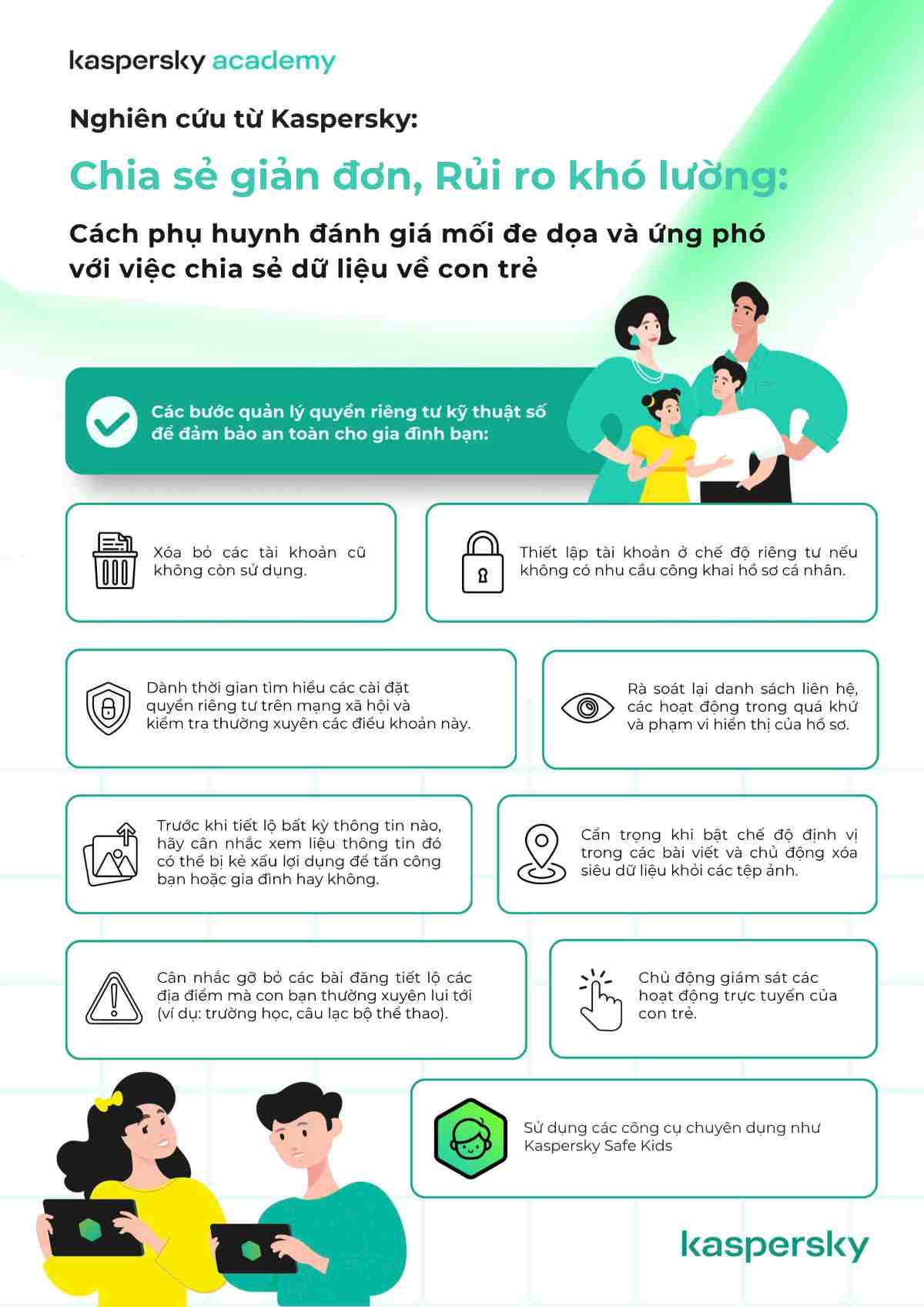
To support parents to proactively improve their self-defense ability and proactively protect and actively protect their children in cyberspace, experts recommend some necessary actions as follows:
- Delete old accounts that are no longer used.
- Set up an account in private mode if you do not need to publicize your personal profile.
- Take time to learn about privacy settings on social media and regularly check these terms because they can change constantly. Review contact lists, past activities, and profile scope.
- Before disclosing any information, consider whether that information could be used by bad guys to attack you or your family.
- Be careful when turning on positioning mode in articles and proactively delete metadata from photo files.
- Consider removing posts that reveal places your child frequents (e.g.: school, sports club).
- Proactively monitor online activities of children.
- Use specialized tools to make parental management easier, including tracking location, managing device usage habits, limiting inappropriate content, and balancing screen usage time.


