
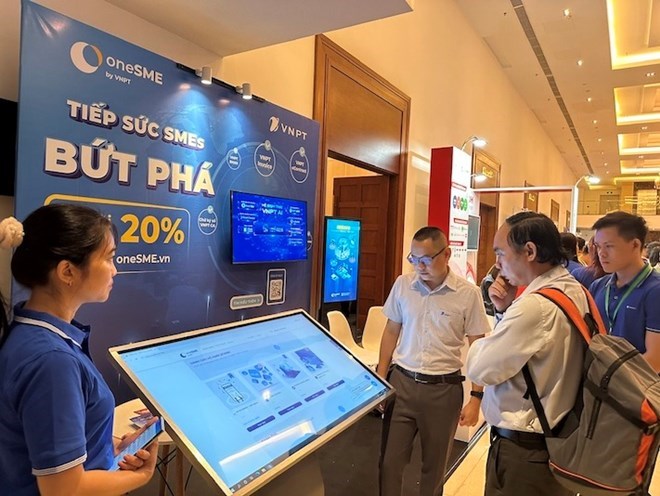
Talking to Lao Dong, Dr. Pham The Dung - Deputy Secretary General of the Vietnam Automation Association said that the current policy of supporting science and technology businesses has had a clear shift, from a single approach to an ecosystem approach. Businesses are placed in a central position, connected with research institutes, universities and management agencies, in order to reduce costs, share risks and create motivation for investment in research and development.
According to Dr. Pham The Dung, current policies are not only for businesses that have been certified as science and technology businesses, but also aimed at groups of technology businesses that need to transform, gradually meeting the criteria for research, technology mastery and product commercialization. The support system is designed according to many axes, from improving research capacity, financial support, technology transfer and mastery, intellectual property protection to participating in science, technology and digital transformation programs.
However, in reality, many businesses, especially small and medium-sized enterprises, still face difficulties in accessing policies. Requirements on the proportion of spending on research and development, R&D human resources or the proportion of revenue from scientific and technological products are considered a major challenge for businesses in the early stages of transformation.
Some businesses have invested in research, have technology products, but do not have enough resources to complete dossiers, or are afraid of lengthy procedures while the effectiveness is not immediately seen. This makes many businesses hesitate when deciding to participate in the science and technology enterprise model," said Dr. Pham The Dung.

Another bottleneck point pointed out is that the implementation of policies in localities is not uniform. Although the authority to issue certificates of science and technology enterprises has been decentralized to provincial-level People's Committees, the work of guiding, updating information and connecting incentives on taxes, land, credit, and research infrastructure is still not really synchronized.
According to Dr. Pham The Dung, for technology businesses to boldly step into the science and technology business ecosystem, management agencies need to strengthen their role in accompanying and guiding businesses right from the stage of identifying needs, building a roadmap to meet criteria, to deployment and acceptance. Propaganda and dissemination of policies also need to go into depth, helping businesses understand the long-term benefits instead of just looking at short-term procedures.
On the business side, Mr. Dung said that it is not possible to just rely on incentives. Technology businesses need to proactively invest in research, build R&D departments, pay attention to intellectual property and strengthen links with research institutes and universities to improve technology absorption capacity and master technology.
Policy has paved the way, but to become a science and technology enterprise, enterprises need to clearly identify this as a long-term development strategy. When enterprises and the State go together on a roadmap, the science, technology and innovation ecosystem can operate effectively," Dr. Pham The Dung emphasized.


