
On the morning of December 6, Hanoi National University of Education opened the HNUE Olympic STEM 2025 competition. This is the first year the contest has been held, with the theme "Shaping a Green Future - Creating a Green Future".
The contest is an academic playground, attracting nearly 1,500 teams, corresponding to about 4,500 students from primary to high school from 21 Departments of Education and Training nationwide.
Associate Professor, Dr. Le Huy Hoang - Deputy Director of the Department of Education, Central Propaganda and Mass Mobilization - acknowledged that the contest has practical significance in the context of the Politburo issuing Resolution No. 57 and Resolution 71. These policies all identify science and technology as a key driving force for national development.
Bringing STEM into high school will help students nurture their passion for science, improve their academic achievements and form innovative capacity - qualities that are suitable for sustainable development requirements.
Associate Professor, Dr. Nguyen Duc Son, Principal of Hanoi National University of Education, emphasized that the contest creates opportunities for each student to express themselves and overcome their own limits.
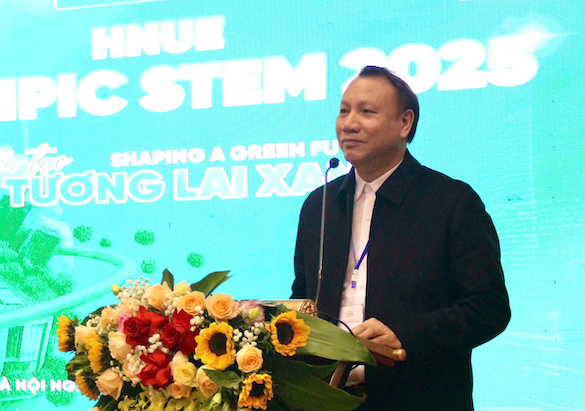
"I hope that each student, each teacher and parent attending will become a "source of brilliance", contributing to spreading the passion for STEM education to the community" - Mr. Son said.
Participating in the contest, Nguyen Duc Huy, an 11th grade student at FPT Bac Giang Primary, Secondary and High School, shared that his group brought a waste classification model using artificial intelligence (AI).
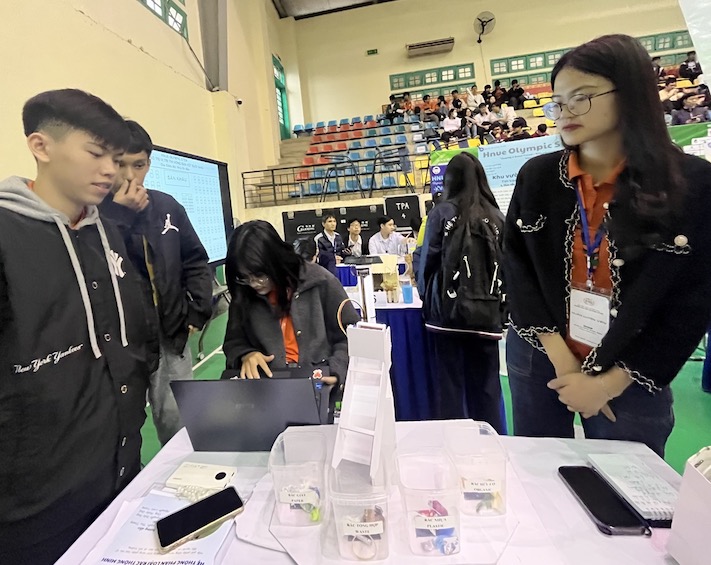
Huy said that the system uses ESP32-CAM cameras to identify waste. The camera will send data to the ESP32 cluster, then transmit it to the server to analyze the image and determine the type of waste to be processed. The classification process takes place immediately when the waste is put in. The products are classified into three main groups: Plastic, paper, organic waste; in addition, there is a general garbage compartment for unidentified types.
The group hopes that in the future, the product will continue to be improved to be able to operate according to the sensor mechanism - only activated when garbage is included, like a light touchscreen. The group aims to use solar energy so that products can be placed in public places, schools or offices.
"We have applied knowledge of Physics and Informatics to assemble and program the system. I want to bring the community a cleaner, less dusty environment. Many places have garbage bins for sorting, but students often conveniently throw them away together. We want this product to help optimize and overcome this" - Huy said.
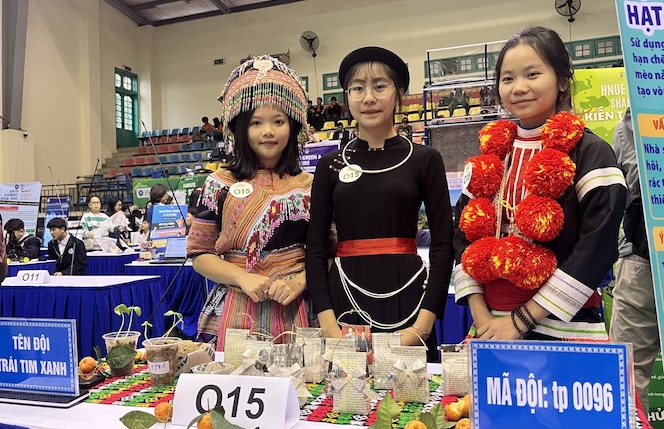
Three students from Lam Binh Secondary and High School for Ethnic Minorities (Tuyen Quang), including Nguyen Thi Nguyen, competed in the competition with the product "Scent-reducing Kit - Reproducing Cat Cucumbers".
Nguyen shared that our stilt houses and dormitories are often moldy and have insects, so she and her friends want to create a product that both helps deodorize, repel insects, and promotes the regeneration of cat melon seeds. Nguyen's group applied knowledge from many subjects such as Chemistry, Biology, Technology, Math and Physics to do it.
The Kit is placed in a wardrobe, shoe ward or a moldy place. After 7 - 9 days, when the tangerine smell was gone, we took the bags to plant because there were cat melon seeds inside. The seeds will sprout and the product will also decompose naturally" - Nguyen explained the product's operation process.
Nguyen believes that competitions like this "help students apply knowledge into practice and create useful products for society".


