
At the Workshop "Hanoi Air Pollution Control: Challenges and Actions", experts and representatives of functional agencies discussed solutions to promote green traffic and public transport in Hanoi.
In which, according to Mr. Nguyen Tuyen - Head of Transport Management Department, Hanoi Department of Construction, Hanoi's determination to pilot low-emission zones in some areas by July 1, 2026 is both a challenge and an opportunity to develop public passenger transport.
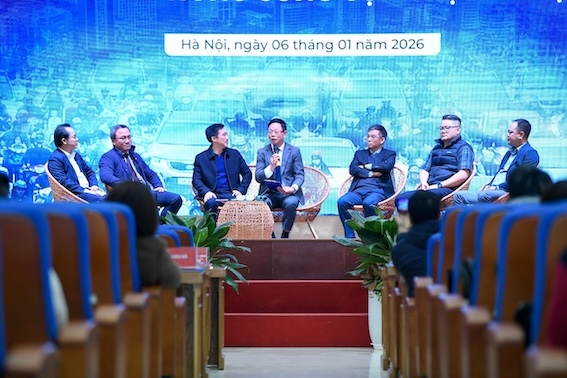

Mr. Tuyen said that in addition to the current bus routes, Hanoi City continues to study small capacity electric bus routes to strengthen the connection between railway stations and urban areas. In addition to buses, the Department continues to develop public bicycle services. Recently, the pilot unit has added 500 more electric bicycles to the public bicycle points. The Department of Construction is directing this unit to continue placing them at railway stations to strengthen and connect bus points.
In addition, the Department also encourages conversion and creation of charging and battery exchange station infrastructure. The city has established a working group to survey locations to install charging stations and battery exchange stations for motorbikes. These are necessary conditions for converting to green vehicles.
At the same time, pay attention to traffic organization, clearly distinguish the types of vehicles restricted. For example, 3.5-ton diesel cars are not allowed to circulate in low emission zones, cars that do not meet EURO4 emission standards are also not allowed to participate in certain time frames. In addition, the Department also coordinates with the Police to study and handle cases of non-compliance.
Regarding supporting people to convert gasoline cars to cars using clean materials, the Department of Construction has consulted experts and the Fatherland Front to build a mechanism to support people and businesses when converting or investing in charging stations and battery exchange cabinets for motorbikes. Solutions will be proposed in the first quarter of 2026," a representative of the Hanoi Department of Construction shared at the Conference "Hanoi Air Pollution Control: Challenges and Actions".
Regarding the Government's goal for Hanoi by 2030, 100% of buses use green energy, the Hanoi Department of Construction has a roadmap for each year, ensuring that by 2030 all buses in the city will ensure clean energy. "With contract cars and grabs with inner-city operating scope, we have developed a plan for taxis to convert 100% to clean and green energy before 2030," Mr. Tuyen added.
Meanwhile, Mr. Nguyen Huu Tien - Deputy Director of the Department of Science and Technology, Environment and Building Materials, Ministry of Construction, said that Hanoi and Ho Chi Minh City have soon issued their own roadmaps, even taking steps faster than the national plan, showing political determination in improving the urban environment.
Promoting green transportation not only aims to reduce emissions and implement climate change commitments, but also opens up new development space for the urban economy, improving the quality of life of people.
In the current international trend, public transport plays a particularly important role, not only as a means of transportation but also as a tool for urban embellishment and raising community awareness. Being likened to a "big blood vessel" of the city, the efficient operation of the public transport system will help reduce congestion, limit pollution and move towards a greener, healthier and more sustainable city in the future," Mr. Nguyen Huu Tien emphasized.
It's a bit of a bit of a bit of a bit of a bit of a bit.


