
Linking to better care for people's health
On July 25, Gia Lai Provincial People's Committee issued a decision approving a project to use public assets at Gia Lai General Hospital for the purpose of joint venture and association with Binh An Gia Lai Hospital Co., Ltd.
The goal is to effectively exploit and use infrastructure and invested assets, and gradually remove existing problems and prolonged obstacles.
At the same time, joint ventures and associations are aimed at meeting the needs for high-quality medical examination and treatment of people in the province and neighboring areas, creating legitimate revenue sources, and improving the financial autonomy of Gia Lai General Hospital.
In which, the joint venture ensures that it does not affect the task of public medical examination and treatment.
The name of the joint venture and association project is Gia Lai General Hospital Service Treatment Unit (No. 132 Ton That Tung, Pleiku ward, Gia Lai province). The service treatment unit has a scale of 200 inpatient beds, including 100 inpatient beds for specialized Internal Medicine and 100 inpatient beds for specialized Surgery according to the service model.
The parties use assets under their management and ownership to carry out joint ventures and associations, and are divided operating results according to joint venture and association contracts and according to the provisions of law.
The total value of joint ventures and associates is 134.605 billion VND. Of which, Gia Lai General Hospital participates with brand value: 17.559 billion VND; Binh An Gia Lai Hospital Co., Ltd. participates with asset value attached to land: 117.046 billion VND.
Opening up new directions for investors
Previously, Lao Dong Newspaper reflected that the Binh An Gia Lai Hospital project due to many legal procedure obstacles, has not been processed by functional sectors for land allocation and land lease procedures, so it has been abandoned for many years, and the construction item is degraded.
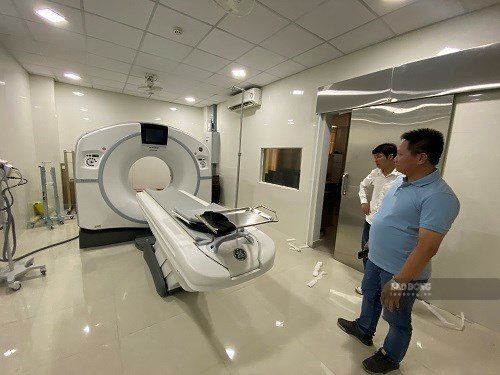
Mr. Nguyen Van Binh - Chairman of the Board of Directors of Binh An Gia Lai Hospital Co., Ltd. is heartbroken when the medical equipment system worth hundreds of billions of VND has to be "covered with blankets". Meanwhile, every month, the company still has to spend more than 100 million VND to hire security, maintenance, and preservation.
Because the project has not been put into operation, the hospital, which is tens of thousands of square meters wide, is gradually degraded and dusty. The 128-row CT – Scanner system worth tens of billions of VND imported from abroad is still new, and the air conditioner must be turned on 24/24h to preserve machinery to avoid damage.
Similarly, the 1.5 Tesla MRI resonance imaging system, the system for measuring total body osteoporosis, the endoscopic surgery system, and the expensive and modern ultrasound system are also in a "covered" state.
The investment project for a private hospital in a high-quality treatment area is registered by Binh An Gia Lai Hospital Co., Ltd. as the sole investor to implement the project. In addition to the facilities of a high-quality treatment area that was built and completed previously, the enterprise has purchased full modern equipment for a new hospital.
The decision to allow new joint ventures and associations has opened up a direction with many opportunities and prospects for exploiting medical services, bringing profits to investors.
In recent years, Gia Lai province has also actively attracted investment and encouraged businesses to participate in developing a private healthcare system to provide health care and meet the needs of the people.
Along with the public health system, private hospitals such as Hoang Anh Gia Lai University of Medicine and Pharmacy Hospital, Hung Vuong Gia Lai Hospital welcome, care for, and treat many people in the area, and even people in Laos and Cambodia.
The provincial health sector advises the Provincial People's Committee to recruit more human resources, a team of skilled and qualified doctors; and at the same time have policies to support housing and living expenses to attract medical personnel, especially for mountainous and difficult areas.


