
Institutionalizing green transformation
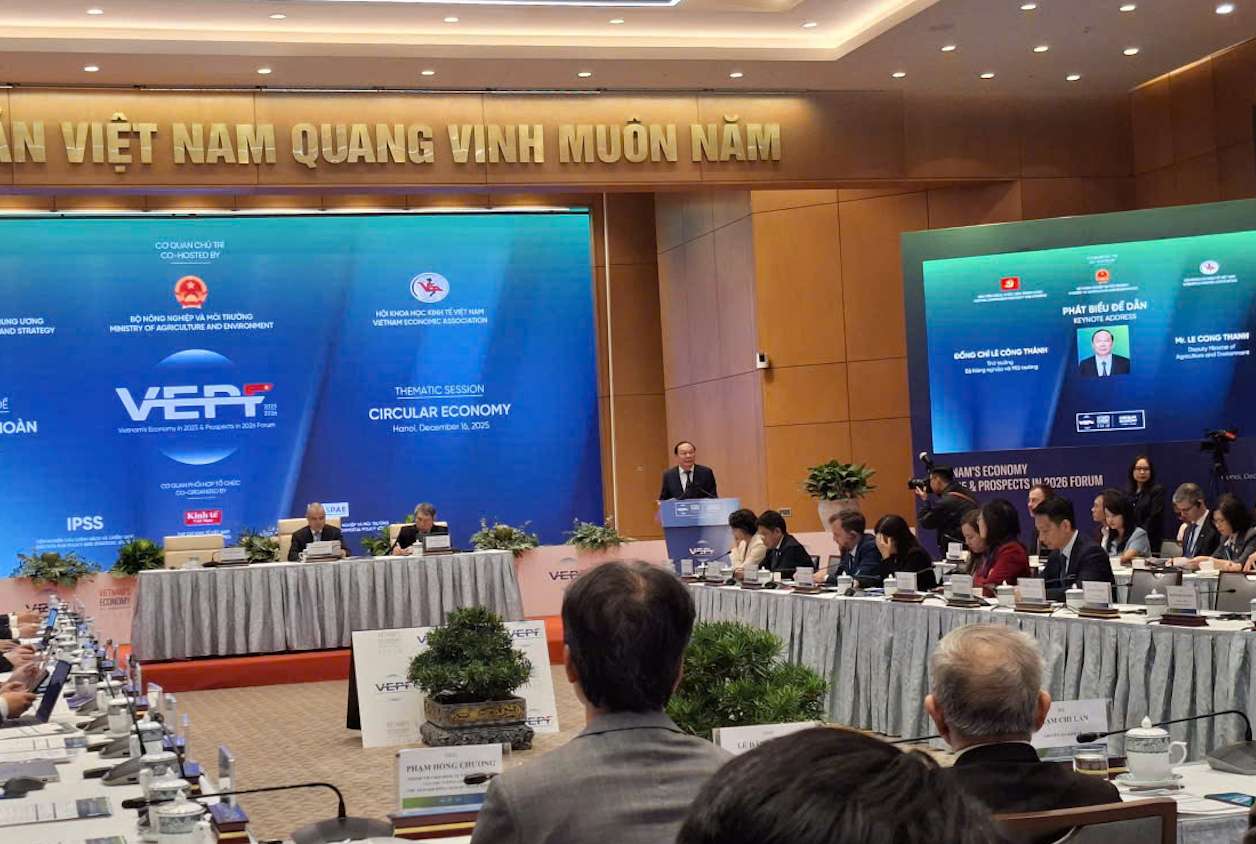
Speaking at the Vietnam Economic Forum 2025, with prospects for 2026, Deputy Minister of Agriculture and Environment Le Cong Thanh said that in the context of our country entering a new stage of development, the merger of the Ministry of Agriculture and Rural Development with the Ministry of Natural Resources and Environment under Decree No. 35 of the Government is an important adjustment in the organization of the state management apparatus.
This change shows the orientation of shifting to a comprehensive management mindset in ecological space, closely linking mineral resources and climate... This is an important foundation to enhance the effectiveness of policy coordination, promoting the goal of sustainable green economic development - Deputy Minister Thanh affirmed.
Recognizing the importance of green development and circular economy, Vietnam has built a relatively comprehensive orientation at the national strategic level.
Deputy Minister Thanh gave an example of the Green Growth Strategy for the period 2021-2030, with a vision to 2050; along with the Law on Environmental Protection, the Government has issued Decrees guiding and regulating the circular economy, waste management, green shopping and environmental industrial development.
In addition, Vietnam has also made important progress in completing the legal framework on reducing greenhouse gas emissions. Decree No. 06/2022/ND-CP amended by Decree No. 119/2025/ND-CP clearly stipulates the development of the carbon market, creating a mechanism for exchanging and offsetting domestic and international credits.
Another important milestone is the issuance of environmental criteria and confirmation of investment projects in the green classification list in Decision No. 21 of the Prime Minister. This regulation directs investment capital flows into environmentally friendly projects.
These documents demonstrate the strong and synchronous direction of the political system in creating institutions for green transformation - Deputy Minister Thanh affirmed.
According to Deputy Minister Le Cong Thanh, Vietnam has recorded many positive signals in practice. The trend of greening production and consumption is spreading strongly.
In agriculture, many ecological agricultural models and low-emission agriculture have been implemented; enterprises and cooperatives apply high technology, greenhouses, environmental control, improve productivity and quality.
In industry and construction, ecological industrial parks and green works are gradually taking shape; green construction certification systems are being deployed more and more commonly...
The green financial market has had a remarkable development. Green credit is growing, focusing mainly on renewable energy, clean energy and green agriculture. The green bond market is also gradually taking shape.
There are still many difficulties to "hold the step"
Despite many positive results, the development of the circular economy in Vietnam still faces many challenges. According to Deputy Minister Le Cong Thanh, many businesses, cooperatives and farmers still face difficulties in capital, technology and governance capacity. New markets such as the carbon market, biodiversity credits, and green insurance have not been operated synchronously. The legal framework for some green financial instruments is still in the process of completion...
To overcome the above limitations, the Ministry of Agriculture and Environment has identified a number of key action orientations in the coming time.
First, continue to thoroughly grasp the viewpoint of socio-economic development associated with environmental protection as a consistent thinking in thinking, sustainable development vision in all development strategies and plans.
Second, strongly promote the circular economic model, implement green transformation through policy mechanisms to encourage research, development and application of environmentally friendly technology in industries, services and agriculture... In particular, proactively build and perfect related mechanisms and policies.
Third, improve the effectiveness of developing ecological agriculture, clean agriculture, high-value agriculture associated with environmental protection and climate change adaptation.
Fourth, prioritize investment in multi-purpose ecological infrastructure, climate change response works; development of ecological agriculture areas, low-carbon industrial parks and sustainable logistics systems...
Fifth, continue to make breakthroughs in institutions and policies; complete legal documents, guide the application of preferential mechanisms for green investment; remove administrative barriers; build and effectively operate new markets such as the carbon market and biodiversity credits to unlock all growth resources.


