The gap between musicals and Vietnamese audiences
Musicals combine many types of performances, from singing, acting to dancing. For a work to operate perfectly, artists not only need good vocals but also to handle dialogue, physique, emotions and interact with co-stars.
High human resource requirements make musicals require long rehearsals, a large creative team and large production costs. Meanwhile, the scale of audiences in Vietnam is not wide enough for many units to confidently invest in the long term.
This is a vicious cycle. Few audiences make producers cautious, the number of plays is limited. Conversely, the lack of works and regular performances makes the public not have the conditions to form the habit of watching musicals.
Jay-Thien Nguyen - founder of Impact Theatre Saigon shared with Lao Dong Newspaper that another obstacle lies in the public's perception of this type.
When mentioning musicals, many people often associate them with "The Phantom of the Opera" or "The Miserable". These are famous works with large-scale musical structures, luxurious performance spaces and ritualistic ways of enjoying them.
Listening to musicals, people often think music is good but luxurious, academic and have to step into a theater to experience it," Jay-Thien Nguyen shared.
This concept inadvertently creates a psychological threshold. People who have never seen it may think that they need to understand Broadway, have foreign language skills or be familiar with the rules in the theater to access the work.
Besides that, there is a question about the closeness of the story. Many classic plays are built from the historical, social and cultural context of the West. If the prototype is only moved to the stage without connection, Vietnamese audiences may admire the performance technique but find it difficult to find their own experience.
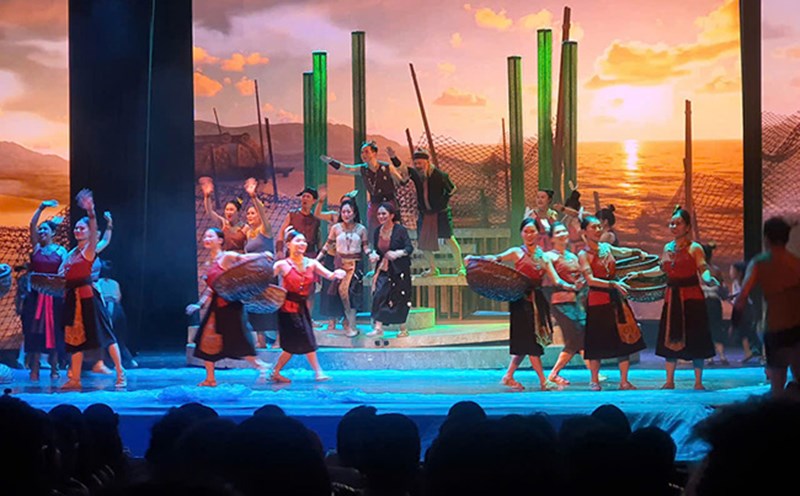
The choice of "Once on this island: Once on an island" shows the effort to find a softer approach. The play tells the story of Ti Moune, an orphan girl who grew up in a poor village in the Caribbean. She falls in love with Daniel, a man of the upper class who faces social prejudice, differences in status and the intervention of the gods.
The work has received a Tony Award and is staged in more than 60 countries. However, the important factor for new audiences is not only international fame but also the story of love, community, poverty and efforts to fight against fate.
According to Jay-Thien Nguyen, the group chose the play because of the close and friendly atmosphere. The actors wore costumes similar to the people on the island, and the audience was encouraged to use clothes with Hawaiian colors.
This organization method aims to reduce the feeling that viewers have to prepare formally to step into a foreign art space. However, making musicals close does not mean simplifying professional requirements.
A work can only retain audiences when actors sing, dance and act evenly; the music supports the story; the staging is clear enough so that people who do not know the original can still follow. If it is only based on novelty or interaction, musical theater is difficult to create a sustainable audience community.
Bringing the audience into the center of the work
One of the directions being tested by the units is to change the relationship between the stage and the auditorium.
In the traditional model, the audience sits in front of the stage and observes the story through one side of the performance. This distance helps the artist control the composition, lighting and perspective, but also puts the viewer in a relatively passive receiving role.
The version of "Once on this island: Once on an island" is organized according to a 360-degree round stage model. Audiences sit around, while actors sing, dance and tell stories right in front of them.
The audience will be a part of the story," Jay-Thiện Nguyễn said.
360-degree stage is not simply about arranging seats. When there are no fixed front and back, actors must maintain expression, voice and movement in all directions. Close proximity also makes technical limitations easier to recognize.
In return, viewers can directly feel the movements, breaths and energy of the actors. The boundary between the fictional world and the auditorium is narrowed, suitable for a story that puts the community at the center.
In the previous staging, some audience members stepped onto the stage and danced with the actors. Jay-Thien Nguyen considers this a positive sign because viewers are no longer outside the work.
However, interaction is only meaningful when it is associated with the structure of the play. If the audience is invited to participate mainly to create an atmosphere, the play is at risk of leaning towards entertainment experiences and weakening the story. The choreographer must clearly define the time, level and function of each interaction part.
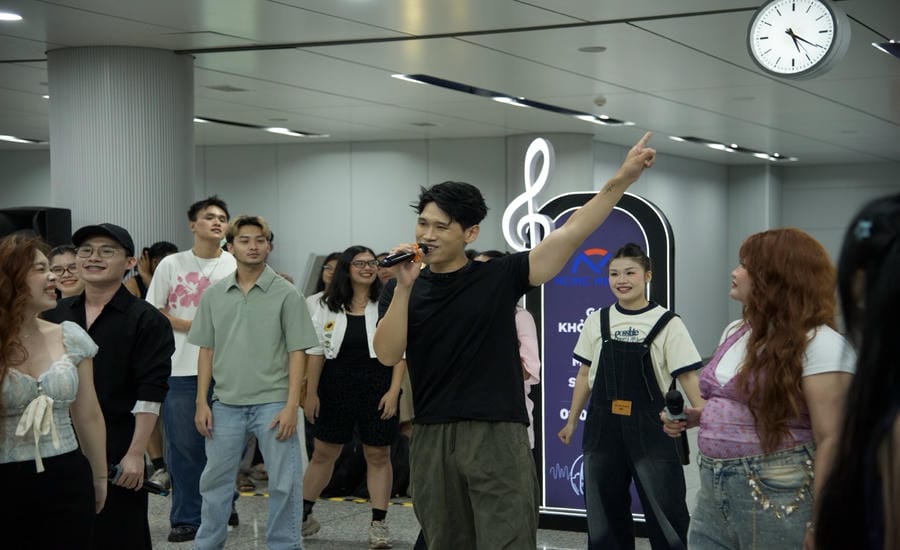
The performance of some Broadway songs at Ben Thanh metro station can also be viewed from the perspective of audience development, instead of a single event activity.
Inside the theater, artists approach people who have actively bought tickets. In public spaces, they also meet people who never thought they would watch a musical. A passenger may stop out of curiosity, then start learning about the work.
This is a way to reduce the risk of experience for new audiences. They do not have to buy tickets or spend a whole evening on unfamiliar genres. Just a few minutes of direct contact can help the public realize that musicals are not as far away as imagined.
However, a performance at a metro station can only open the first door. To turn casual viewers into regular audiences, units need to have diverse works, stable performance schedules, easily accessible information and reasonable prices.
The greater difficulty is still building an ecosystem. Musicals need actors who are multi-talented, directors who understand music structure, musicians, choreographers, stage designers and specialized technical teams. Dependence on each short-term project makes it difficult for the professional force to maintain a continuous training process.
The plan to bring purely Vietnamese musicals to the rehearsal stage of Impact Theatre Saigon is therefore noteworthy. This may be a shift from introducing Broadway to building works that bring stories, music and psychology of Vietnamese people.
But "purely Vietnamese" should not only be understood as using Vietnamese or placing characters in a domestic context. A play needs to find a way so that the lyrics do not create a tension, the music naturally connects with the script and social issues are handled in modern theatrical language.
The path of Vietnamese musicals is still narrow due to high costs, limited human resources and unstable markets. Bringing art to public spaces or organizing 360-degree stages can help shorten the initial distance. However, the decisive factor is still the ability to create works close enough for the audience to recognize themselves in it, and at the same time of sufficient quality for them to want to return to the theater.