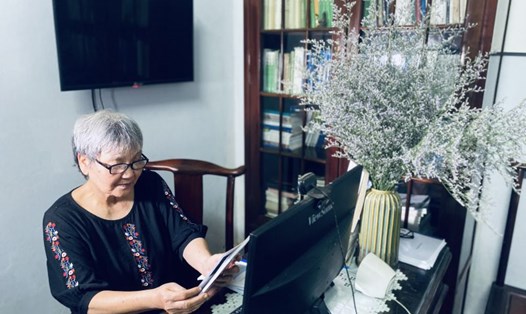
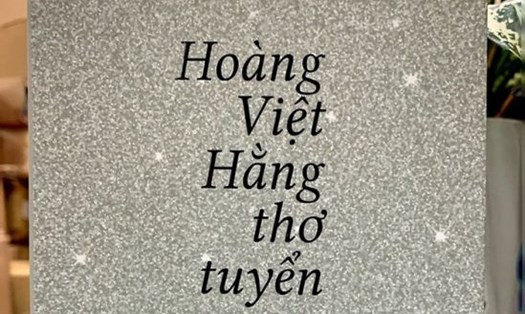
There, one can feel the author's love for Hanoi, for the distant past of difficult times, for the fates of people who have met in human life.
In Buddhist beliefs, the concept of "temporary realm" (also known as the realm of Ta Ba - Saha) compares the mortal world to a stopover, where people come to the world empty-handed and leave empty-handed. A human life, whether long or short, is just a small grain of dust in infinite time.
The poetry or literature of author Hoang Viet Hang is always heavy with thoughts, affection, comfort for human fate, for the shortness in the life-and-death distance, for the fleetingness between the limits of the mortal world and the realm of death.

The novel "Time in the Temporary Realm" has a line: "Life and death come as quickly as a stone thrown into a pond", "The temporary realm of a person's life is also long for one person, and also very short for one person"... In the temporary realm with countless joys, anger, and love of that person's life, author Hoang Viet Hang hides her emotions and thoughts through the character Ngoc Nu to tell about the flow of memories, from childhood to adulthood, has witnessed, passed through so many streets, so many ups and downs of the times, has silently walked before so many human fates.
Time in the Temporary Realm" is not massive in terms of volume but possesses a very large volume of characters. Ngoc Nu is a rare character throughout the work, the rest are the fates of people passing through Ngoc Nu's life. Those who came and then left, those who were attached and left, the fates Ngoc Nu witnessed and recorded.
Time in the Temporary Realm" witnesses the movement of time through each fate, and the constant fluctuations of the times on the streets of Hanoi.
Reading "Thoi gian trong coi tam" (Time in the temporary realm) you will see again Hanoi of the 1960s - 1970s, the time of bombs and bullets to the time of stamps and ballots, peace.
Ngoc Nu loves Hanoi, loves every street corner, remembers every movement, change in every alley, every apartment complex, every house, the fate in Hanoi.
Hanoi is childhood, youth, and throughout the journey of maturity, witnessing the suffering and happiness of Ngoc Nu. Conversely, Ngoc Nu also witnessed Hanoi of the years of being submerged in US B52 carpets (1972), the sound of American airplane horns approaching, people calling each other all over the streets sneaking into shelters. Ngoc Nu witnessed Hanoi of the years of poverty after the war, each house was awarded a shopping voucher, there was a famous poet (who was renamed) who had to sweep fallen leaves in Thong Nhat Park to cook because he lost the oil purchase stamp.
Hanoi also appears vividly through writings describing the collective life in 20m2 cramped rooms in Kim Lien. The collective house was once considered a part of history, a memory, a witness to a turbulent time in the urbanization process of Hanoi after the war.
The old collective housing areas of Kim Lien and Trung Tu still stand tall on the golden land of Hanoi after 50 years, witnessing time flowing, witnessing the turbulent times. For Ngoc Nu, memories of a cramped, deprived life, seemingly never to fade away, still appear somewhere when she suddenly passes through the old collective housing areas.
In each page of author Hoang Viet Hang's writing, true memories are like a memoir. Emotions are written with sincerity, meticulousness, both slow and sad, both distant and close.
The author records in detail memories of participating in the construction of famous buildings in Hanoi such as the Vietnam-Soviet Friendship Cultural Palace, the Central Circus. Over time, the buildings appeared prominently, changing the face of the Capital in the urbanization process. But, behind each of those buildings, there are countless tragic and reluctant fates - that have been left far away by time, and no one remembers them anymore.
Only Ngoc Nu still remembers. Remembering Ms. Hoe - a supporting worker, at the age of 21, who fell off the scaffolding. Hoe passed away when life and dreams were still unfinished, forever stopping at the age of 21. Nu still remembers Ms. My, beautiful and obedient, because of her unrequited love for a handsome welder who decided to become a monk. Ngoc Nu still remembers Mr. Huu Loan - a talented and creative worker, who built both the Central Circus and the Cultural Palace. That worker, after many years, still took a bus to admire the Cultural Palace building, everything was still intact and splendid, only him and the old workers were forgotten by time.
Each word of author Hoang Viet Hang seems calm, seemingly just recounting, but full of feelings, heavy burdens in each page written about the fate of people who have gone through this world, whether meeting or just glancing at each other.
The pen of author Hoang Viet Hang does not forget anyone, does not forget anyone, the workers who built the Cultural Palace, the people living in the collective area, the people who helped Ngoc Nu come to literature, or even the people who complained that Nu heard about, observed, and witnessed.
The woman named Ot has 3 sons, life is full of misfortune. The woman selling goods at Am Phu market. The woman working as a janitor at the hospital falls in love with the man who works as a shaman... The fate of women - whether with or without a title - returns on the pages of author Hoang Viet Hang full of pain, full of sorrow, full of sympathy.
Time in the Temporary Realm" is a painting of movement, change, and ups and downs in Hanoi. On the background of that painting, on the background of dizzying changes and changes, is the regret and longing for the old days of Hoang Viet Hang. Remembering the difficult days, the days of queuing to collect water, the days of living with stamps... And deep inside the layer of longing and regret is life, human fate passing through in the temporary realm - that world with joys and sorrows, pains, but full of love, sympathy, and the desire to be comforted and comforted.
It's a bit of a bit of a bit of a bit of a bit of a bit.
It's a bit of a bit of a bit of a bit of a bit of a bit.
It's a bit of a bit of a bit of a bit of a bit of a bit.