
Ensuring the principles of independence and objectivity in index assessment
On December 12, the Standing Committee of the Central Committee of the Vietnam Fatherland Front organized a scientific workshop on the content and methods of implementing the independent assessment of the provincial-level social trust index.
Ms. Ha Thi Nga - Member of the Party Central Committee, Vice Chairman of the Central Committee of the Vietnam Fatherland Front; Mr. Vu Van Tien - Member of the Presidium, Head of the Propaganda Department of the Central Committee of the Vietnam Fatherland Front chaired the workshop.
Speaking at the workshop, Mr. Vu Van Tien said that social trust is the foundation of political and social stability, a factor that creates consensus and a spiritual resource to effectively implement the policies and guidelines of the Party and the State. The construction of the provincial-level Social Trust Index stems from the solid political and legal foundation that our Party has established.
"With the motto "People know, people discuss, people do, people inspect, people supervise, people benefit", we affirm the central position of the People in the entire process of planning and implementing policies. Strengthening people's trust must be based on real results, effective governance and transparency in implementation.
In the context of the country promoting innovation, building a socialist rule of law state and extensive international integration, the independent measurement of social trust becomes even more urgent," Mr. Vu Van Tien emphasized.
Therefore, the Social Trust Index needs to be built on a scientific, independent and practical foundation; clear structure; measurement methods suitable to Vietnam's conditions but approaching international standards; ensuring comparison over time and between localities; truly reflecting people's feelings and strongly applying digital transformation.

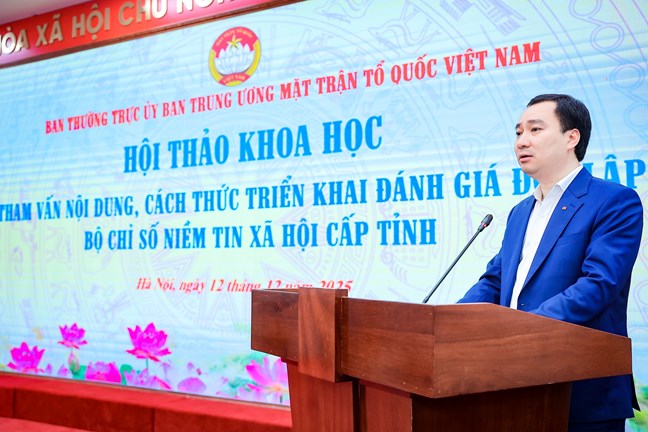
According to Mr. Vu Van Tien, the index must answer the big questions: At what level is people's confidence? Where are the strengths and weaknesses of each locality? What factors promote or decrease confidence? What solutions do localities need to strengthen social trust in a sustainable way?
At the workshop, Mr. Dau Anh Tuan - Deputy General Secretary of VCCI said that over nearly two decades, PCI's time series data has provided a vivid and scientific picture of the movement of local governance in Vietnam.
Based on technical experience and PCI implementation practices, Mr. Dau Anh Tuan said that in building the Social Trust Index, the Central Committee of the Vietnam Fatherland Front needs to absolutely ensure the principles of independence and objectivity.
Social trust assessment needs to be conducted by an independent expert panel or used by a reputable independent research unit. It is necessary to absolutely avoid the situation where re-evaluated units participate in the data collection or processing process.
Along with that, it is necessary to establish a strict identity security process; Combining survey data and statistical data and measurement results with accountability because the strength of an index set is not only in the rankings but also in the reform pressure created afterwards.
The results of the Social Trust Index need to be used as a tool for monitoring power, associated with the accountability of the heads of local Party committees and authorities. It is necessary to build a mechanism for authorities at all levels to organize dialogues, explanations and propose specific solutions when the confidence index in a certain field decreases.
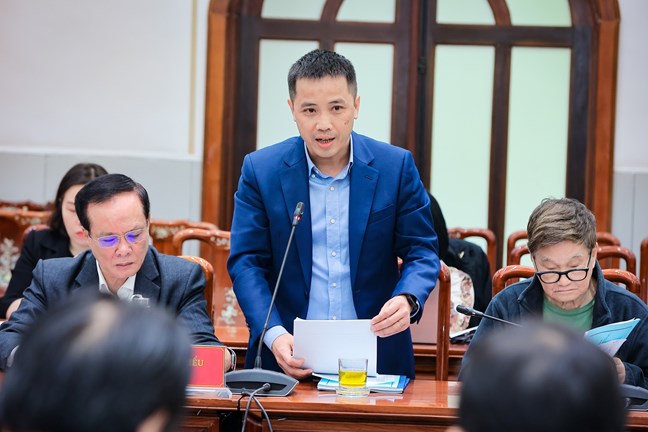
To ensure the feasibility and application value of the index, Dr. Bui Phuong Dinh - Deputy Director, Academy of Public Administration and Governance, Ho Chi Minh National Academy of Politics said that it is necessary to unify a measurement framework of four groups of indicators and twelve component indicators, ensuring that each group reflects the core aspects of social trust.
Standmarizing the index structure helps create consistency, helping provinces and cities have a basis for objective comparison and monitoring changes through development stages.
"It is necessary to promote the application of digital data, big data analysis technology and online monitoring tools to increase accuracy, reduce costs and expand the scope of information collection.
Digital platforms can support real-time collection of people's feedback, analysis of belief trends and early detection of issues that need policy adjustments," Dr. Bui Phuong Dinh suggested.
Building an index to ensure scientificity, independence, and objectivity
For the Index to be maintained regularly, Ta Van Sy - former Director of the Center for Cadre Training and Scientific Research of the Vietnam Fatherland Front said that it is necessary to build a sustainable operating model.
That model must have: in-depth human resources, methodical experts, a survey team that meets technical standards, a large and stable enough database, and financial resources guaranteed for the medium and long term.
The approach to the "step-by-step roadmap" is appropriate: pilot - complete the model - expand implementation - standardize the national model. This both ensures experience accumulation, limits methodical risks, and creates conditions for the Front system at all levels to adapt to the new governance model based on evidence.
Accepting the opinions of delegates attending the workshop, Vice President Ha Thi Nga emphasized that the opinions of delegates will be the basis for the Standing Committee of the Central Committee of the Vietnam Fatherland Front to build an index in the coming time to ensure scientificity, independence, objectivity in evaluating and standardizing the process and ensuring publicity and transparency to assess the level of satisfaction of the people in implementing policies and guidelines, implementing socio-economic development programs of localities and meeting the trust of the people and the whole society.
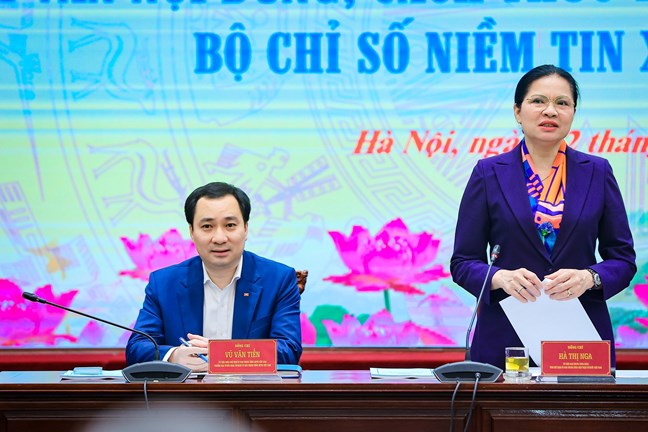
The completion of the index will contribute to perfecting the relationship between the government and the people and create an important tool to meet the requirements of implementing the two-level local government model in the coming time, thereby contributing to promoting the strength of national solidarity and affirming the role and position of the Vietnam Fatherland Front in the current period.
Emphasizing that this is a new, unprecedented task and requires the Vietnam Fatherland Front to complete it soon to put it into practice, Vice President Ha Thi Nga hopes to continue to receive the support and coordination of experts, scientists, and the Advisory Council in the process of building the index.


