
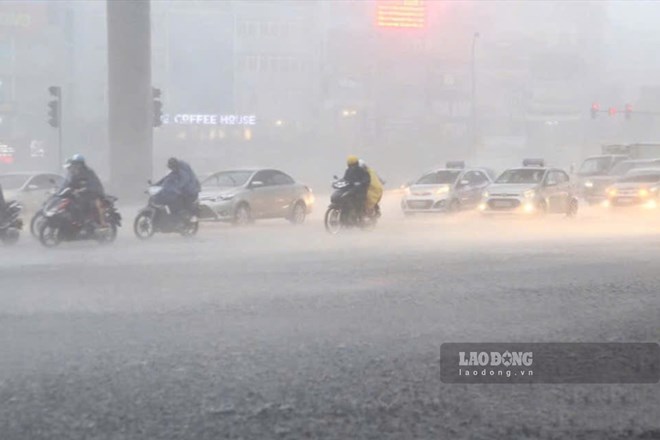
According to the National Center for Hydro-Meteorological Forecasting, from July 16 to the end of July 18, the mountainous and midland areas of the Northern region and Quang Ninh will have moderate rain, heavy rain and thunderstorms with common rainfall of 80-150mm, locally over 300mm. It is noteworthy that there is a risk of very heavy rain, exceeding 100mm in 3 hours. From July 19, the mountainous and midland areas of the Northern region will continue to have rain, locally over 100mm.
Functional agencies also warned that from the night of July 16 to July 21, rivers in the Northern region are likely to experience a flood with an amplitude of 2-5m. The peak flood water level on small rivers may reach alarm level 2 to alarm level 3; on the Thao River, Lo River and upstream of the Thai Binh river system, it is possible to rise to alarm level 1 to alarm level 2, in some places above alarm level 2.
To proactively respond, the National Steering Committee for Civil Defense requests localities to closely monitor weather developments, promptly inform local authorities and people to proactively prevent and avoid.
The Steering Committee requests localities to mobilize shock forces to inspect, review, and organize the relocation and evacuation of people in riverside areas, streams, low-lying areas, areas at risk of deep flooding, flash floods, and landslides to safe places; and at the same time clear the flow and prepare forces and vehicles to support people to overcome the consequences when situations occur.
The Steering Committee also requested to strengthen guards and traffic control at underpasses, spillways, deeply flooded areas or fast-flowing areas; resolutely not allowing people and vehicles to pass if safety is not ensured.
Along with that, localities must inspect, review, and ensure safety for mineral mining tunnels, reservoirs, especially small hydropower reservoirs, small irrigation reservoirs and key reservoirs; arrange on-duty forces to operate, regulate and promptly handle arising situations.
The Steering Committee also requested to notify cages and rafts owners, waterway transport vehicle owners, mineral exploitation units and riverside construction projects to proactively take measures to ensure safety for people, vehicles and property.
For the dyke system, localities are required to review dyke protection plans, inspect key dyke points, locations where incidents have occurred or construction is underway; strictly implement patrol and guard work to promptly detect and handle incidents right from the first hour.
In addition, the Steering Committee requests to strengthen communication, especially the grassroots information system, to guide people on skills to respond to heavy rain, floods, inundation, flash floods, landslides, tornadoes, lightning and hail so that people know, proactively prevent, avoid, and minimize damage.


