
This is the first time in half a century that two large assets have exploded at the same time with extreme valuations.
According to reports from three experts from the Bank for International payments (BIS) - Giulio Cornelli, Marco Jacopo Lombardi and Andreas Schrimpf, both gold and the S&P 500 have "overcome the threshold of explosive price increases" for many years. However, what has never happened before is that both peaked at the same time, causing market risks to increase sharply.
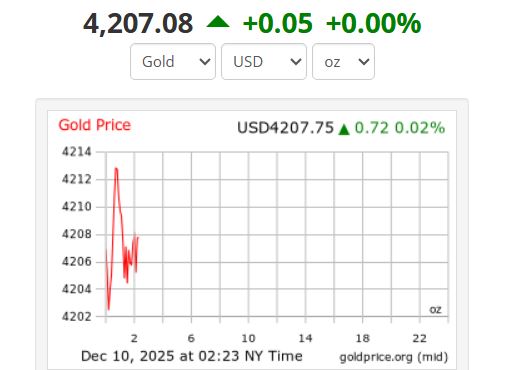
As of now, the S&P 500 has increased by more than 16% in 2025 and is trading around 6,850 points. Meanwhile, gold prices have risen more than 50% since the beginning of the year, reaching $4,200/ounce - the fastest increase since 1979.
In 2025 alone, US stocks have broken records more than 20 times, while gold prices have set nearly 50 new peaks, many times surpassing the 4,000 USD/ounce mark. Two seemingly opposite markets - one is risk assets, one is shelters - all broke out simultaneously.
According to BIS, the core reason for this price increase is the massive cash flow from individual investors, not the institutional sector.
Capital flow data shows that retail investors are taking a heavy stake in US stocks and gold ETFs.
Gold ETFs are constantly trading on net asset value (NAV) - a typical sign of FOMO psychology.
Meanwhile, major financial institutions are withdrawing capital from US stocks or holding a neutral position on gold.
BIS warns that this is a familiar formula for bubbles: Individual investors, under the influence of the media and the flock effect, are easily caught up in the rapid profit-taking spiral.
If the trend turns, the selling pressure from this group can amplify fluctuations, pushing the market into a vulnerable situation.
However, many experts believe that the sharp increase in world gold prices is not completely unreasonable. The market still has solid supporting factors.
First, the central bank continues to buy gold on a large scale. In 2025, central banks are expected to buy about 900 tons of gold - lower than the 1,000 tons of the previous 3 years but still above the long-term average. One of the main drivers is the downward trend dependent on the USD.
Second, expect the Fed to cut interest rates until 2026. Lower interest rates will reduce bond yields, weakening the USD - two factors that often promote gold prices.
Third, stock valuations are too high, causing investors to "respect risks". When stocks increase too much, gold becomes a more effective portfolio balance tool.
The fact that US gold and stock prices both set records creates a paradoxical market picture. This synchronization - according to BIS - is a sign of abnormality and less joy, more worry, because if a shock occurs, both can decrease sharply.
However, in the short term, analysts believe that the fundamental factor is still supporting gold prices, especially when interest rates are on the decline and central banks continue to accumulate gold on a large scale.
The world gold price at 11:23 on December 10 was trading at 4,207.08 USD/ounce, up 0.05 USD.
Regarding domestic gold prices, SJC gold bar prices are trading around 152.7 - 154.7 million VND/tael (buy - sell).
The price of 9999 Bao Tin Minh Chau gold rings is trading around 150.7 - 153.7 million VND/tael (buy - sell).
Investors point out that the market is looking for positive signals that the US Federal Reserve (Fed) may adopt a slower-than-expected monetary easing roadmap in the coming time. With continued geopolitical uncertainty increasing the safe-haven appeal of precious metals, combined with the prospect of a Fed policy easing which is under pressure to reduce borrowing costs, the natural trend of gold prices is still up, said ActivTrades analyst Ricardo Evangelista.
Some analysts described the recent gold rally as too exciting and said that although supporting factors are still present in 2026, after a strong rally, the market is unlikely to avoid the accumulation phase.


