
In 2025, gold prices rose by about 65%, the strongest increase in nearly half a century, as geopolitical tensions increased and public debt in major economies widened. In that rare context, gold even surpassed the inflation adjustment peak set in 1980.
However, according to the assessment of many large fund managers, "re-making history" in 2026 does not mean a new fever. Instead, the familiar scenario after the shock increases is that gold prices enter a period of prolonged accumulation, fluctuating strongly but still being kept in the highlands.
Talking to Bloomberg, many portfolio managers said they have no intention of significantly cutting the proportion of gold.
Mr. Ian Sampson, manager at Fidelity International, said that the factors that once supported the gold price rise are still present, from central bank net buying demand to the low interest rate environment and high fiscal deficit.
Another key driving force is the decline in confidence in legal tender currencies. Political pressure on monetary policy and controversy surrounding public debt have made gold increasingly seen as a systemic risk hedging tool.
Mr. Mike Wilson, chief investment strategist at Morgan Stanley, said that gold has essentially become a bet against legal tender rather than just reflecting inflation.
However, short-term prospects are not entirely flat. Darwi Kung, Head of Goods at DWS Group, forecasts that gold prices may increase slightly by the end of 2026, but fluctuations will be higher due to the impact of general corrections in the financial market. He believes that this is a more suitable environment for medium- and long-term holding strategies, rather than short-term surfing.
History also gave a clear warning. After peaking in 2011, gold lost nearly a decade to return to that price level. Similarly, the jump in 1979 opened up a prolonged downward price market.
However, the current cycle has an important difference in the role of central banks. According to Goldman Sachs, gold still accounts for a very small proportion of US investors' portfolios, while central banks are forecast to continue to net buy strongly in 2026.
In this context, the scenario of gold prices "repeating history" is understood by experts in a more cautious sense: Not a spectacular breakthrough, but a long accumulation period in the high price zone, with a slow upward trend but supported by structural pushes.
In that context, investment bank J.P. Morgan is most optimistic, forecasting gold prices could reach about 5,055 USD/ounce by the end of 2026. Goldman Sachs raised the gold price target to about 4,900 USD/ounce. Deutsche Bank forecasts an average price in 2026 of about 4,450 USD/ounce, with a trading range of about 3,950 to 4,950 USD/ounce depending on market conditions.
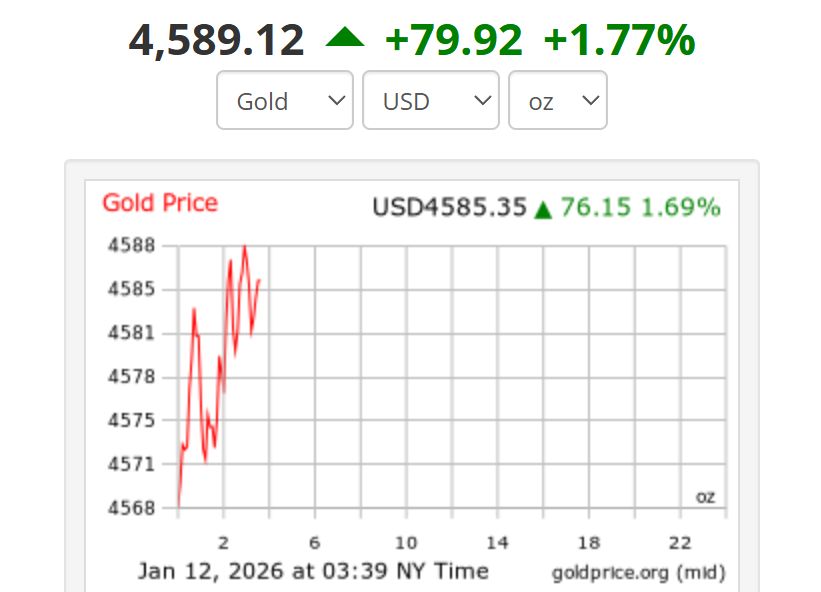
World gold prices at 3:39 PM on January 12, Vietnam time, traded at 4,589.12 USD/ounce, up 79.92 USD, equivalent to 1.77%.
Regarding domestic gold prices, SJC gold bar prices are traded at 160 - 162 million VND/tael (buying - selling). 9999 Bao Tin Minh Chau gold ring prices are traded at 158 - 161 million VND/tael (buying - selling).


