A new study by experts from the California Institute of Technology reveals a worrying scenario: The San Andreas fracture in California (USA) could release a larger earthquake than any natural disaster to date.
The discovery was drawn from a horrific earthquake in Myanmar in March 2025, which claimed the lives of more than 5,000 people.
Scientists have focused on studying the Sagaing fracture in Myanmar - a type of slipping fracture of the San Andreas variety. Contrary to predictions, instead of breaking the "sleepping" 300km section since 1839, Sagaing slid over a length of more than 500km.
Through satellite images before and after the earthquake, researchers discovered that the eastern part had moved southward by up to 3m from the western part. This shows that disruptions do not necessarily repeat the old scenario, but can flare up more fiercely and unexpectedly.
Future earthquakes may not simply repeat the past. Even straight and predictable breaks like Sagaing or San Andreas can slide further, more strongly than the accumulated shortfall from the previous time, said Professor Jean- Philippe Avouac, co-author of the study at the California Institute of Technology ( Caltech).
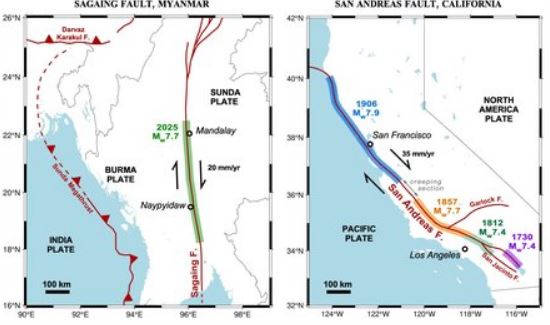
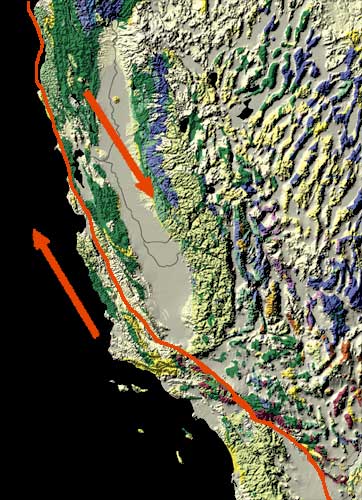
The San Andreas is the longest cluster in California, stretching about 1,200km from the Salton Sea in the south to the outside of the Mendocino in the north. In 1906, this severed northern section created a 7.9-magnitude earthquake that killed more than 3,000 people and submerged San Francisco in flames.
Geologists have long warned that the San Andreas will soon repeat a super earthquake. According to the US Geological Survey (USGS), the area near Los Angeles has a 60% chance of experiencing an earthquake of 6.7 or more richter in the next 30 years.
Research from Myanmar makes that worry more urgent: If San Andreas acts outside the script like Sagaing, the consequences could be a super earthquake that far exceeds all current forecasts.
We are seeing evidence that the disruptions dont work in a simple way. This means that forecast models need to be updated urgently, Dr. Solene Antoine, lead author of the study, emphasized.
Earthquakes are unpredictable, but this study shows that risks are more complex. If a breach could exceed the seismic gap and slide on a larger scale than expected, all seismic prevention plans in California will need to be recalculated.
The breake of Sagaing was once considered a "weak point" of Myanmar, but now it has become a " mirror" for the world, especially the US. And the scariest question now is when will San Andreas launch the next attack, and how big will it be?