
According to the latest weather forecast from the US National Oceanic and Atmospheric Administration (NOAA), El Nino is continuing to strengthen and is more than 90% likely to reach a "very strong" level in the fall and winter of 2026-2027 in the Northern Hemisphere. NOAA forecasts that in December-December there is a 75% chance of a historic El Nino outbreak.
El Nino occurs when the sea surface temperature in the equatorial Pacific region is higher than the average, leading to changes in the atmosphere and impacting the weather in many regions of the world.
According to NOAA, sea surface temperatures in the equatorial eastern Pacific region in August were above average over 3°C. The Nino-3.4 index reached +1.8°C, Nino-3 reached +2.5°C and Nino-1+2 reached +3.4°C.
To assess the intensity of El Nino, the NOAA uses the relative 3.4 Nino Index over the ocean (RONI). The latest weekly RONI value reaches +2°C compared to the average, corresponding to the "very strong" threshold - the highest official level. This is also the level unofficially called "superpowerful" El Nino.
NOAA said that El Nino is currently the strongest wave ever recorded at this time of year and is still likely to continue to intensify. If the 3-month average RONI reaches +2.5°C or higher, this will be a historic El Nino event, exceeding the intensity of waves recorded since 1950.
The strength of El Nino is also going hand in hand with remarkable storm activity in the Pacific. NOAA recorded 16 storms that have formed and developed in the eastern and central Pacific regions, including 2 Category 5 storms. Hawaii alone has faced 3 tropical systems in less than a month.
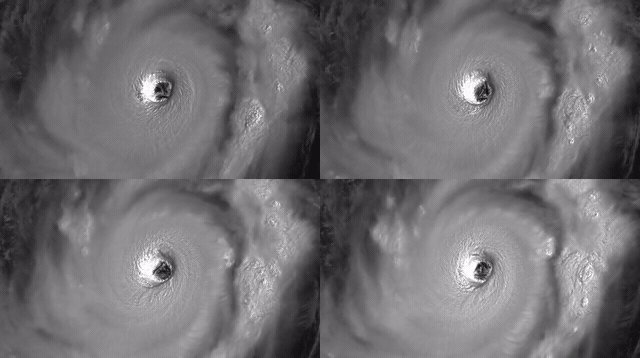
A prominent case is Hurricane Lowell, which once reached Category 5 with sustained winds of about 260 km/h and a central pressure of 922 hPa. The storm then headed towards Hawaii, causing the area to monitor the risk of heavy rain, flash floods, landslides, high waves and dangerous offshore currents.
Meanwhile, El Nino often creates adverse conditions for storm activity in the Atlantic due to increasing wind shear. NOAA noted that stronger El Nino intensity does not necessarily mean that all areas will suffer more extreme weather.
NOAA also recorded August 2026 as the hottest August ever recorded globally, while global sea temperatures set records. El Nino is forecast to peak in winter, when the impact of this phenomenon on global weather may be most pronounced.


