
During the 8-day Lunar New Year holiday and before the God of Wealth Day (February 26, 2026, i.e., the 10th day of the first lunar month), Chinese people flock to buy gold when the demand for weddings, gifts and asset hoarding is concentrated in the peak season.
According to Chinese media reports, many jewelry businesses have launched large-scale promotions to stimulate demand.
Brands such as Laopu Gold and Chow Tai Fook are implementing incentives such as a 100 yuan (375,000 VND) discount for each 1,000 yuan (3.75 million VND) spent, a gram discount or a crafting fee reduction.
Laopu Gold also announced that it will adjust and increase the price of all products from February 28 - the first price increase in 2026.
Some Zhou Liu Fu stores applied discounts of up to 150 yuan/gram, while CHJ Jewelry launched deep discounts of 247 yuan/gram for gold products.
A salesperson at a Chow Tai Fook store in Chaoyang County, Beijing, said that the number of customers coming to buy during the holiday was significantly higher than before.
The main driving force for this increase in purchases comes from the wedding market. In China, full sets of gold jewelry are almost an indispensable part of the wedding ceremony, with an average transaction value exceeding 100,000 yuan (375 million VND) per set.
Currently, domestic gold prices in China fluctuate around 1,500 yuan (5.6 million VND)/gram, nearly double compared to the same Tet period last year. Analysts believe that the "gold fever" reflects the strong belief of Chinese consumers in the role of shelter and preservation of the value of precious metals.
Domestic developments in China are in line with international trends. During the Tet holiday, spot gold prices on the world market fluctuated from 4,800-5,200 USD/ounce, reaching 5,160 USD/ounce at one point in the early morning of February 23.
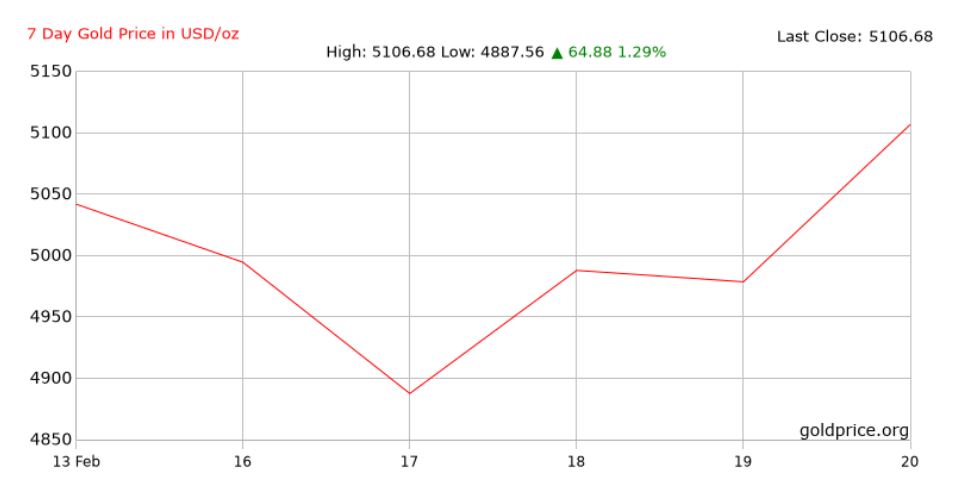
According to experts, the fundamental factors pushing gold prices up have not changed.
First, the challenges to the credit position of the USD continue to exist, boosting the demand for holding assets in gold.
Second, every time geopolitical risks arise, gold plays its role as a "hard currency" and safe asset. Since the beginning of 2026, a series of tensions, including the risk of confrontation between the US and Iran, have contributed to increasing the risk compensation for the precious metal.
However, experts warn that the risk of strong fluctuations is still present because gold prices have increased significantly in the past time. The possibility of technical correction may occur if information emerges that eases global tensions or changes monetary policy expectations.
According to a report by the World Gold Council, total global gold demand in 2025 reached 5,000 tons - a record high and exceeding this threshold for the first time. Gold holdings of ETFs increased by 801 tons, recording the 2nd strongest year in history.
Following that trend, many central banks continued to increase gold reserves. As of the end of January 2026, China's gold reserves reached 74.19 million ounces, an increase of 40,000 ounces compared to the previous month and marking the 15th consecutive month of net buying.
In the context of high gold prices and strong consumer demand during Tet, the precious metal market in China is forecast to maintain its heat in the short term, despite the risk of major fluctuations.
World gold price at 5:10 PM on February 23rd Vietnam time traded at 5,147.56 USD/ounce, up 40.45 USD, equivalent to an increase of 0.81%.
Regarding domestic gold prices in the Vietnamese market, as of 3:36 PM on February 23, SJC gold bar prices and Bao Tin Minh Chau 9999 gold ring prices both traded at 181.6 - 184.6 million VND/tael (buying - selling), an increase of 3.6 million VND per tael compared to before the Tet holiday.


