
Izvestia newspaper reported that Mr. Vladislav Maslennikov, Director of the European Affairs Department of the Russian Ministry of Foreign Affairs, said that Moscow is ready to dialogue with all well-intentioned partners, including Western Arctic countries such as Norway or Finland, to exploit the Northern Sea Route (NSR).
Currently, China and India are still Russia's two main partners in Arctic logistics development, but the door is gradually opening.
Instability in Hormuz, the Arctic line takes the throne
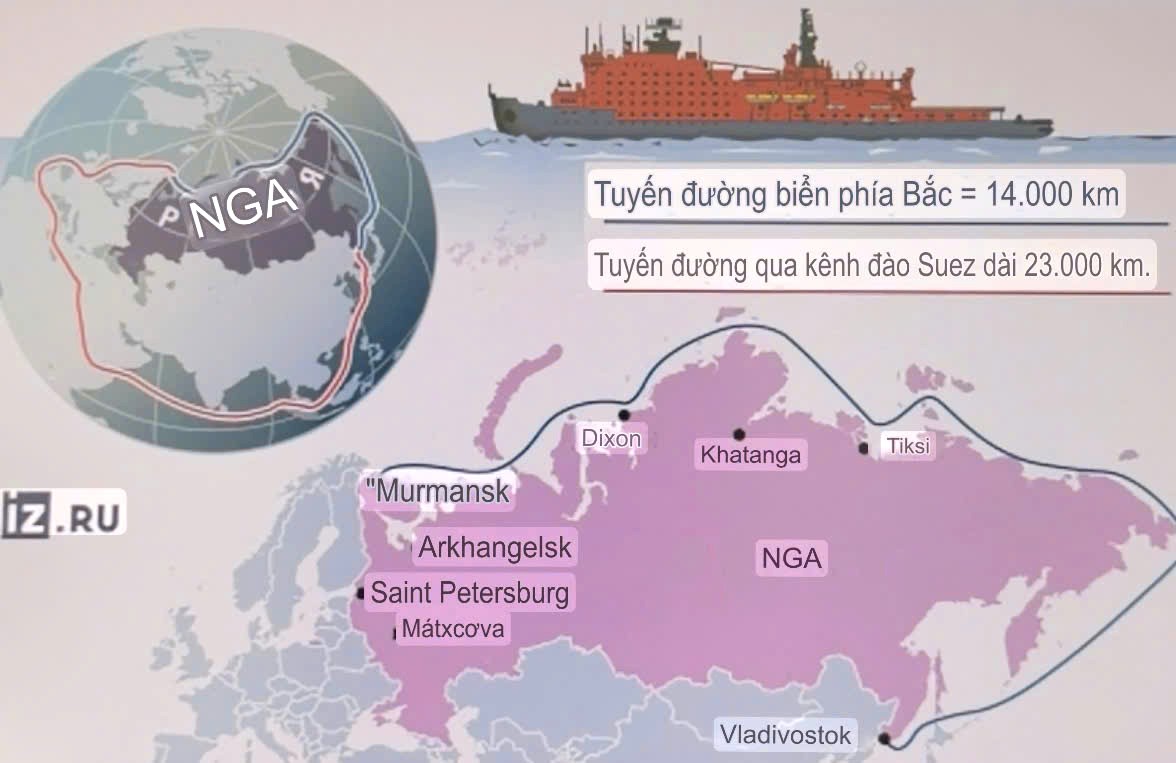
The crisis in the Strait of Hormuz - the world's most important energy transport route - has raised questions for many countries about the safety of traditional trade corridors. In that context, the Northern Maritime Route emerged as an alternative thanks to its shorter distance and less geopolitical risk.
In terms of time, the advantage of this route is very clear. A shipment of liquefied natural gas (LNG) from the Arctic to Asia takes only about 20 days in the summer, compared to 30 days through the Suez Canal and up to 37 days if it goes around the Cape of Good Hope. This significantly reduces transportation costs and time.
The volume of goods through NSR is also increasing. In 2025, the transshipment volume reached 3.2 million tons and continued to grow in 2026. This is a signal that this route is gradually attracting market attention.
Will the West return to cooperation with Russia?
Before 2022, Arctic cooperation between Russia and the West mainly took place within the Arctic Council framework. However, the conflict in Ukraine has freeze many mechanisms.
However, some "ice thawing" signals are appearing. Expert groups have resumed operations, and the possibility of holding direct meetings is being discussed. Notably, cooperation between Russia and Norway in the fields of fishing and scientific research continues, despite sanctions.
According to analysts, Finland and Norway are the most potential partners if the West returns to cooperation. Finland has strengths in shipbuilding, while Norway has direct interests in the Arctic region.
However, this prospect still largely depends on geopolitical developments. Many Western countries affirm that the full restoration of relations with Russia can only take place after the conflict in Ukraine ends.
Sub-line but full of potential
In the short term, the Northern Maritime Route is unlikely to completely replace traditional routes such as the Strait of Hormuz or the Suez Canal.
Currently, NSR mainly serves oil and liquefied gas exports and the supply needs of Russia's northern region. The integration of this route into the global logistics network is still limited, as many Arctic ports are not fully equipped.
To become a true international trade route, Russia needs to invest heavily in seaport systems, icebreakers, rescue services, healthcare and repair infrastructure.
But in the context of an increasingly unstable world, the role of NSR as an additional transport route is becoming more important than ever.
If Russia succeeds in upgrading infrastructure and expanding international cooperation, this route could become a new strategic link in the global supply chain - especially when "bottlenecks" like Hormuz are constantly being challenged.


