
The 4th search week for MH370 (January 22-28, 2026) ended early on the ground when the Armada 86 05 of Ocean Infinity company recovered the self-propelled robot submarines (AUVs) and left the search area, heading to Fremantle port (Australia), forcing them to leave the area from January 23 due to severe weather.
This search week helps to unravel an important technical mystery - while raising new questions about the next journey of efforts to track down the missing Boeing 777 for nearly 12 years.
In the last days of week 4, Armada 86 05 was almost unable to deploy AUV due to large waves and prolonged bad weather. Cruise data showed that the ship moved slowly, windingly, not following the familiar model of previous AUV release and salvage phases.
This once sparked speculation that Ocean Infinity may have restricted the operation of 1 or 2 AUVs when the weather temporarily improved. However, all hope quickly closed when the ship completely left the search area and returned to Fremantle.
With this development, the MH370 search operation for the period 2025-2026 has currently swept a total of about 7,236km2 of seabed - less than half of the area that Ocean Infinity once announced its plan for.
While the search progress is interrupted, a controversial technical question from last week has been clarified: Why does each AUV scan cover a wide range of about 1.8km, much larger than the commonly announced parameters of the sonar mounted on the AUV?
According to documents from manufacturer Kongsberg, the HISAS 1030 side-scan sonar system only has a maximum scanning range of about 200-260m on each side, causing many people to worry that the MH370 aircraft may be outside the "vision" of the device.
Answering this question, experts said that AUV does not only use a single sonar technology. Besides the traditional rib scanning sonar, there is also a synthetic aperture sonar (Synthetic Aperture Sonar - SAS). SAS provides very detailed images but only works effectively at short distances, while the rib scanning sonar can "see" further, even with lower resolution.
When the target is large objects such as aircraft engines, landing gear or even a pile of debris, low-resolution sonar but wide scanning range is still capable of detecting unusual signs.
Data from the Australian Transportation Safety Board (ATSB) in a previous search campaign also showed that submerged test objects off Perth could still be detected at a distance of over 1km by ribbed sonar (photo below).
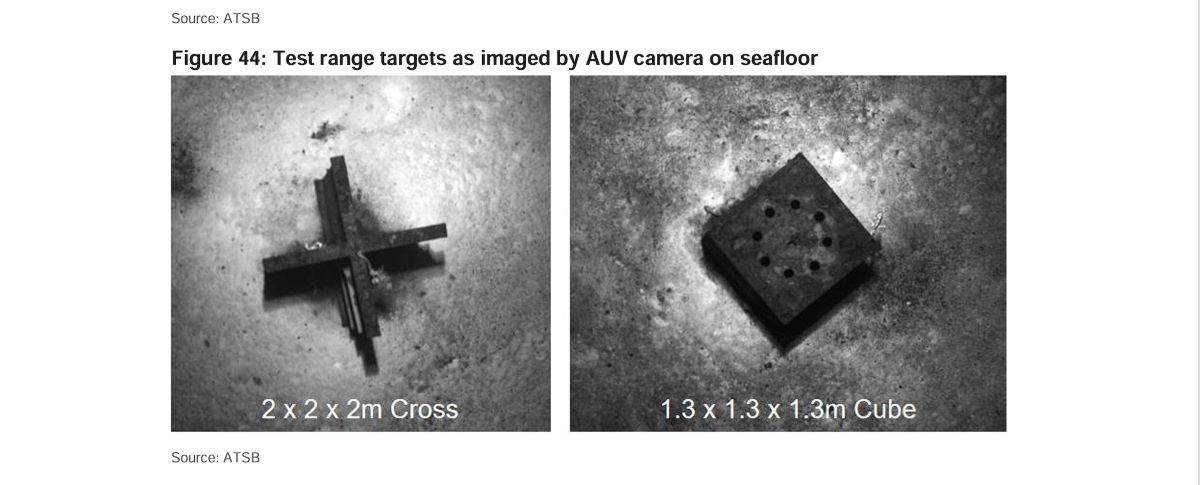
This explains why Ocean Infinity chooses wide scanning strips: The initial goal is to detect major signs, then deploy detailed surveys to confirm.
When the technical mystery is solved, another question arises: Where will Armada 86 05 go next? The port schedule currently records the "next destination" as Pago Pago (American Samoa), raising concerns that the ship may switch to another commercial project, meaning the search for MH370 is interrupted again.
However, past experience shows that the information in the port schedule does not always accurately reflect the final plan. In 2018, the search ship recorded another destination but still returned to the MH370 area after leaving Fremantle.
Therefore, although the current phase has been temporarily suspended, the hope of finding MH370 has not completely closed. At least, the 4th week campaign has provided an important answer about search technology capabilities - and maintained the belief that, if the weather allows, the journey to find the biggest aviation mystery of the century still has a chance to continue.


