
Domestic pepper prices: Unchanged
As of 11:30 am today (May 30), domestic pepper prices have been standing still for the 2nd consecutive week, averaging 139,400 VND/kg. Currently, key areas are trading in the range of 137,000 - 142,000 VND/kg.
Domestic pepper prices have remained unchanged for 6 consecutive days, currently the listed prices in regions are as follows:
Gia Lai province traded at the threshold of 137,000 VND/kg.
Dong Nai and Ho Chi Minh City are listed at prices of 137,000 VND/kg and 139,000 VND/kg respectively.
Meanwhile, Dak Lak and Lam Dong remained unchanged, offering for sale at the highest purchase price of 142,000 VND/kg.
World pepper prices: Reverse downwards
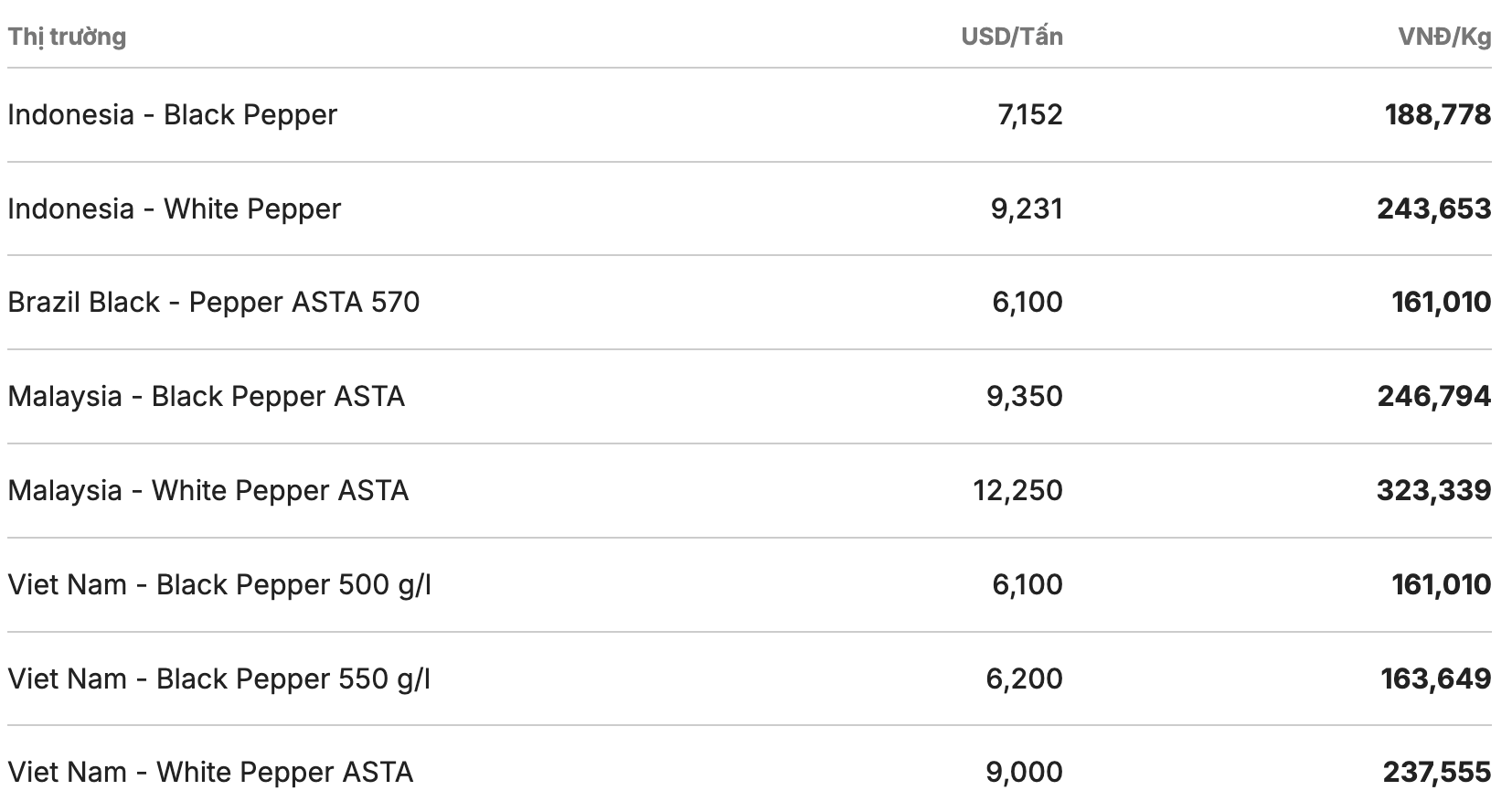
In the world market, pepper prices adjusted in some countries. The two items of black and white pepper in Indonesia decreased, trading in the range of 7,152 - 9,231 USD/ton (equivalent to 188,778 VND/kg - 244,928 VND/kg), down 52 USD/ton and 49 USD/ton respectively.
The Brazilian market also lowered the price by 100 USD/ton, anchored at 6,100 USD/ton (about 161,010 VND/kg). Notably, black and white peppers are still trading at high prices, respectively 12,250 USD/ton and 9,350 USD/ton.
In Vietnam's pepper export market, the price of black pepper of 500 g/l and 550 g/l remains at 6,100 - 6,200 USD/ton. In the same direction, ASTA white pepper is offered for sale at 9,000 USD/ton (equivalent to 237.555 VND/kg).
Assessments and forecasts
Compared to the end of April, the current domestic pepper price is still 3,200 VND/kg lower, when the average price is anchored at 142,600 VND/kg.
Besides the US market, Europe is also an ideal destination for the Vietnamese pepper market. However, data is showing a sharp decrease in output as European importers are proactively diversifying supply sources to reduce dependence on some major exporting countries.
According to the Vietnam Pepper and Spice Plant Association (VPSA), citing data from the International Trade Center (ITC), Germany imported 1,823 tons of pepper in March 2026, down 24.5% compared to the same period last year and down nearly 29% compared to the previous month.
Brazil ranks second with 340 tons, accounting for 22.7% market share. However, imports from both Vietnam and Brazil decreased compared to the same period last year, showing that demand in the European market is showing signs of adjustment.


