
Domestic pepper prices
As of 11:30 AM today (September 7), the average domestic pepper price is at 135,700 VND/kg, unchanged compared to last week. Currently, the listed price range is in the range of 135,000 - 137,000 VND/kg.
At the end of the trading session last week, Gia Lai, Ho Chi Minh City and Dong Nai all anchored at the threshold of 135,000 VND/kg.
In the same direction, Dak Lak announced a price of 136,500 VND/kg.
In Lam Dong, pepper prices are currently at the highest level of 137,000 VND/kg.
World pepper price
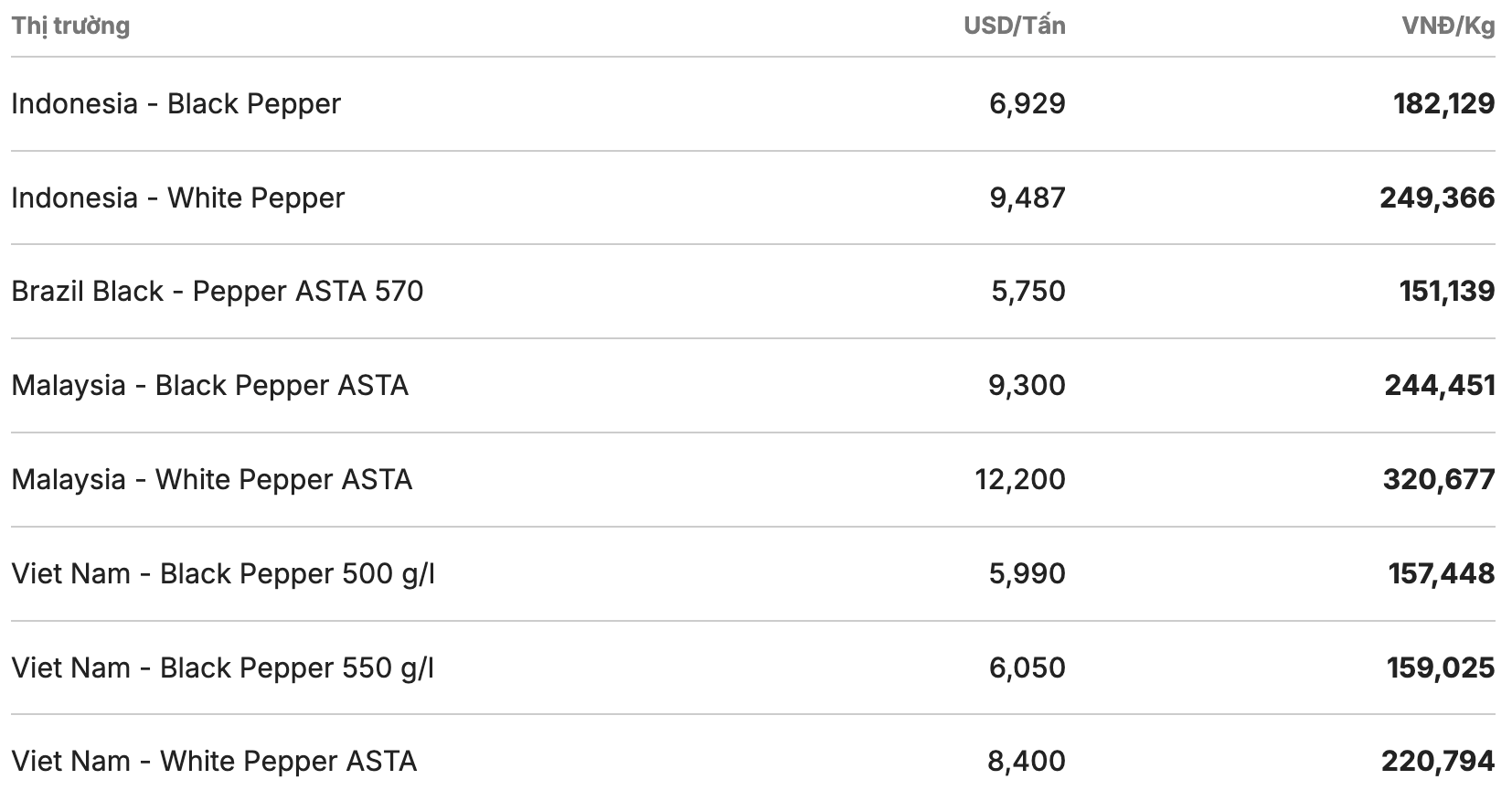
In the world market, pepper prices maintain a stable state in all countries. Indonesia's black and white peppers are no exception, trading in the range of 6,929 - 9,487 USD/ton (equivalent to 182,129 VND/kg - 249,366 VND/kg).
In the same direction, the price of Brazilian black pepper sold to the market is 5,750 USD/ton (about 151,139 VND/kg). Black and white Malaysian peppers still maintain the same price range, trading at high prices, respectively 12,200 USD/ton and 9,300 USD/ton.
Notably, in Vietnam's pepper export market, black pepper prices of 500 g/l and 550 g/l are traded at 5,990 - 6,050 USD/ton. ASTA white pepper is offered for sale at 8,400 USD/ton (equivalent to 220,794 VND/kg).
Assessments and forecasts
Compared to the same period in August, the average domestic pepper price level is 3,300 VND/kg lower. However, the current price is 500,000 VND/kg higher than the beginning of July.
Thus, the domestic pepper price range continuously fluctuates in a narrow range, not witnessing a clear and breakthrough upward trend.
On the world trading floor, the International Pepper Corporation (IPC) pointed out that pepper prices of major exporting countries also did not record much fluctuation.
According to assessments from the Vietnam Pepper and Spice Plant Association (VPSA), the supply and demand problem in this crop year is facing a major challenge, as global pepper production in 2026 is expected to decrease sharply compared to initial estimates. Unfavorable weather phenomena accompanied by crop yield decline have directly affected the output of three key producing countries: Vietnam, Indonesia and India.


