
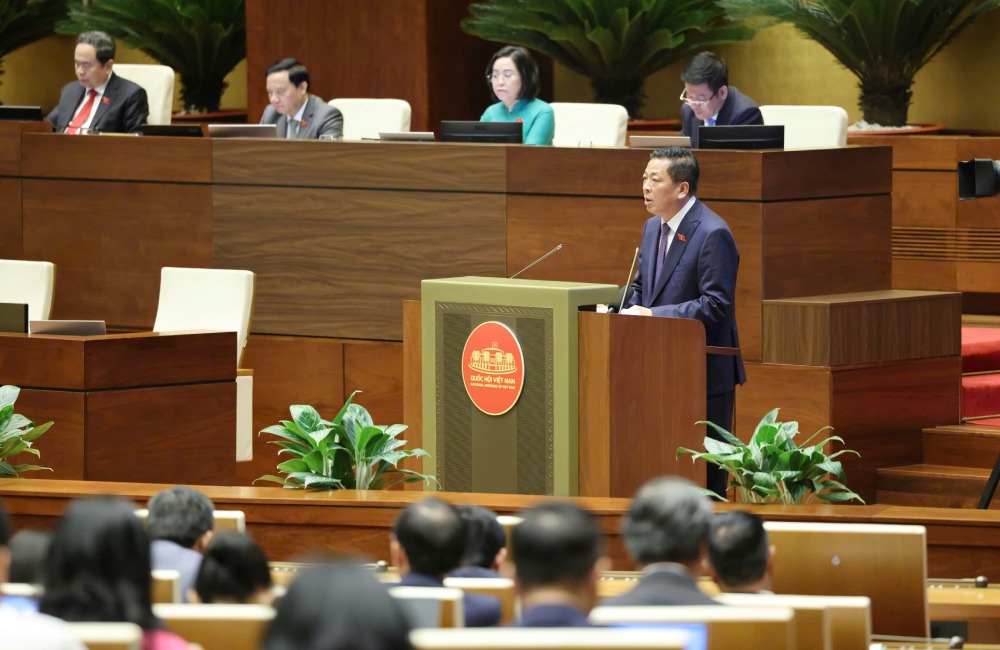
In the afternoon of April 20, the National Assembly discussed in the hall about the socio-economic development plan (SEDP).
Explaining and clarifying the opinions of National Assembly deputies, Minister of Construction Tran Hong Minh said that in the field of roads, according to the plan to 2050, the whole country has 43 expressways with a total length of about 8,993km; of which, 6,539km were invested before 2030; the rest were invested in the period 2030-2050. To date, the whole country has exploited and technically opened traffic for about 3,345km, 458km of intersections.
Regarding investment scale, there are 548km of 2-lane expressways (accounting for 16%); 1,559km of 4-lane limited expressways (accounting for 47%) and 1,238km of 4-6-lane complete expressways (accounting for 37%).
In which, the Ministry of Construction (formerly the Ministry of Transport) implemented 2,561km (accounting for 77%), the remaining 748km was implemented by localities.
Providing more information, the Minister said that 1,252km of transition is being implemented, expected to be completed in 2027. Of which, the Ministry of Construction implements 153km; localities and the Ministry of National Defense implement 1,099km with 611km being public investment and 641km being PPP investment.
By the end of 2025, the expressway density nationwide reached about 2.23 km/100 km2. However, there is still a large gap between regions, while the Mekong Delta reached 4.43 km/100 km2, and 14 old northern border provinces only reached 0.58 km/100 km2.
In the 2026-2030 period, it is expected to focus resources on investing and upgrading about 1,721km of expressway, including upgrading the 2-lane, 4-lane expressway to 6-lane in accordance with the plan, with a capital demand of about 802,868 billion VND.
In the railway sector, according to the plan, the network includes 25 lines with a total length of 6,658km; of which 7 existing lines are 2,510km long and 18 newly built lines are 4,148km long.
According to the Minister, the current national railway system mainly has a 1,000mm gauge, built a long time ago; the Hanoi - Lang Son line uses a 1,435 mm gauge.
In the coming time, it will focus on developing national railway lines such as: Hanoi - Ho Chi Minh City; Lao Cai - Hanoi - Hai Phong; Hanoi - Lang Son; Hai Phong - Ha Long - Mong Cai; Ho Chi Minh City - Can Tho - Ca Mau...
For urban railways, in 10 years of construction, the whole country has completed 3 lines with a total length of about 41km (of which Hanoi has 2 lines, Ho Chi Minh City has 1 line).
In the coming period, Hanoi is expected to develop 18 routes, Ho Chi Minh City will invest in building 12 routes. Total length is about 2,224 km/30 routes, capital needs are about 743,907 billion VND.
Regarding the aviation sector, the Minister said that according to the plan to 2030, the whole country will have 31 airports (including 15 international airports, 16 domestic airports), with a capacity of about 294 million passengers/year; orientation to 2050 to have 34 airports, with an operating capacity of 533 million passengers/year.
To date, the whole country has 22 airports with a total capacity of about 155 million passengers/year, an increase of 1.6 times compared to the previous term.
Regarding development orientation, out of 31 airports according to the plan, there will be 6 4F-class airports, 1 4C-class airport, and the remaining 4E-class airports.
Regarding investment, the Minister said that the orientation will be to reduce the proportion of public investment, focusing on upgrading and repairing projects; strengthening the mobilization of social resources, especially PPP projects and investment to develop airports.


